


Wydawcy
Katalog tematyczny
- Archeologia (109)
- Ekonomia, finanse, business (13704)
- Filozofia (1445)
- Historia (3040)
- Języki i językoznawstwo (2356)
- Lifestyle, hobby i rozrywka (475)
- Medycyna (9704)
- Nauki humanistyczne (4)
- Nauki o Ziemi i środowisku (2638)
- Nauki ścisłe (20412)
- Astronomia (294)
- Biologia (5119)
- Chemia (6540)
- Fizyka (3309)
- Elektryczność i magnetyzm (90)
- Fizyka atomowa i molekularna (110)
- Fizyka cząstek elementarnych (36)
- Fizyka jądra atomowego (36)
- Fizyka kwantowa (210)
- Fizyka matematyczna (121)
- Fizyka relatywistyczna (36)
- Fizyka statystyczna (51)
- Fizyka stosowana (498)
- Mechanika klasyczna (186)
- Optyka i światło (133)
- Stany materii (202)
- Matematyka (4574)
- Nauki ścisłe, ogólnie (503)
- Nauki społeczne (8486)
- Nauki techniczne (13450)
- Prawo (1696)
- Publikacje informacyjne i interdyscyplinarne (1288)
- Religia i wierzenia (917)
- Technika komputerowa (4067)
- Zdrowie, relacje międzyludzkie i rozwój osobisty (657)





Informacje szczegółowe o książce
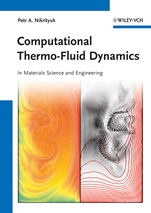
Computational Thermo–Fluid Dynamics: In Materials Science and Engineering
ISBN 9783527331017
Autor: Petr A. Nikrityuk
Wydawca: Wiley
Dostępność: 3-6 tygodni
Cena: 693,00 zł
Przed złożeniem zamówienia prosimy o kontakt mailowy celem potwierdzenia ceny.
ISBN13: |
9783527331017 |
ISBN10: |
3527331018 |
Autor: |
Petr A. Nikrityuk |
Oprawa: |
Hardback |
Rok Wydania: |
2011-08-24 |
Ilość stron: |
370 |
Wymiary: |
252x180 |
Tematy: |
PH |
Combining previously unconnected computational methods, this monograph discusses the latest basic schemes and algorithms for the solution of fluid, heat and mass transfer problems coupled with electrodynamics. It presents the necessary mathematical background of computational thermo–fluid dynamics, the numerical implementation and the application to real–world problems. Particular emphasis is placed throughout on the use of electromagnetic fields to control the heat, mass and fluid flows in melts and on phase change phenomena during the solidification of pure materials and binary alloys. However, the book provides much more than formalisms and algorithms; it also stresses the importance of good, feasible and workable models to understand complex systems, and develops these in detail.
Bringing computational fluid dynamics, thermodynamics and electrodynamics together, this is a useful source for materials scientists, PhD students, solid state physicists, process engineers and mechanical engineers, as well as lecturers in mechanical engineering.
Spis treści:
Preface.
Acknowledgments.
1 Introduction.
1.1 Heat and Fluid Flows in Materials Science and Engineering.
1.2 Overview of the Present Work.
2 Mathematical Description of Physical Phenomena in Thermofluid Dynamics.
2.1 Conservation Equations for ContinuumMedia.
2.2 Boundary and Initial Conditions.
2.3 Conservation Equations in Electromagnetics.
3 Discretization Approaches and Numerical Methods.
3.1 The Finite Difference Method.
3.2 The Finite Volume Method.
3.3 Solution of Linear Equation Systems.
4 Calculations of Flows with Heat and Mass Transfer.
4.1 Solution of Incompressible Navier–Stokes Equations.
4.2 Pressure and Velocity Coupling: SIMPLE Family.
4.3 Illustrations of Schemes for Flow with Heat Transfer.
4.4 Complex Geometry Problems on Fixed Cartesian Grids.
5 Conv
ection–Diffusion Phase–Change Problems.
5.1 Some Aspects of Solidification Thermodynamics.
5.2 Modeling of Macroscale Phase–Change Phenomena. 129
5.3 Turbulent Solidification.
5.5 Modeling of Crystal Growth.
5.6 Melting of Pure Calium under the Influence of Natural Convection.
6 Application I: Spin–Up of a Liquid Metal in Cylindrical Cavities.
6.1 Spin–Up of Isothermal Flow Driven by a Rotating Magnetic Field.
6.2 Impact of Buoyancy Force on Spin–Up Dynamics.
7 Application II: Laminar and Turbulent Flows Driven by an RMF.
7.1 Laminar Flows: State of the Art.
7.2 Turbulent Flows.
8 Application III: Contactless Mixing of Liquid Metals.
8.1 Mixing under Zero–Gravity Conditions.
8.2 The Impact of Gravity on Mixing.
9 Application IV: Electromagnetic Control of Binary Metal Alloys Solidification.
9.1 Control of a Binary Metal Alloy Solidification by Use of Alternating Current Fields.
9.2 Control of Solidification by Use of Steady Electromagnetic Fields.
9.3 The Impact of a Steady Electrical Current on Unidirectional Solidification.
9.4 The Impact of an Electric Field on the Shape of a Dendrite.
9.5 The Impact of Parallel Applied Electric and Magnetic Fields on Dendritic Growth.
References.
Index.
Nota biograficzna:
Petr Nikrityuk is head of the research group "Interphase Phenomena" within the "Virtual High Temperature Conversion Processes" (VIRTUHCON) project at the Technical University Freiberg, Germany. He studied mechanical engineering at the Moscow Aviation Institute where he also obtained his PhD on the topic of mathematical modeling of thermal processes. Before taking up his current position in Freiberg, Petr Nikrityuk worked as software developer in the field of computational fluid dynamics and as a research scientist in the Institute for Aerospace Engineering at the Tech
nical University Dresden, Germany.
Koszyk
Książek w koszyku: 0 szt.
Wartość zakupów: 0,00 zł
Informacje


Kontakt
Gambit
Centrum Oprogramowania
i Szkoleń Sp. z o.o.
Al. Pokoju 29b/22-24
31-564 Kraków
Siedziba Księgarni
ul. Kordylewskiego 1
31-542 Kraków
+48 12 410 5991
+48 12 410 5987
+48 12 410 5989
Subskrypcje
Administratorem danych osobowych jest firma Gambit COiS Sp. z o.o. Na podany adres będzie wysyłany wyłącznie biuletyn informacyjny.
Autoryzacja płatności

Informacje na temat autoryzacji płatności poprzez PayU.

© Copyright 2012: GAMBIT COiS Sp. z o.o. Wszelkie prawa zastrzeżone.
Projekt i wykonanie: Alchemia Studio Reklamy