


Wydawcy
Katalog tematyczny
- Archeologia (109)
- Ekonomia, finanse, business (13704)
- Filozofia (1445)
- Historia (3040)
- Języki i językoznawstwo (2356)
- Lifestyle, hobby i rozrywka (475)
- Medycyna (9704)
- Nauki humanistyczne (4)
- Nauki o Ziemi i środowisku (2638)
- Nauki ścisłe (20412)
- Astronomia (294)
- Biologia (5119)
- Chemia (6540)
- Fizyka (3309)
- Elektryczność i magnetyzm (90)
- Fizyka atomowa i molekularna (110)
- Fizyka cząstek elementarnych (36)
- Fizyka jądra atomowego (36)
- Fizyka kwantowa (210)
- Fizyka matematyczna (121)
- Fizyka relatywistyczna (36)
- Fizyka statystyczna (51)
- Fizyka stosowana (498)
- Mechanika klasyczna (186)
- Optyka i światło (133)
- Stany materii (202)
- Matematyka (4574)
- Nauki ścisłe, ogólnie (503)
- Nauki społeczne (8486)
- Nauki techniczne (13450)
- Prawo (1696)
- Publikacje informacyjne i interdyscyplinarne (1288)
- Religia i wierzenia (917)
- Technika komputerowa (4067)
- Zdrowie, relacje międzyludzkie i rozwój osobisty (657)





Informacje szczegółowe o książce
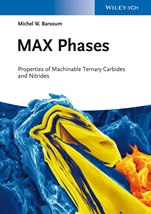
MAX Phases: Properties of Machinable Ternary Carbides and Nitrides
ISBN 9783527330119
Autor: Michel W. Barsoum
Wydawca: Wiley
Dostępność: 3-6 tygodni
Cena: 801,15 zł
Przed złożeniem zamówienia prosimy o kontakt mailowy celem potwierdzenia ceny.
ISBN13: |
9783527330119 |
ISBN10: |
3527330119 |
Autor: |
Michel W. Barsoum |
Oprawa: |
Hardback |
Rok Wydania: |
2013-09-11 |
Ilość stron: |
436 |
Wymiary: |
245x173 |
Tematy: |
PH |
In this comprehensive yet compact monograph, Michel W. Barsoum, one of the pioneers in the field and the leading figure in MAX phase research, summarizes and explains, from both an experimental and a theoretical viewpoint, all the features that are necessary to understand and apply these new materials. The book covers elastic, electrical, thermal, chemical and mechanical properties in different temperature regimes. By bringing together, in a unifi ed, self–contained manner, all the information on MAX phases hitherto only found scattered in the journal literature, this one–stop resource offers researchers and developers alike an insight into these fascinating materials.
Preface XI 1 Introduction 1 1.1 Introduction 1 1.2 History of the MAX Phases 3 References 10 2 Structure, Bonding, and Defects 13 2.1 Introduction 13 2.2 Atom Coordinates, Stacking Sequences, and Polymorphic Transformations 14 2.3 Lattice Parameters, Bond Lengths, and Interlayer Thicknesses 21 2.4 Theoretical Considerations 26 2.5 To Be or Not to Be 46 2.6 Distortion of Octahedra and Trigonal Prisms 47 2.7 Solid Solutions 49 2.8 Defects 50 2.9 Summary and Conclusions 57 Appendix A: Bond distances and distortions in the M3AX2 and M4AX3 phases 58 References 60 3 Elastic Properties, Raman and Infrared Spectroscopy 65 3.1 Introduction 65 3.2 Elastic Constants 65 3.3 Young’s Moduli and Shear Moduli 71 3.4 Poisson’s Ratios 79 3.5 Bulk Moduli 79 3.6 Extrema in Elastic Properties 87 3.7 Effect of Temperature on Elastic Properties 88 3.8 Raman Spectroscopy 90 3.9 Infrared Spectroscopy 99 3.10 Summary and Conclusions 100 References 100 4 Thermal Properties 107 4.1 Introduction 107 4.2 Thermal Conductivities 107 4.3 Atomic Displacement Parameters 115 4.4 Heat Capacities 126 4.5 Thermal Expansion 136 4.6 Thermal Stability 142 4.7 Summary and Conclusions 146 4.A Appendix 147 References 149 5 Electronic, Optical, and Magnetic Properties 155 5.1 Introduction 155 5.2 Electrical Resistivities, Hall Coefficients, and Magnetoresistances 155 5.3 Seebeck Coefficients, Θ 172 5.4 Optical Properties 175 5.5 Magnetic Properties 180 5.6 Superconducting Properties 181 5.7 Summary and Conclusions 182 References 182 6 Oxidation and Reactivity with Other Gases 187 6.1 Introduction 187 6.2 Ti3SiC2 188 6.3 Tin+1AlXn 197 6.4 Solid Solutions between Ti3AlC2 and Ti3SiC2 210 6.5 Cr2AlC 211 6.6 Nb2AlC and (Ti0.5,Nb0.5)2AlC 213 6.7 Ti2SC 216 6.8 V2AlC and (Ti0.5,V0.5)2AlC 217 6.9 Ti3GeC2 and Ti3(Si,Ge)C2 219 6.10 Ta2AlC 220 6.11 Ti2SnC, Nb2SnC, and Hf2SnC 221 6.12 Ti2InC, Zr2InC, (Ti0.5,Hf0.5)2InC, and (Ti0.5,Zr0.5)2InC 222 6.13 Sulfur Dioxide, SO2 222 6.14 Anhydrous Hydrofluoric, HF, Gas 223 6.15 Chlorine Gas 224 6.16 Summary and Conclusions 225 Appendix A: Oxidation of Tin+1AlXn When Alumina Does Not Form a Protective Layer 226 References 231 7 Chemical Reactivity 237 7.1 Introduction 237 7.2 Diffusivity of the M and A Atoms 238 7.3 Reactions with Si, C, Metals, and Intermetallics 241 7.4 Reactions with Molten Salts 251 7.5 Reactions with Common Acids and Bases 255 7.6 Summary and Conclusions 263 7.A Appendix 263 References 267 8 Dislocations, Kinking Nonlinear Elasticity, and Damping 271 8.1 Introduction 271 8.2 Dislocations and Their Arrangements 271 8.3 Kink Band Formation in Crystalline Solids 274 8.4 Incipient Kink Bands 280 8.5 Microscale Model for Kinking Nonlinear Elasticity 280 8.6 Experimental Verification of the IKB Model 283 8.7 Effect of Porosity 287 8.8 Experimental Evidence for IKBs 289 8.9 Why Microcracking Cannot Explain Kinking Nonlinear Elasticity 292 8.10 The Preisach–Mayergoyz Model 293 8.11 Damping 294 8.12 Nonlinear Dynamic Effects 296 8.13 Summary and Conclusions 301 References 302 9 Mechanical Properties: Ambient Temperature 307 9.1 Introduction 307 9.2 Response of Quasi–Single Crystals to Compressive Loads 308 9.3 Response of Polycrystalline Samples to Compressive Stresses 311 9.4 Response of Polycrystalline Samples to Shear Stresses 321 9.5 Response of Polycrystalline Samples to Flexure Stresses 322 9.6 Response of Polycrystalline Samples to Tensile Stresses 323 9.7 Hardness 324 9.8 Fracture Toughness and R–Curve Behavior 334 9.9 Fatigue Resistance 339 9.10 Damage Tolerance 342 9.11 Micromechanisms Responsible for High K1c, R–Curve Behavior, and Fatigue Response 344 9.12 Thermal Sock Resistance 352 9.13 Strain Rate Effects 353 9.14 Solid Solution Hardening and Softening 354 9.15 Machinability 355 9.16 Summary and Conclusions 355 References 356 10 Mechanical Properties: High Temperatures 363 10.1 Introduction 363 10.2 Plastic Anisotropy, Internal Stresses, and Deformation Mechanisms 364 10.3 Creep 378 10.4 Response to Other Stress States 388 10.5 Summary and Conclusions 394 References 396 11 Epilogue 399 11.1 Outstanding Scientific Questions 399 11.2 MAX Phase Potential Applications 403 11.3 Forming Processes and Sintering 410 11.4 Outstanding Technological Issues 411 11.5 Some Final Comments 412 References 413 Index 417
Michel W. Barsoum is Distinguished and Grosvenor–Professor in the Department of Materials Science and Engineering at Drexel University, USA. His research group was the fi rst to fabricate and fully characterize the MAX phases, an important new class of machinable ternary carbides and nitrides on which he and his collaborators have published more than 200 papers. He is also the author of a textbook on the Fundamentals of Ceramics, the leading textbook in the field. Prof. Barsoum was awarded a Humboldt Max Planck Research Award in 2000 and spent one year at the Max Planck Institute in Stuttgart, Germany. In 2008 – 2009 he spent a sabbatical year at Los Alamos National Lab as the prestigious Wheatley Scholar. He is a Fellow of the American Ceramic Society and the World Academy of Ceramics. In addition, Prof. Barsoum is visiting professor at Linkoping University in Sweden. With a h index of close to 50, his work has been highly and widely cited. He is on ISI′s most highly cited authors list. He is the author of the two entries on the MAX phases in the Encyclopedia of Materials Science and Engineering.
Koszyk
Książek w koszyku: 0 szt.
Wartość zakupów: 0,00 zł
Informacje


Kontakt
Gambit
Centrum Oprogramowania
i Szkoleń Sp. z o.o.
Al. Pokoju 29b/22-24
31-564 Kraków
Siedziba Księgarni
ul. Kordylewskiego 1
31-542 Kraków
+48 12 410 5991
+48 12 410 5987
+48 12 410 5989
Subskrypcje
Administratorem danych osobowych jest firma Gambit COiS Sp. z o.o. Na podany adres będzie wysyłany wyłącznie biuletyn informacyjny.
Autoryzacja płatności

Informacje na temat autoryzacji płatności poprzez PayU.

© Copyright 2012: GAMBIT COiS Sp. z o.o. Wszelkie prawa zastrzeżone.
Projekt i wykonanie: Alchemia Studio Reklamy