


Wydawcy
Katalog tematyczny
- Archeologia (109)
- Ekonomia, finanse, business (13704)
- Filozofia (1445)
- Historia (3040)
- Języki i językoznawstwo (2356)
- Lifestyle, hobby i rozrywka (475)
- Medycyna (9704)
- Nauki humanistyczne (4)
- Nauki o Ziemi i środowisku (2638)
- Nauki ścisłe (20412)
- Astronomia (294)
- Biologia (5119)
- Chemia (6540)
- Chemia analityczna (361)
- Chemia fizyczna (346)
- Chemia nieorganiczna (137)
- Chemia organiczna (535)
- Krystalografia (27)
- Minerologia (46)
- Fizyka (3309)
- Matematyka (4574)
- Nauki ścisłe, ogólnie (503)
- Nauki społeczne (8486)
- Nauki techniczne (13450)
- Prawo (1696)
- Publikacje informacyjne i interdyscyplinarne (1288)
- Religia i wierzenia (917)
- Technika komputerowa (4067)
- Zdrowie, relacje międzyludzkie i rozwój osobisty (657)





Informacje szczegółowe o książce
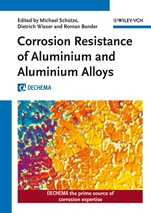
Corrosion Resistance of Aluminium and Aluminium Alloys
ISBN 9783527330010
Autor: Michael Schütze, Dietrich Wieser, Roman Bender
Wydawca: Wiley
Dostępność: 3-6 tygodni
Cena: 1 341,90 zł
Przed złożeniem zamówienia prosimy o kontakt mailowy celem potwierdzenia ceny.
ISBN13: |
9783527330010 |
ISBN10: |
3527330011 |
Autor: |
Michael Schütze, Dietrich Wieser, Roman Bender |
Oprawa: |
Hardback |
Rok Wydania: |
2010-10-27 |
Ilość stron: |
636 |
Wymiary: |
242x181 |
Tematy: |
PN |
With an annual use of almost 47 million metric tones, aluminium is the second most commonly applied metal in the world. The main reasons for the continued growth of aluminium use are its ratio of strength to density, the conductivity, its barrier properties, the excellent corrosion resistance and the recyclability. Aluminium’s lightweight performance delivers great benefit in transportation applications such as aerospace, cars, ships trains and buses and helps to increase fuel economy, reduce emissions and improve driving performance. Another significant advantage of aluminium is its corrosion resistance which is valuable for products used in architecture, construction, civil engineering, transport, for heal exchangers and many other applications.
Spis treści:
Preface.
How to use the Handbook.
Warranty disclaimer.
Acetates (L. Hasenberg).
Acetic Acid (G. Elsner).
Acid Halides (G. Elsner).
Aliphatic Aldehydes (G. Elsener).
Aliphatic amines (L. Hasenberg).
Aliphatic Ketones (H. Barkholt).
Alkaline Earth Chlorides (R. Weidemann).
Alkaline Earth Hydroxides (A. Weser).
Alkanecarboxylic Acids (L. Hasenberg).
Alkanols (K. Hauffe).
Aluminium Chloride (L. Hasenberg).
Amine Salts (K. Hauffe).
Ammonia and Ammonium.
Hydroxide (P. Drodten).
Ammonium Salts (K. Hauffe).
Atmosphere (K. Baumann).
Benzene and Benzene.
Homologues (K. Hauffe).
Bromides (K. John).
Bromine (K. John).
Carbonic Acid (L. Hasenberg).
Carboxylic Acid Esters (L. Hasenberg).
Chlorinated Hydrocarbons – Chloroethanes (H. G. Spilker).
Chlorinated Hydrocarbons – Chlorometh
anes (H. G. Spilker).
Chlorine and Chlorinated Water (K. Hauffe).
Chlorine Dioxide (L. Hasenberg).
Drinking Water (G. Heim, K. Reeh).
Ferrous Chlorides (FeCl2, FeCl3) (A. Werner).
Fluorides (K. Hauffe).
Fluorine, Hydrogen Fluoride, Hydrofluoric Acid (K. Hauffe).
Formic Acid (H. Leyerzapf).
Hot Oxidizing Gases (K. Hauffe).
Hydrochloric Acid (A. Bäumel, P. Drodten).
Hydrogen Chloride (H. Barkholt).
Hypochlorites (L. Hasenberg).
Industrial Waste Gases (G. Subat).
Lithium Hydroxide (K. John).
Methanol (H. G. Spilker).
Mixed Acids (M. B. Rockel).
Nitric Acid (K. Hauffe).
Phosphoric Acid (L. Hasenberg).
Polyols (G. Elsner).
Potassium Chloride (L. Hasenberg).
Potassium Hydroxide (P. Drodten).
Seawater (P. Drodten).
Sodium Chloride (M. B. Rockel).
Sodium Hydroxide (P. Drodten).
Sodium Sulfate (J. Küpper–Feser).
Soil (Underground Corrosion) (G. Elsner).
Steam (H. Leyerzapf).
Sulfonic Acids (K. Hauffe).
Sulfur Dioxide (L. Hasenberg).
Sulfuric Acid (L. Hasenberg).
Waste Water (Industrial) (E. Heitz, G. Subat).
Waste Water (Municipal) (G. Heim, K. Reeh).
Bibliogaphy.
Index of materials.
Subject Index.
Nota biograficzna:
Michael Schutze, born 1952, studied materials sciences at the University of Erlangen–Nurnberg from 1972 to 1978, then joined the Karl Winnacker Institute of the DECHEMA as a research associate. He received his doctorate in engineering sc
iences from the RWTH (Technical University) in Aachen in 1983, completed his habilitation in 1991, becoming a member of the external teaching staff of the RWTH. Since 1998, he holds a professorship there. In 1996, he was appointed director of the Karl Winnacker Institute. He is recipient of the Friedrich–Wilhelm–Prize and the Rahmel–Schwenk medal, past Chairman of the Gordon Research Conference on Corrosion, editor of the journal Materials and Corrosion, Past–President of the European Federation of Corrosion, Past–President of the World Corrosion organization and Chairman of the Working Party Corrosion by Hot Gases and Combustion Products of the European Federation of Corrosion.
Dietrich Wieser, born 1957, studied nonferrous metallurgy at the University of Leoben (Montanuniversitat Leoben) and joined the Research & Development Center of VAWaluminium AG (VAW) in Bonn in 1985. He received his doctorate in engineering sciences from the Technical University of Clausthal in 1992 with a thesis about Influence of the Nature and Distribution of Precipitations on the Corrosion Behaviour of Aluminium Materials . For many years he has been in charge for the corrosion laboratory of VAW and Norsk Hydro ASA (which took over VAW in 2002) working on various topics about corrosion behavior, corrosion testing and corrosion protection of aluminium and aluminium materials. Since 2005 he is with Alcoa, currently in the position of a Director Business Development for Ground Transportation in Europe. He is member of the advisory board of the journal Materials Science and Engineering Technology and chairman of the working group Corrosion and Corrosion Protection of Aluminium and Magnesium in the GfKORR (Gesellschaft für Korrosionsschutz e.V.) and its sub–groups Galvanic Corrosion and Corrosion Testing/Corrosion Investigations for Magnesium Materials.
Roman Bender, born 1971, studied chemistry at the Justus Liebig Univers
tity of Giesßen from 1992 to 1997. After he received his diploma he joined the Karl Winnacker Institute of the DECHEMA in Frankfurt (Main) as an research associate. Since 2000 he is head of the group materials and corrosion at the DECHEMA and editor in chief of the worlds largest corrosion data collection the DECHEMA Werkstofftabelle and the Corrosion Handbook. In 2001 he received his doctorate in natural sciences from the Technical University of Aachen (RWTH Aachen). He became chief executive officer the GfKORR in Frankfurt (Main) The Society for Corrosion Protection in 2008.
Okładka tylna:
With an annual use of almost 47 million metric tones, aluminium is the second most commonly applied metal in the world. The main reasons for the continued growth of aluminium use are its ratio of strength to density, the conductivity, its barrier properties, the excellent corrosion resistance and the recyclability. Aluminium’s lightweight performance delivers great benefit in transportation applications such as aerospace, cars, ships trains and buses and helps to increase fuel economy, reduce emissions and improve driving performance. Another significant advantage of aluminium is its corrosion resistance which is valuable for products used in architecture, construction, civil engineering, transport, for heal exchangers and many other applications.
Koszyk
Książek w koszyku: 0 szt.
Wartość zakupów: 0,00 zł
Informacje


Kontakt
Gambit
Centrum Oprogramowania
i Szkoleń Sp. z o.o.
Al. Pokoju 29b/22-24
31-564 Kraków
Siedziba Księgarni
ul. Kordylewskiego 1
31-542 Kraków
+48 12 410 5991
+48 12 410 5987
+48 12 410 5989
Subskrypcje
Administratorem danych osobowych jest firma Gambit COiS Sp. z o.o. Na podany adres będzie wysyłany wyłącznie biuletyn informacyjny.
Autoryzacja płatności

Informacje na temat autoryzacji płatności poprzez PayU.

© Copyright 2012: GAMBIT COiS Sp. z o.o. Wszelkie prawa zastrzeżone.
Projekt i wykonanie: Alchemia Studio Reklamy