


Wydawcy
Katalog tematyczny
- Archeologia (109)
- Ekonomia, finanse, business (13704)
- Filozofia (1445)
- Historia (3040)
- Języki i językoznawstwo (2356)
- Lifestyle, hobby i rozrywka (475)
- Medycyna (9704)
- Nauki humanistyczne (4)
- Nauki o Ziemi i środowisku (2638)
- Nauki ścisłe (20412)
- Astronomia (294)
- Biologia (5119)
- Chemia (6540)
- Chemia analityczna (361)
- Chemia fizyczna (346)
- Chemia nieorganiczna (137)
- Chemia organiczna (535)
- Krystalografia (27)
- Minerologia (46)
- Fizyka (3309)
- Matematyka (4574)
- Nauki ścisłe, ogólnie (503)
- Nauki społeczne (8486)
- Nauki techniczne (13450)
- Prawo (1696)
- Publikacje informacyjne i interdyscyplinarne (1288)
- Religia i wierzenia (917)
- Technika komputerowa (4067)
- Zdrowie, relacje międzyludzkie i rozwój osobisty (657)





Informacje szczegółowe o książce
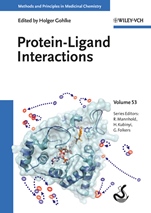
Protein–Ligand Interactions
ISBN 9783527329663
Autor: Holger Gohlke, Raimund Mannhold, Hugo Kubinyi, Gerd Folkers
Wydawca: Wiley
Dostępność: 3-6 tygodni
Cena: 801,15 zł
Przed złożeniem zamówienia prosimy o kontakt mailowy celem potwierdzenia ceny.
ISBN13: |
9783527329663 |
ISBN10: |
3527329668 |
Autor: |
Holger Gohlke, Raimund Mannhold, Hugo Kubinyi, Gerd Folkers |
Oprawa: |
Hardback |
Rok Wydania: |
2012-04-18 |
Ilość stron: |
359 |
Wymiary: |
245x176 |
Tematy: |
PN |
Innovative and forward–looking, this volume focuses on recent achievements in this rapidly progressing field and looks at future potential for development. The first part provides a basic understanding of the factors governing protein–ligand interactions, followed by a comparison of key experimental methods (calorimetry, surface plasmon resonance, NMR) used in generating interaction data. The second half of the book is devoted to insilico methods of modeling and predicting molecular recognition and binding, ranging from first principles–based to approximate ones. Here, as elsewhere in the book, emphasis is placed on novel approaches and recent improvements to established methods. The final part looks at unresolved challenges, and the strategies to address them. With the content relevant for all drug classes and therapeutic fields, this is an inspiring and often–consulted guide to the complexity of protein–ligand interaction modeling and analysis for both novices and experts.
List of Contributors XIII Preface XVII A Personal Foreword XIX Part I Binding Thermodynamics 1 1 Statistical Thermodynamics of Binding and Molecular Recognition Models 3 Kim A. Sharp 1.1 Introductory Remarks 3 1.2 The Binding Constant and Free Energy 3 1.3 A Statistical Mechanical Treatment of Binding 4 1.3.1 Binding in a Square Well Potential 6 1.3.2 Binding in a Harmonic Potential 7 1.4 Strategies for Calculating Binding Free Energies 9 1.4.1 Direct Association Simulations 9 1.4.2 The Quasi–Harmonic Approximation 10 1.4.3 Estimation of Entropy Contributions to Binding 11 1.4.4 The MoleculeMechanics Poisson–Boltzmann Surface AreaMethod 13 1.4.5 Thermodynamic Work Methods 14 1.4.6 Ligand Decoupling 15 1.4.7 Linear Interaction Methods 15 1.4.8 Salt Effects on Binding 16 1.4.9 Statistical Potentials 17 1.4.10 Empirical Potentials 18 References 19 2 Some Practical Rules for the Thermodynamic Optimization of Drug Candidates 23 Ernesto Freire 2.1 Engineering Binding Contributions 25 2.2 Eliminating Unfavorable Enthalpy 25 2.3 Improving Binding Enthalpy 26 2.4 Improving Binding Affinity 27 2.5 Improving Selectivity 28 2.6 Thermodynamic Optimization Plot 28 Acknowledgments 30 References 31 3 Enthalpy–Entropy Compensation as Deduced from Measurements of Temperature Dependence 33 Athel Cornish–Bowden 3.1 Introduction 33 3.2 The Current Status of Enthalpy–Entropy Compensation 34 3.3 Measurement of the Entropy and Enthalpy of Activation 34 3.4 An Example 35 3.5 The Compensation Temperature 38 3.6 Effect of High Correlation on Estimates of Entropy and Enthalpy 39 3.7 Evolutionary Considerations 40 3.8 Textbooks 40 References 42 Part II Learning from Biophysical Experiments 45 4 Interaction Kinetic Data Generated by Surface Plasmon Resonance Biosensors and the Use of Kinetic Rate Constants in Lead Generation and Optimization 47 U. Helena Danielson 4.1 Background 47 4.2 SPR Biosensor Technology 48 4.2.1 Principles 48 4.2.2 Sensitivity 49 4.2.3 Kinetic Resolution 50 4.2.4 Performance for Drug Discovery 51 4.3 From Interaction Models to Kinetic Rate Constants and Affinity 53 4.3.1 Determination of Interaction Kinetic Rate Constants 53 4.3.2 Determination of Affinities 54 4.3.3 Steady–State Analysis versus Analysis of Complete Sensorgrams 54 4.4 Affinity versus Kinetic Rate Constants for Evaluation of Interactions 55 4.5 From Models to Mechanisms 56 4.5.1 Irreversible Interactions 57 4.5.2 Induced Fit 57 4.5.3 Conformational Selection 58 4.5.4 Unified Model for Dynamic Targets 58 4.5.5 Heterogeneous Systems/Parallel Reactions 59 4.5.6 Mechanism–Based Inhibitors 60 4.5.7 Multiple Binding Sites and Influence of Cofactors 61 4.6 Structural Information 61 4.7 The Use of Kinetic Rate Constants in Lead Generation and Optimization 62 4.7.1 Structure–Kinetic Relationships 62 4.7.2 Selectivity/Specificity and Resistance 63 4.7.3 Chemodynamics 63 4.7.4 Thermodynamics 64 4.8 Designing Compounds with Optimal Properties 65 4.8.1 Correlation between Kinetic and Thermodynamic Parameters and Pharmacological Efficacy 65 4.8.2 Structural Modeling 66 4.9 Conclusions 67 Acknowledgments 67 References 67 5 NMR Methods for the Determination of Protein–Ligand Interactions 71 Bernd W. Koenig, Sven Schünke, Matthias Stoldt, and Dieter Willbold 5.1 Experimental Parameters from NMR 72 5.2 Aspects of Protein–Ligand Interactions That Can Be Addressed by NMR 77 5.2.1 Detection and Verification of Ligand Binding 77 5.2.2 Interaction Site Mapping 78 5.2.3 Interaction Models and Binding Affinity 80 5.2.4 Molecular Recognition 81 5.2.5 Structure of Protein–Ligand Complexes 82 5.3 Ligand–Induced Conformational Changes of a Cyclic Nucleotide Binding Domain 84 5.4 Ligand Binding to GABARAP Binding Site and Affinity Mapping 86 5.5 Transient Binding of Peptide Ligands to Membrane Proteins 88 References 90 Part III Modeling Protein–Ligand Interactions 99 6 Polarizable Force Fields for Scoring Protein–Ligand Interactions 101 Jiajing Zhang, Yue Shi, and Pengyu Ren 6.1 Introduction and Overview 101 6.2 AMOEBA Polarizable Potential Energy Model 102 6.2.1 Bond, Angle, and Cross–Energy Terms 102 6.2.2 Torsional Energy Term 103 6.2.3 Van der Waals Interactions 103 6.2.4 Permanent Electrostatic Interactions 103 6.2.5 Electronic Polarization 104 6.2.6 Polarization Energy 105 6.3 AMOEBA Explicit Water Simulation Applications 106 6.3.1 Small–Molecule Hydration Free Energy Calculations 106 6.3.2 Ion Solvation Thermodynamics 108 6.3.3 Binding Free Energy of Trypsin and Benzamidine Analogs 110 6.4 Implicit Solvent Calculation Using AMOEBA Polarizable Force Field 113 6.5 Conclusions and Future Directions 115 References 116 7 Quantum Mechanics in Structure–Based Ligand Design 121 Pär Söderhjelm, Samuel Genheden, and Ulf Ryde 7.1 Introduction 121 7.2 Three MM–Based Methods 122 7.3 QM–Based Force Fields 123 7.4 QM Calculations of Ligand Binding Sites 125 7.5 QM/MM Calculations 126 7.6 QM Calculations of Entire Proteins 127 7.6.1 Linear Scaling Methods 128 7.6.2 Fragmentation Methods 129 7.7 Concluding Remarks 133 Acknowledgments 134 References 134 8 Hydrophobic Association and Volume–Confined Water Molecules 145 Riccardo Baron, Piotr Setny, and J. Andrew McCammon 8.1 Introduction 145 8.2 Water as a Whole in Hydrophobic Association 146 8.2.1 Background 146 8.2.2 Computational Modeling of Hydrophobic Association 150 8.2.2.1 Explicit versus Implicit Solvent: Is the Computational Cost Motivated? 152 8.3 Confined Water Molecules in Protein–Ligand Binding 153 8.3.1 Protein Hydration Sites 153 8.3.2 Thermodynamics of Volume–Confined Water Localization 154 8.3.3 Computational Modeling of Volume–Confined Water Molecules 156 8.3.4 Identifying Hydration Sites 158 8.3.5 Water in Protein–Ligand Docking 160 Acknowledgments 161 References 161 9 Implicit Solvent Models and Electrostatics in Molecular Recognition 171 Tyler Luchko and David A. Case 9.1 Introduction 171 9.2 Poisson–Boltzmann Methods 173 9.3 The Generalized Born Model 175 9.4 Reference Interaction Site Model of Molecular Solvation 176 9.5 Applications 179 9.5.1 The ‘‘MM–PBSA’’ Model 180 9.5.2 Rescoring Docking Poses 182 9.5.3 MM/3D–RISM 182 Acknowledgments 185 References 185 10 Ligand and Receptor Conformational Energies 191 Themis Lazaridis 10.1 The Treatment of Ligand and Receptor Conformational Energy in Various Theoretical Formulations of Binding 191 10.1.1 Double Decoupling Free Energy Calculations 192 10.1.2 MM–PB(GB)SA 192 10.1.3 Mining Minima 193 10.1.4 Free Energy Functional Approach 194 10.1.5 Linear Interaction Energy Methods 195 10.1.6 Scoring Functions 196 10.2 Computational Results on Ligand Conformational Energy 196 10.3 Computational Results on Receptor Conformational Energy 198 10.4 Concluding Remarks 199 Acknowledgments 199 References 199 11 Free Energy Calculations in Drug Lead Optimization 207 Thomas Steinbrecher 11.1 Modern Drug Design 207 11.1.1 In Silico Drug Design 210 11.2 Free Energy Calculations 212 11.2.1 Considerations for Accurate and Precise Results 215 11.3 Example Protocols and Applications 217 11.3.1 Example 1: Disappearing an Ion 219 11.3.2 Example 2: Relative Ligand Binding Strengths 221 11.3.3 Applications 223 11.4 Discussion 226 References 227 12 Scoring Functions for Protein–Ligand Interactions 237 Christoph Sotriffer 12.1 Introduction 237 12.2 Scoring Protein–Ligand Interactions: What for and How to? 237 12.2.1 Knowledge–Based Scoring Functions 238 12.2.2 Force Field–Based Methods 240 12.2.3 Empirical Scoring Functions 242 12.2.4 Further Approaches 244 12.3 Application of Scoring Functions: What Is Possible and What Is Not? 246 12.4 Thermodynamic Contributions and Intermolecular Interactions: Which Are Accounted for and Which Are Not? 248 12.5 Conclusions or What Remains to be Done and What Can be Expected? 254 Acknowledgments 255 References 255 Part IV Challenges in Molecular Recognition 265 13 Druggability Prediction 267 Daniel Alvarez–Garcia, Jesus Seco, Peter Schmidtke, and Xavier Barril 13.1 Introduction 267 13.2 Druggability: Ligand Properties 267 13.3 Druggability: Ligand Binding 268 13.4 Druggability Prediction by Protein Class 270 13.5 Druggability Predictions: Experimental Methods 270 13.5.1 High–Throughput Screening 270 13.5.2 Fragment Screening 271 13.5.3 Multiple Solvent Crystallographic Screening 272 13.6 Druggability Predictions: Computational Methods 272 13.6.1 Cavity Detection Algorithms 272 13.6.2 Empirical Models 273 13.6.2.1 Training Sets 273 13.6.2.2 Applicability and Prediction Performance 274 13.6.3 Physical Chemistry Predictions 275 13.7 A Test Case: PTP1B 276 13.8 Outlook and Concluding Remarks 278 References 278 14 Embracing Protein Plasticity in Ligand Docking 283 Manuel Rueda and Ruben Abagyan 14.1 Introduction 283 14.2 Docking by Sampling Internal Coordinates 284 14.3 Fast Docking to Multiple Receptor Conformations 285 14.4 Single Receptor Conformation 285 14.5 Multiple Receptor Conformations 286 14.5.1 Exploiting Existing Experimental Conformational Diversity 286 14.5.2 Selecting ‘‘Important’’ Conformations 288 14.5.3 Generating In Silico Models 288 14.6 Improving Poor Homology Models of the Binding Pocket 289 14.7 State of the Art: GPCR Dock 2010 Modeling and Docking Assessment 290 14.8 Conclusions and Outlook 290 Acknowledgments 292 References 292 15 Prospects of Modulating Protein–Protein Interactions 295 Shijun Zhong, Taiji Oashi, Wenbo Yu, Paul Shapiro, and Alexander D. MacKerell Jr. 15.1 Introduction 295 15.2 Thermodynamics of Protein–Protein Interactions 297 15.3 CADD Methods for the Identification and Optimization of Small–Molecule Inhibitors of PPIs 298 15.3.1 Identifying Inhibitors of PPIs Using SBDD 299 15.3.1.1 Protein Structure Preparation 299 15.3.1.2 Binding Site Identification 300 15.3.1.3 Virtual Chemical Database 302 15.3.1.4 Virtual Screening of Compound Database 302 15.3.1.5 Rescoring 304 15.3.1.6 Final Selection of Ligands for Experimental Assay 306 15.3.2 Lead Optimization 307 15.3.2.1 Ligand–Based Optimization 307 15.3.2.2 Computation of Binding Free Energy 308 15.4 Examples of CADD Applied to PPIs 308 15.4.1 ERK 309 15.4.2 BCL6 311 15.4.3 S100B 313 15.4.4 p56Lck Kinase SH2 Domain 313 15.5 Summary 315 Acknowledgments 315 References 315 Index 331
Holger Gohlke is Professor of Pharmaceutical and Medicinal Chemistry at the Heinrich–Heine–University, Düsseldorf, Germany. He obtained his diploma in chemistry from the Technical University of Darmstadt and his PhD from Philipps–University, Marburg, working with Gerhard Klebe, where he developed the DrugScore and AFMoC approaches. He then did postdoctoral research at The Scripps Research Institute, La Jolla, USA, working with David Case on developing and evaluating computational biophysical methods to predict protein–protein interactions. After appointments as Assistant Professor at Goethe University Frankfurt and Professor at Christian–Albrechts–University, Kiel, he moved to Düsseldorf in 2009. He was awarded the ′Innovationspreis in Medizinischer und Pharmazeutischer Chemie′ from the Gesellschaft Deutscher Chemiker and the Deutsche Pharmazeutische Gesellschaft, and the Hansch Award of the Cheminformatics and QSAR Society. His current research focuses on the understanding, prediction, and modulation of interactions involving biological macromolecules from a theoretical perspective. His group applies and develops techniques grounded in bioinformatics, computational biology, and computational biophysics.
Koszyk
Książek w koszyku: 0 szt.
Wartość zakupów: 0,00 zł
Informacje


Kontakt
Gambit
Centrum Oprogramowania
i Szkoleń Sp. z o.o.
Al. Pokoju 29b/22-24
31-564 Kraków
Siedziba Księgarni
ul. Kordylewskiego 1
31-542 Kraków
+48 12 410 5991
+48 12 410 5987
+48 12 410 5989
Subskrypcje
Administratorem danych osobowych jest firma Gambit COiS Sp. z o.o. Na podany adres będzie wysyłany wyłącznie biuletyn informacyjny.
Autoryzacja płatności

Informacje na temat autoryzacji płatności poprzez PayU.

© Copyright 2012: GAMBIT COiS Sp. z o.o. Wszelkie prawa zastrzeżone.
Projekt i wykonanie: Alchemia Studio Reklamy