


Wydawcy
Katalog tematyczny
- Archeologia (109)
- Ekonomia, finanse, business (13704)
- Filozofia (1445)
- Historia (3040)
- Języki i językoznawstwo (2356)
- Lifestyle, hobby i rozrywka (475)
- Medycyna (9704)
- Nauki humanistyczne (4)
- Nauki o Ziemi i środowisku (2638)
- Nauki ścisłe (20412)
- Astronomia (294)
- Biologia (5119)
- Chemia (6540)
- Chemia analityczna (361)
- Chemia fizyczna (346)
- Chemia nieorganiczna (137)
- Chemia organiczna (535)
- Krystalografia (27)
- Minerologia (46)
- Fizyka (3309)
- Matematyka (4574)
- Nauki ścisłe, ogólnie (503)
- Nauki społeczne (8486)
- Nauki techniczne (13450)
- Prawo (1696)
- Publikacje informacyjne i interdyscyplinarne (1288)
- Religia i wierzenia (917)
- Technika komputerowa (4067)
- Zdrowie, relacje międzyludzkie i rozwój osobisty (657)





Informacje szczegółowe o książce
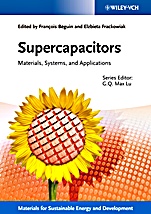
Supercapacitors: Materials, Systems, and Applications
ISBN 9783527328833
Autor: Max Lu, Francois Beguin, Elzbieta Frackowiak
Wydawca: Wiley
Dostępność: 3-6 tygodni
Cena: 838,95 zł
Przed złożeniem zamówienia prosimy o kontakt mailowy celem potwierdzenia ceny.
ISBN13: |
9783527328833 |
ISBN10: |
3527328831 |
Autor: |
Max Lu, Francois Beguin, Elzbieta Frackowiak |
Oprawa: |
Hardback |
Rok Wydania: |
2013-03-13 |
Ilość stron: |
568 |
Wymiary: |
243x174 |
Tematy: |
PN |
Supercapacitors are a relatively new energy storage system that provides higher energy density than dielectric capacitors and higher power density than batteries. They are particularly suited to applications that require energy pulses during short periods of time, e.g., seconds or tens of seconds. They are recommended for automobiles, tramways, buses, cranes, fork–lifts, wind turbines, electricity load leveling in stationary and transportation systems, etc. Despite the technological maturity of supercapacitors, there is a lack of comprehensive literature on the topic. Many high performance materials have been developed and new scientific concepts have been introduced. Taking into account the commercial interest in these systems and the new scientific and technological developments now is the ideal time to publish this book, capturing all this new knowledge. The book starts by giving an introduction to the general principles of electrochemistry, the properties of electrochemical capacitors, and electrochemical characterization techniques. Electrical double layer capacitors and pseudocapacitors are then discussed, followed by the various electrolyte systems. Modelling, manufacture of industrial capacitors, constraints, testing, and reliability as well as applications are also covered. ′Supercapacitors – Materials, Systems, and Applications′ is part of the series on Materials for
Sustainable Energy and Development edited by Prof. G.Q. Max Lu. The series covers advances in materials science and innovation for renewable energy, clean use of fossil energy, and greenhouse gas mitigation and associated environmental technologies.
GENERAL PRINCIPLES OF ELECTROCHEMISTRY
Equilibrium Electrochemistry
Ionics
Dynamic Electrochemistry
GENERAL PROPERTIES OF ELECTROCHEMICAL CAPACITORS
Introduction
Capacitor Principles
Electrochemical Capacitors
Summary
ELECTROCHEMICAL TECHNIQUES
Electrochemical Apparatus
Electrochemical Cell
Electrochemical Interface: Supercapacitors
Most Used Electrochemical Techniques
ELECTRICAL DOUBLE–LAYER CAPACITORS AND CARBONS FOR EDLCS
Introduction
The Electrical Double Layer
Types of Carbons Used for EDLCs
Capacitance versus Pore Size
Evidence of Desolvation of Ions
Performance Limitations: Pore Accessibility or Saturation of Porosity
Beyond the Double–Layer Capacitance in Microporous Carbons
Conclusions
MODERN THEORIES OF CARBON–BASED ELECTROCHEMICAL CAPACITORS
Introduction
Classical Theories
Recent Developments
Concluding Remarks
ELECTRODE MATERIALS WITH PSEUDOCAPACITIVE PROPERTIES
Introduction
Conducting Polymers in Supercapacitor Application
Metal Oxide/Carbon Composites
Pseudocapacitive Effect of Heteroatoms Present in the Carbon Network
Nanoporous Carbons with Electrosorbed Hydrogen
Electrolytic Solutions –
A Source of Faradaic Reactions
Conclusions –
Profits and Disadvantages of Pseudocapacitive Effects
LI–ION–BASED HYBRID SUPERCAPACITORS IN ORGANIC MEDIUM
Introduction
Voltage Limitation of Conventional EDLCs
Hybrid Capacitor Systems
Material Design for NHC
Conclusion
ASYMMETRIC AND HYBRID DEVICES IN AQUEOUS ELECTROLYTES
Introduction
Aqueous Hybrid (Asymmetric) Devices
Aqueous Asymmetric Electrochemical Capacitors
Tantalum Oxide–Ruthenium Oxide Hybrid Capacitors
Perspectives
EDLCS BASED ON SOLVENT–FREE IONIC LIQUIDS
Introduction
Carbon Electrode/Ionic Liquid Interface
Ionic Liquids
Carbon Electrodes
Supercapacitors
Concluding Remarks
MANUFACTURING OF INDUSTRIAL SUPERCAPACITORS
Introduction
Cell Components
Cell Design
Module Design
Conclusions and Perspectives
SUPERCAPACITOR MODULE SIZING AND HEAT MANAGEMENT UNDER ELECTRIC, THERMAL, AND AGING CONSTRAINTS
Introduction
Electrical Characterization
Thermal Modeling
Supercapacitor Lifetime
Supercapacitor Module Sizing Methods
Applications
TESTING OF ELECTROCHEMICAL CAPACITORS
Introduction
Summaries of DC Test Procedures
Applicatin of the Test Procedures to Carbon/Carbon Devices
Testing of Hybrid, Pseudocapacitive Devices
Relationships between AC Impedance and DC Testing
Uncertainties in Ultracapacitor Data Interpretation
Summary
RELIABILITY OF ELECTROCHEMICAL CAPACITORS
Introduction
Reliability Basics
Cell Reliability
System Reliability
Assessment of Cell Reliability
Reliability of Practical Systems
Increasing System Reliability
System Design Example
MARKET AND APPLICATIONS OF ELECTROCHEMICAL CAPACITORS
Introduction: Principles and History
Commerical Designs: DC Power Applications
Energy Conservation and Energy Harvesting Applications
Technology Combination Applications
Electricity Grid Applications
Conclusions
Francois Béguin is Professor of Materials Chemistry at Orléans University, France. His research activities are devoted to chemical and electrochemical applications of carbon materials, with special attention to the development of nano–carbons with controlled porosity and surface functionality for applications in energy conversion/storage and environment protection. He has published over 230 papers, owns several patents, and his works have been cited over 3000 times. Beguin is the Director of two national programmes in the French Agency for Research (ANR), one on Energy Storage (Stock–E), the other on Hydrogen and Fuel Cells (H–PAC).
Elzbieta Frackowiak is a full professor at Poznan University of Technology, Poland. She is an electrochemist, with research interests focused on energy storage/conversion. Frackowiak has more than 150 publications and 2800 citations to her name, and is Chair Elect of Division 3 (Electrochemical Energy Conversion and Storage) of the International Society of Electrochemistry.
Koszyk
Książek w koszyku: 0 szt.
Wartość zakupów: 0,00 zł
Informacje


Kontakt
Gambit
Centrum Oprogramowania
i Szkoleń Sp. z o.o.
Al. Pokoju 29b/22-24
31-564 Kraków
Siedziba Księgarni
ul. Kordylewskiego 1
31-542 Kraków
+48 12 410 5991
+48 12 410 5987
+48 12 410 5989
Subskrypcje
Administratorem danych osobowych jest firma Gambit COiS Sp. z o.o. Na podany adres będzie wysyłany wyłącznie biuletyn informacyjny.
Autoryzacja płatności

Informacje na temat autoryzacji płatności poprzez PayU.

© Copyright 2012: GAMBIT COiS Sp. z o.o. Wszelkie prawa zastrzeżone.
Projekt i wykonanie: Alchemia Studio Reklamy