


Wydawcy
Katalog tematyczny
- Archeologia (109)
- Ekonomia, finanse, business (13704)
- Filozofia (1445)
- Historia (3040)
- Języki i językoznawstwo (2356)
- Lifestyle, hobby i rozrywka (475)
- Medycyna (9704)
- Chirurgia (272)
- Inne gałęzie medycyny (1871)
- Medycyna kliniczna (4187)
- Choroby wewnętrzne (514)
- Dermatologia (51)
- Diagnostyka medyczna (3)
- Endokrynologia (144)
- Gastroenterologia (27)
- Geriatria (50)
- Ginekologia i położnictwo (134)
- Hematologia (46)
- Hepatologia (10)
- Kardiologia (71)
- Laryngologia (12)
- Nefrologia (10)
- Neurologia (500)
- Oftalmologia (50)
- Pediatria (33)
- Pulmunologia (32)
- Reumatologia (14)
- Terapia genowa (1)
- Układ mięśniowo-szkieletowy (1)
- Urologia (14)
- Medycyna niekonwencjonalna (14)
- Medycyna przedkliniczna (269)
- Medycyna, ogólnie (1740)
- Medyczne służby pomocnicze (745)
- Studia medyczne (16)
- Weterynaria (548)
- Nauki humanistyczne (4)
- Nauki o Ziemi i środowisku (2638)
- Nauki ścisłe (20412)
- Nauki społeczne (8486)
- Nauki techniczne (13450)
- Prawo (1696)
- Publikacje informacyjne i interdyscyplinarne (1288)
- Religia i wierzenia (917)
- Technika komputerowa (4067)
- Zdrowie, relacje międzyludzkie i rozwój osobisty (657)





Informacje szczegółowe o książce
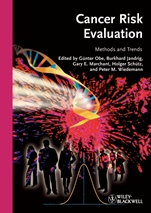
Cancer Risk Evaluation: Methods and Trends
ISBN 9783527327539
Autor: Günter Obe, Gary E. Marchant, Burkhard Jandrig, Holger Schütz, Peter M. Wiedemann
Wydawca: Wiley
Dostępność: 3-6 tygodni
Cena: 502,95 zł
Przed złożeniem zamówienia prosimy o kontakt mailowy celem potwierdzenia ceny.
ISBN13: |
9783527327539 |
ISBN10: |
3527327533 |
Autor: |
Günter Obe, Gary E. Marchant, Burkhard Jandrig, Holger Schütz, Peter M. Wiedemann |
Oprawa: |
Hardback |
Rok Wydania: |
2011-04-20 |
Ilość stron: |
366 |
Wymiary: |
249x180 |
Tematy: |
MJ |
An overview of the different approaches to cancer risk assessment of environmental factors ? including ?–omics? technologies, discussing the strengths and weaknesses of the methods in different fields. The main focus is on the carcinogenic effects of ionizing and non–ionizing radiation, demonstrating the difficulties in accurately assessing those factors that may or may not pose a significant cancer risk. The book extends the view to a broader context of risk assessment, highlighting various aspects of risk management. Written by leading experts in the field, this is a resource for policy makers and professionals in health risk assessment, and public health workers, as well as oncologists and researchers in academia.
Spis treści:
Preface.
List of Contributors.
1 Introduction.
References.
Part One Models and Approaches.
2 Models of Cancer Development: Genetic and Environmental Influences (Burkhard Jandrig).
2.1 Introduction.
2.2 Specific Characteristics of Tumors.
2.3 Tumorigenesis as a Multistep Process.
2.4 Epigenetic Changes in Cancer Development.
2.5 miRNAs and Cancer.
2.6 Cancer Stem Cells.
2.7 Cancer and the Environment.
2.8 Systems Analysis of Cancer.
2.9 Outlook.
3 Endogenous DNA Damage and Its Relevance for the Initiation of Carcinogenesis (Bernd Epe and Markus Fußer).
3.1 Introduction.
3.2 Types and Generation of Oxidative DNA Modifications.
3.3 Repair of Endogenous DNA Modifications.
3.4 Basal Steady–State Levels.
3.5 Contribution of Endogenous DNA Modifications to Cancer Risk.
4 The IARC Monographs Programme: Cancer Hazard Identification as a First Step in Cancer Risk Assessment and Cancer Prevention (Robert A. Baan and Vincent J. Cogliano).
4.1 Introduction.
4.2 Formaldehyde, Nasopharyngeal Cancer, and Leukemia: Evolution in Evaluation.
4.3 Herbal Medicines, Aristolochia Plan
t Species, and Aristolochic Acid Nephropathy.
4.4 Concluding Remarks.
Part Two Epidemiological Research.
5 The Role of Epidemiology in Cancer Risk Assessment of Nonionizing Radiation (Joachim Schüz, Gabriele Berg–Beckhoff, Brigitte Schlehofer, and Maria Blettner).
5.1 Introduction.
5.2 Brief Outline of Common Epidemiological Study Designs.
5.3 Criteria for Evaluating the Plausibility of Epidemiological Findings.
5.4 Bias and Errors in Epidemiological Studies.
5.5 Compatibility between Study Findings and Time Trends in the Occurrence of Disease.
5.6 Discussion.
6 The Role of Epidemiology in Cancer Risk Assessment of Ionizing Radiation (Richard Wakeford).
6.1 Introduction.
6.2 Japanese Atomic Bomb Survivors.
6.3 Medical Exposures.
6.4 Occupational Exposures.
6.5 Environmental Exposures.
6.6 Conclusions.
Part Three Animal Studies.
7 Animal Studies on RF EMF Cancer Effects (Clemens Dasenbrock and Jochen Buschmann).
7.1 Introduction.
7.2 Exemplary Carcinogenicity Studies Testing the Possible Health Effects Related to Mobile Telephones and Base Stations (PERFORM–A).
7.3 Research Gaps.
7.4 Proposed Research Strategy.
7.5 Summary.
8 Animal Studies in Carcinogen Identification: The Example of Power Frequency (50/60 Hz) Magnetic Fields (David L. McCormick).
8.1 Introduction.
8.2 Strengths and Limitations of Epidemiology Studies of EMF as a Cancer Hazard.
8.3 Strengths and Limitations of Experimental Studies of EMF as a Cancer Hazard.
8.4 Role of Mechanistic Studies in EMF Hazard Assessment.
8.5 Oncogenicity Studies of EMF.
8.6 Conclusions.
Part Four Genotoxicity Studies.
9 Chromosomal Aberrations in Human Populations and Cancer (Günter Obe, David C. Lloyd, and Marco Durante).
9.1 Introduction.
9.2 Chromosomal Aberrations and Their Spontaneous Fre
quencies in Human Peripheral Lymphocytes.
9.3 Micronuclei.
9.4 Sister Chromatid Exchanges.
9.5 Age Dependency of CA, MN, and SCE.
9.6 Origin of CA in HPL.
9.7 Ionizing Radiation and Chromosomal Aberrations.
9.8 CA and Cancer in Human Populations.
10 Cytogenetic Studies in Mammalian Somatic Cells Exposed to Radio Frequency Radiation: A Meta–Analysis (Vijayalaxmi and Thomas J. Prihoda).
10.1 Introduction.
10.2 Materials and Methods.
10.3 Results.
10.4 Cytogenetic Endpoints as Biomarkers for Cancer Risk.
10.5 Perspective from Meta–Analysis and Conclusions.
Part Five Omics: A New Tool for Cancer Risk Assessment?
11 Genomics and Cancer Risk Assessment (Michal R. Schweiger and Bernd Timmermann).
11.1 Introduction.
11.2 Tissue Material.
11.3 Analysis Technologies.
11.4 Outlook for Individualized Cancer Treatment.
12 Transcriptomics and Cancer Risk Assessment (Wolfgang Kemmner).
12.1 Introduction.
12.2 Sample Preparation, Technical Issues, and Data Analysis.
12.3 Conclusions.
13 Proteomics and Cancer Risk Assessment (Alexander Schramm).
13.1 Introduction.
13.2 Sample Preparation and Storage: A Challenge in Clinical Settings.
13.3 Caveats and Hurdles in Protein Analysis Using Cancer Specimen and Clinical Samples.
13.4 Separation and Fractionation of Protein Mixtures as a Prerequisite to Proteomic Analyses and Protein Quantification.
13.5 Identification of Proteins by Mass Spectrometry.
13.6 Array–Based Proteome Technology in Cancer Research.
13.7 The Present and the Future: Proteomics for Individualized Cancer Therapy.
Part Six Current Use of Omics Studies for Cancer Risk Assessment.
14 Omics in Cancer Risk Assessment: Pathways to Disease (Christopher J. Portier and Reuben Thomas).
14.1 Introduction.
14.2 "Omics"Data in Cancer Risk Assessment.
14
.3 High–Throughput Screening.
14.4 Discussion.
15 What Have "Omics"Taught Us about the Health Risks Associated with Exposure to Low Doses of Ionizing Radiation (William F. Morgan and Marianne B. Sowa).
15.1 Introduction.
15.2 Pre–"Omics".
15.3 Functional Genomics.
15.4 Gene Expression Profiling for Nontargeted Effects Induced by Exposure to Ionizing Radiation.
15.5 Gene Expression Profiling for Adaptive Responses Induced by Exposure to Ionizing Radiation.
15.6 In Vivo Gene Profiling after Irradiation.
15.7 Radiation–Induced Oscillatory Signaling.
15.8 Proteomic Profiling after Exposure to Ionizing Radiation.
15.9 Metabolomic Profiling after Exposure to Ionizing Radiation.
15.10 Conclusions.
16 Transcriptomics Approach in RF EMF Research (Meike Mevissen).
16.1 Introduction.
16.2 Transcriptomics in RF EMF Research.
16.3 Discussion.
17 Proteomics Approach in Mobile Phone Radiation Research (Dariusz Leszczynski).
Part Seven Challenges for Risk Management.
18 Evaluating the Reliability of Controversial Scientific Results (Alexander Lerchl).
18.1 Introduction.
18.2 Detection of Scientific Misconduct.
18.3 Committee on Publication Ethics.
18.4 Conclusions.
19 Comparative Risk Assessment with Ionizing and Nonionizing Radiations (Jürgen Kiefer).
19.1 Introduction.
19.2 Review of Different Radiation Types.
19.3 Discussion.
20 Communicating about Uncertainties in Cancer Risk Assessment (Peter Wiedemann and Holger Schütz).
20.1 Introduction.
20.2 The Concept of Uncertainty.
20.3 Reasons for Communicating Uncertainties.
20.4 Findings on Communicating Uncertainties.
20.5 Explaining Inconclusive Evidence.
20.6 Conclusions.
21 The Precautionary Principle and Radio Frequency Exposure from Mobile Phones (
Gary E. Marchant).
21.1 Introduction.
21.2 Background on the Precautionary Principle.
21.3 Pros and Cons of the Precautionary Principle.
21.4 Applying the Precautionary Principle to Radio Frequency Electromagnetic Fields.
21.5 Conclusions.
References.
Index.
Nota biograficzna:
Günter Obe was a full professor at the University of Duisburg–Essen from 1988 until his retirement in 2004. He obtained his degree from the Free University Berlin in 1967, where he was a professor from 1974 onwards. His field of research focused on cytogenetics, such as in vitro induction of chromosomal aberrations, cytogenetic population monitoring of persons exposed to suspected mutagens, and mechanisms of the origin of chromosomal aberrations.
Burkhard Jandrig gained his degree in biochemistry from the University of Leipzig. From 1982 until 1991 he was a research associate and group leader at the Institute of Cancer Research Berlin, working in the areas of chemical carcinogenesis and multidrug resistance. From 1992 through 2010 he held the same positions at the Max–Delbrück Center for Molecular Medicine in Berlin. His research activities are in the fields of molecular carcinogenesis, tumor genetics, tumor virology and bioethics.
Gary Marchant is the Lincoln Professor of Emerging Technologies, Law and Ethics at the Sandra Day O´Connor College of Law at Arizona State University, where he is also a professor of life sciences and executive director of the Center for Law, Science & Innovation. Professor Marchant teaches and researches in the subject areas of environmental law, risk assessment and risk management, genetics and the law, biotechnology law, food and drug law, legal aspects of nanotechnology, and law, sciences and technology.
Holger Schütz studied educational sciences at the Technical University of Braunschweig. From 1986 to 1990 he worked at the Institute of Psycho
logy, Technical University of Berlin, and has been at the Research Center Jülich since 1990. His research focuses on risk perception and risk communication, comparative assessment of environmental health risks, and evidence assessment.
Peter Wiedemann is a psychologist and professor at the Karlsruhe Institute of Technology, teaches at the University of Innsbruck, Austria, and a former president of the Society of Risk Analysis, Europe. His research and teaching activities focus on risk perception, risk communication, and precautionary risk management, as well as on risk and sustainability issues.
Koszyk
Książek w koszyku: 0 szt.
Wartość zakupów: 0,00 zł
Informacje


Kontakt
Gambit
Centrum Oprogramowania
i Szkoleń Sp. z o.o.
Al. Pokoju 29b/22-24
31-564 Kraków
Siedziba Księgarni
ul. Kordylewskiego 1
31-542 Kraków
+48 12 410 5991
+48 12 410 5987
+48 12 410 5989
Subskrypcje
Administratorem danych osobowych jest firma Gambit COiS Sp. z o.o. Na podany adres będzie wysyłany wyłącznie biuletyn informacyjny.
Autoryzacja płatności

Informacje na temat autoryzacji płatności poprzez PayU.

© Copyright 2012: GAMBIT COiS Sp. z o.o. Wszelkie prawa zastrzeżone.
Projekt i wykonanie: Alchemia Studio Reklamy