


Wydawcy
Katalog tematyczny
- Archeologia (109)
- Ekonomia, finanse, business (13704)
- Filozofia (1445)
- Historia (3040)
- Języki i językoznawstwo (2356)
- Lifestyle, hobby i rozrywka (475)
- Medycyna (9704)
- Nauki humanistyczne (4)
- Nauki o Ziemi i środowisku (2638)
- Nauki ścisłe (20412)
- Astronomia (294)
- Biologia (5119)
- Chemia (6540)
- Fizyka (3309)
- Elektryczność i magnetyzm (90)
- Fizyka atomowa i molekularna (110)
- Fizyka cząstek elementarnych (36)
- Fizyka jądra atomowego (36)
- Fizyka kwantowa (210)
- Fizyka matematyczna (121)
- Fizyka relatywistyczna (36)
- Fizyka statystyczna (51)
- Fizyka stosowana (498)
- Mechanika klasyczna (186)
- Optyka i światło (133)
- Stany materii (202)
- Matematyka (4574)
- Nauki ścisłe, ogólnie (503)
- Nauki społeczne (8486)
- Nauki techniczne (13450)
- Prawo (1696)
- Publikacje informacyjne i interdyscyplinarne (1288)
- Religia i wierzenia (917)
- Technika komputerowa (4067)
- Zdrowie, relacje międzyludzkie i rozwój osobisty (657)





Informacje szczegółowe o książce
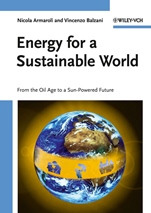
Energy for a Sustainable World: From the Oil Age to a Sun–Powered Future
ISBN 9783527325405
Autor: Vincenzo Balzani, Nicola Armaroli
Wydawca: Wiley
Dostępność: 3-6 tygodni
Cena: 205,80 zł
Przed złożeniem zamówienia prosimy o kontakt mailowy celem potwierdzenia ceny.
ISBN13: |
9783527325405 |
ISBN10: |
3527325409 |
Autor: |
Vincenzo Balzani, Nicola Armaroli |
Oprawa: |
Paperback |
Rok Wydania: |
2010-12-15 |
Ilość stron: |
390 |
Wymiary: |
240x173 |
Tematy: |
PH |
An easy read, balancing the pros and cons, this book surveys the energy issue from a broad scientific perspective while considering environmental, economic, and social factors. It explains the basic concepts, provides a historical overview of energy resources, assesses our unsustainable energy system based on fossil fuels, and shows that the energy crisis is not only a tough challenge, but also an unprecedented opportunity to become more concerned about the world in which we live and the society we have built up. By outlining the alternatives for today and the future, it gives an extensive overview on nuclear energy, solar thermal and photovoltaics, solar fuels, wind power, ocean energies and other renewables, highlighting the increasing importance of electricity and the long–term perspectives of a hydrogen–based economy. An excellent source of updated and carefully documented information on the entangled aspects of the energy issue, this book is a guide for scientists, students and teachers looking for ways out of the energy and climate crisis, and the problems and disparities generated during the fossil fuel era.
Spis treści:
Preface.
Acknowledgments.
Notation.
Part One. Living on Spaceship Earth.
1. The Energy Challenge.
1.1 Our Spaceship Earth.
1.2 An Unsustainable Growth in an Unequal World.
1.3 Energy and Climate Crisis.
1.4 Dealing with Change.
1.5 Unavoidable Questions.
2. Concepts and Misconcepts.
2.1 The Elusive Definition of Energy.
2.2 A Taste of Basic Principles.
2.3 Converting Primary Energy into Useful Energy.
2.4 It Takes Energy to Make Energy: Useful Energy.
2.5 Embodied Energy.
2.6 Energy Units and Conversions.
2.7 The Immense Energy and Power Scales.
2.8 Some Energy Key Parameters.
2.9 Energy Pervasiveness Versus Energy Illiteracy.
2.10 Key Numbers: an Abacus for Energy Literacy.
3. Energy in History.
3.1 Historia Magist
ra Vitae.
3.2 Animal Power.
3.3 Human Slaves and Energy Slaves.
3.4 Waterwheels and Windwheels.
3.5 From Wood to Coal.
3.6 Steam–Powered Machines.
3.7 Road Vehicles.
3.8 Aircraft.
3.9 Electricity.
Part Two. Fossil Fuels.
4. Oil.
4.1 What is Oil.
4.2 Oil History, Exploration, Drilling, Production.
4.3 Oil Transportation.
4.4 Oil Refining.
4.5 Oil Storage.
4.6 Unconventional Oil.
4.7 Petrochemicals.
4.8 Oil as a Fuel.
4.9 America’s Addiction to Oil.
4.10 Oil Price.
4.11 Oil Peak and Reserves.
5. Natural Gas.
5.1 What is Natural Gas and Where It Comes From.
5.2 Gas Properties and Definitions.
5.3 Brief Historical Notes on Gas Exploitation.
5.4 Gas Production, Consumption, and Reserves.
5.5 Liquefield Natural Gas (LNG).
5.6 Natural Gas Processing.
5.7 Transport, Storage, and Distribution.
5.8 Gas Uses: Energy and Feedstock.
5.9 Unconventional Gas.
6. Coal.
6.1 What is Coal.
6.2 Coal Extraction.
6.3 Coal Transportation and Industrial Uses.
6.4 Coal Gasification.
6.5 Coal Production, Consumption, and Reserves.
6.6 Carbon Capture and Sequestration (CCS).
6.7 Integrated Gasification Combined Cycle (IGCC).
7. Fossil Legacy.
7.1 The Energy Dark Sides.
7.2 Alteration of the Carbon Cycle by Fossil Fuel Combustion.
7.3 Anthropogenic Climate Change.
7.4 Air Pollution and Global Warming.
7.5 Counterbalancing our Climate Influence.
7.6 Putting a Limit to CO2.
7.7 Air Pollution and Human Health.
7.8 Land and Water Degradation.
7.9 So, What?
Part Three. Nuclear Energy.
8. Nuclear Energy.
8.1 Principles of Nuclear Fission and Fusion.
8.2 Power from Nuclear Fission.
8.3 Civilian Use of Nuclear Fusion?
Part Four. Renewable Energies.
9. Solar Energy Basics.
9.1 The Origin of Sunshine.
9.2 Solar Radiation and Attenuation.
9.3 Abu
ndant, Fairly Distributed, Vital.
9.4 Sun’s Limits: Dilution and Intermittency.
9.5 The Conversion of Solar Energy: Heat, Fuels, Electricity.
10. Solar Heat and Electricity.
10.1 Passive Solar Harnessing in Buildings.
10.2 Thermal Conversion: Unconcentrated Solar Flux.
10.3 Thermal Conversion: Concentrated Solar Flux.
10.4 The Birth and Rise of Photovaltaics.
10.5 Inorganic Photovoltaics: Key Principles.
10.6 Silicon Solar Cells.
10.7 Thin Film Solar Cells.
10.8 Organic Solar Cells.
10.9 Concentrated Photovoltaics and Other Innovative Concepts.
10.10 Photovoltaics: Global Installation and Market Trends.
10.11 Solar Energy: Sustainable and Affordable.
11. Solar Fuels.
11.1 Introduction.
11.2 Natural Photosynthesis.
11.3 Biomass and Biofuels.
11.4 Future Options for Transportation Fuels.
11.5 Artificial Photosynthesis.
11.6 Dye–sensitized Solar Cells.
11.7 The Solar Fuel Challenge.
12. Other Renewables.
12.1 Hydroelectric Energy.
12.2 Wind Energy.
12.3 Ocean Energies.
12.4 Geothermal Energy.
Part Five. Energy Carriers.
13. Electricity.
13.1 Basic Concepts.
13.2 Illumination.
13.3 Traditional Power Generation.
13.4 Traditional Electricity Grid.
13.5 Power Generation from New Renewables.
13.6 Energy Storage for Electricity Supply Networks.
13.7 Plugging–in Transportation.
13.8 Smart Grid.
13.9 Towards an Electricity Powered World.
14. Hydrogen.
14.1 Introduction.
14.2 Properties and Industrial Uses.
14.3 Hydrogen as an Energy Carrier: The Scale of the Task.
14.4 Methods for Producing Hydrogen.
14.5 Hydrogen Storage.
14.6 Hydrogen Transportation and Distribution.
14.7 End Uses of Hydrogen Fuel.
14.8 Hydrogen Powered Vehicles.
14.9 Towards a Hydrogen Economy?
Part Six. Scenarios for a Sustainable Future.
15. The Challenge.
15.1 Reflection on the St
ate of Our Planet: Now We Know.
15.2 Energy Demand and Supply.
15.3 Energy and the Quality of Life.
15.4 Saving the Climate.
15.5 Phasing Out Fossil Fuels.
15.6 Avoiding Nuclear Energy.
15.7 Ecological Sustainability.
15.8 Why We Need to Develop Renewable Energy Energies.
15.9 Conclusion.
Appendix – Did You Know That… ?
References.
Index.
Nota biograficzna:
Nicola Armaroli got his PhD in chemical sciences in 1994 from the University of Bologna. After post–doctoral studies in the U.S. and Italy, in 1997 he joined the Italian National Research Council (CNR), where he his currently senior research scientist. He has published three books and over 150 papers, giving tens of lectures worldwide. His current research is concerned with the photochemistry and photophysics of coordination compounds, carbon nanostructures and supramolecular materials, with focus on luminescence and photoinduced energy– and electron–transfer. This work is of interest both in fundamental science and technological applications, such as solar energy conversion and lighting devices.
Vincenzo Balzani gained his chemistry degree in 1960 from the University of Bologna, where he has been Professor of Chemistry since 1973. He has been a visiting Professor in Canada, Israel, France and Belgium, headed various scientific committees and institutes and has held over 300 lectures worldwide. Alongside his membership of several editorial boards, Prof. Balzani has six books and over 500 papers to his name. He is a fellow of numerous societies, and has won many awards around the world. His research interests include photochemistry, photophysics, supramolecular chemistry, electron transfer reactions, molecular–level devices and machines, molecular nanotechnology, and photochemical solar energy conversion.
Okładka tylna:
An easy read, balancing the pros and cons, this book surveys the
energy issue from a broad scientific perspective while considering environmental, economic, and social factors. It explains the basic concepts, provides a historical overview of energy resources, assesses our unsustainable energy system based on fossil fuels, and shows that the energy crisis is not only a tough challenge, but also an unprecedented opportunity to become more concerned about the world in which we live and the society we have built up. By outlining the alternatives for today and the future, it gives an extensive overview on nuclear energy, solar thermal and photovoltaics, solar fuels, wind power, ocean energies and other renewables, highlighting the increasing importance of electricity and the long–term perspectives of a hydrogen–based economy. An excellent source of updated and carefully documented information on the entangled aspects of the energy issue, this book is a guide for scientists, students and teachers looking for ways out of the energy and climate crisis, and the problems and disparities generated during the fossil fuel era.
Koszyk
Książek w koszyku: 0 szt.
Wartość zakupów: 0,00 zł
Informacje


Kontakt
Gambit
Centrum Oprogramowania
i Szkoleń Sp. z o.o.
Al. Pokoju 29b/22-24
31-564 Kraków
Siedziba Księgarni
ul. Kordylewskiego 1
31-542 Kraków
+48 12 410 5991
+48 12 410 5987
+48 12 410 5989
Subskrypcje
Administratorem danych osobowych jest firma Gambit COiS Sp. z o.o. Na podany adres będzie wysyłany wyłącznie biuletyn informacyjny.
Autoryzacja płatności

Informacje na temat autoryzacji płatności poprzez PayU.

© Copyright 2012: GAMBIT COiS Sp. z o.o. Wszelkie prawa zastrzeżone.
Projekt i wykonanie: Alchemia Studio Reklamy