


Wydawcy
Katalog tematyczny
- Archeologia (109)
- Ekonomia, finanse, business (13704)
- Filozofia (1445)
- Historia (3040)
- Języki i językoznawstwo (2356)
- Lifestyle, hobby i rozrywka (475)
- Medycyna (9704)
- Nauki humanistyczne (4)
- Nauki o Ziemi i środowisku (2638)
- Nauki ścisłe (20412)
- Astronomia (294)
- Biologia (5119)
- Chemia (6540)
- Chemia analityczna (361)
- Chemia fizyczna (346)
- Chemia nieorganiczna (137)
- Chemia organiczna (535)
- Krystalografia (27)
- Minerologia (46)
- Fizyka (3309)
- Matematyka (4574)
- Nauki ścisłe, ogólnie (503)
- Nauki społeczne (8486)
- Nauki techniczne (13450)
- Prawo (1696)
- Publikacje informacyjne i interdyscyplinarne (1288)
- Religia i wierzenia (917)
- Technika komputerowa (4067)
- Zdrowie, relacje międzyludzkie i rozwój osobisty (657)





Informacje szczegółowe o książce
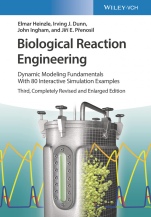
Biological Reaction Engineering: Dynamic Modeling Fundamentals with 80 Interactive Simulation Examples
ISBN 9783527325245
Autor: Elmar Heinzle, Irving J. Dunn, John Ingham, Jiří E. Přenosil
Wydawca: Wiley
Dostępność: 3-6 tygodni
Cena: 784,35 zł
Przed złożeniem zamówienia prosimy o kontakt mailowy celem potwierdzenia ceny.
ISBN13: |
9783527325245 |
ISBN10: |
3527325247 |
Autor: |
Elmar Heinzle, Irving J. Dunn, John Ingham, Jiří E. Přenosil |
Oprawa: |
Hardback |
Rok Wydania: |
2021-04-27 |
Numer Wydania: |
3rd, Completely Revised and Enlarged Edition |
Ilość stron: |
560 |
Wymiary: |
248x176 |
Tematy: |
PN |
Biological reactions may be mediated by enzymes, and whole microbial, animal or plant cells are at the core of many processes and products in a wide range of industries, such as the food and beverage, health, pharmaceutical, environmental, and chemical industries. Biological engineering has gained in breadth as we have moved from traditional biological processes for chemicals and pharmaceuticals to modern biotech medicine, and to specialty chemicals for food and industrial use. At the same time, much progress has been made in systems biology and metabolic engineering leading to next generation processes for biofuels and chemicals. Biological engineering still represents the heart of the biotech industry, such that the scaling of high productivity processes as well as the increased use of automation is critical.
This practical book presents the modeling of dynamic biological engineering processes in a readily comprehensible manner, using the unique combination of simplified fundamental theory and direct hands–on computer simulation. The mathematics is kept to a minimum, and yet the 60 examples supplied on the web–server illustrate almost every aspect of biological engineering science, with each one described in detail, including the model equations. The programs are written in the modern user–friendly simulation language Berkeley Madonna, which runs on both Windows PC and Apple computers. The results may be viewed simultaneously on multiple–graph windows or by using overlays, and the examples varied to fit any real situation.
The authors? extensive teaching experience is reflected in this well–balanced presentation, which is suitable for teachers, students, biochemists or engineers.
PART I: Principles of Bioreactor Modelling
MODELLING PRINCIPLES
Fundamentals of Modelling
Formulation and Structuring of the Problem
Formulation of Balance Equations
BASIC BIOREACTOR CONCEPTS
Information for Bioreactor Modelling
Bioreactor Operation
BIOLOGICAL KINETICS
Enzyme Kinetics
Simple Microbial Kinetics
Structured Kinetic Models
BIOREACTOR MODELLING
General Balances for Tank–Type Biological Reactors
Modelling Tubular Plug Flow Bioreactors
MASS TRANSFER
Mass Transfer in Biological Reactors
Interphase Gas–Liquid Mass Transfer
General Oxygen Balances for Gas–Liquid Transfer
DIFFUSION AND BIOLOGICAL REACTION IN IMMOBILIZED BIOCATALYST SYSTEMS
External Mass Transfer
Internal Diffusion and Reaction within Biocatalysts
AUTOMATIC BIOPROCESS CONTROL FUNDAMENTALS
Elements of Feedback Control
Types of Controller Action
Advanced Control Strategies
Controller Tuning
Concepts for Bioprocess Control
BASICS OF CELL FACTORY MODELLING
Modularisation of Cell Modelling (Transport, Enzymatic Reactions, Enzyme Regulation, Expression Control, ...)
Compartmentation and Transport
Combination of Model Elements (Kinetics, Regulation, Induction, Repression, Transport, ...)
Cell Population Modelling
PART II: Modelling, Dynamic Simulation Examples, and the BERKELEY MADONNA Simulation Language
EXAMPLES OF MODEL SET UP
Introductory Examples
SIMULATION EXAMPLES OF BIOLOGICAL REACTION PROCESSES USING BERKELEY MADONNA
Introductory Examples
Batch Reactors
Fed Batch Reactors
Continuous Reactors
Oxygen Uptake Systems
Controlled Reactor
Diffusion Systems
Multi–Organism Models
Irving J. Dunn is retired from the ETH–Zurich, where he taught and did research in the area of biochemical engineering for over thirty years, within the Chemical Engineering Dept. His degrees are from the University of Washington and Princeton University. Dr. Dunn has published widely in his field, ranging from bioreactor design, process control, animal cell culture, and specialized wastewater treatment. His teaching and research has featured the use of modelling and simulation and has resulted in the publication of three textbooks: Biological Reaction Engineering, Environmental Bioprocesses and Chemical Engineering Dynamics.
Elmar Heinzle is the Chair of Biochemical Engineering at the Saarland University in Saarbrücken, Germany. Having obtained his academic degrees from the Technical University of Graz, Austria, he spent most of his career at the Chemical Engineering Department of ETH–Zurich, Switzerland, before taking his present appointment. Professor Heinzle published over 200 scientific publications in bioreactor design, metabolic engineering, on–line analysis and control and design of sustainable processes. In his teaching in Biochemical and Chemical Engineering he is extensively using modelling. He has authored several books in these fields.
John Ingham is now retired from Chemical Engineering at Bradford University U.K. The first of a long series of courses on the Modelling and Simulation of Dynamical Chemical Engineering Systems was begun there in 1974, sponsored by the Institution of Chemical Engineers and inspired by leave of absence at the ETH Zurich. Research areas include Liquid–Liquid Column Hydrodynamics, Extraction Process Dynamics and Biochemical Engineeering; the latter, being developed, during a further leave of absence at the GBF, Braunschweig. He is especially proud of this and the two other VCH–Wiley Modelling and Simulation books.
Jiri E. Prenosil was born 1939 in Prague, Czechoslovakia. Educated in Prague with PhD in Chemical Engineering, he worked in the Czechoslovak Academy of Science and various universities abroad. 1971 he moved to Switzerland with appointment at the Swiss Federal Institute of Technology (ETH) in Zürich. 1984 he was a Visiting Professor at the University of London, Canada. His life interest is in Biochemical Engineering, design and modelling of bioreactors with immobilized biocatalysts. It has resulted in over 100 publications and co–authorship of two other books in this area. He is a co–founder of the renowned International Modelling and Simulation Courses in Braunwald, Switzerland since 1981. 1997 he was granted the Swiss Technology Transfer Award. In 2006, he retired from the ETH.
Koszyk
Książek w koszyku: 0 szt.
Wartość zakupów: 0,00 zł
Informacje


Kontakt
Gambit
Centrum Oprogramowania
i Szkoleń Sp. z o.o.
Al. Pokoju 29b/22-24
31-564 Kraków
Siedziba Księgarni
ul. Kordylewskiego 1
31-542 Kraków
+48 12 410 5991
+48 12 410 5987
+48 12 410 5989
Subskrypcje
Administratorem danych osobowych jest firma Gambit COiS Sp. z o.o. Na podany adres będzie wysyłany wyłącznie biuletyn informacyjny.
Autoryzacja płatności

Informacje na temat autoryzacji płatności poprzez PayU.

© Copyright 2012: GAMBIT COiS Sp. z o.o. Wszelkie prawa zastrzeżone.
Projekt i wykonanie: Alchemia Studio Reklamy