


Wydawcy
Katalog tematyczny
- Archeologia (109)
- Ekonomia, finanse, business (13704)
- Filozofia (1445)
- Historia (3040)
- Języki i językoznawstwo (2356)
- Lifestyle, hobby i rozrywka (475)
- Medycyna (9704)
- Nauki humanistyczne (4)
- Nauki o Ziemi i środowisku (2638)
- Nauki ścisłe (20412)
- Nauki społeczne (8486)
- Nauki techniczne (13450)
- Budownictwo lądowe (1045)
- Chemia przemysłowa (2258)
- Elektronika i telekomunikacja (3287)
- Energetyka (1122)
- Inne nauki stosowane (363)
- Inżynieria biochemiczna (507)
- Inżynieria transportu (232)
- Mechanika i materiały (3316)
- Nauka o środowisku (321)
- Rolnictwo (507)
- Technika, ogólnie (475)
- Prawo (1696)
- Publikacje informacyjne i interdyscyplinarne (1288)
- Religia i wierzenia (917)
- Technika komputerowa (4067)
- Zdrowie, relacje międzyludzkie i rozwój osobisty (657)





Informacje szczegółowe o książce
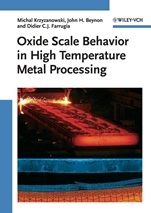
Oxide Scale Behavior in High Temperature Metal Processing
ISBN 9783527325184
Autor: Michal Krzyzanowski, John H. Beynon, Didier C. J. Farrugia
Wydawca: Wiley
Dostępność: 3-6 tygodni
Cena: 827,40 zł
Przed złożeniem zamówienia prosimy o kontakt mailowy celem potwierdzenia ceny.
ISBN13: |
9783527325184 |
ISBN10: |
3527325182 |
Autor: |
Michal Krzyzanowski, John H. Beynon, Didier C. J. Farrugia |
Oprawa: |
Hardback |
Rok Wydania: |
2010-04-22 |
Ilość stron: |
386 |
Wymiary: |
247x180 |
Tematy: |
TG |
The result of a fruitful, on–going collaboration between academia and industry, this book reviews recent advances in research on oxide scale behavior in high–temperature forming processes. Presenting novel, previously neglected approaches, the authors emphasize the pivotal role of reproducible experiments to elucidate the oxide scale properties and develop quantitative models with predictive accuracy. Each chapter consists of a detailed, systematic examination of different aspects of oxide scale formation with immediate impact for researchers and developers in industry.
The clear and stringent style of presentation makes this monograph both coherent and easily readable.
1. INTRODUCTION
2. ROLE OF SECONDARY OXIDE SCALE DURING HOT ROLLING AND FOR SUBSEQUENT PRODUCT QUALITY
Friction
Heat Transfer
Thermal Evolution in Hot Rolling
Secondary Scale Related Defects
3. SCALE GROWTH AND FORMATION OF SUBSURFACE LAYERS
High Temperature Oxidation of Steel
Formation and Structure of the Subsurface Layer in Aluminum Rolling
4. METHODOLOGY FOR NUMERICAL CHARACTERISATION OF THE OXIDE SCALE IN THERMOMECHANICAL PROCESSING
Combination of Experiments and Computer Modelling: A Key for the Scale Characterisation
Prediction of Mild Steel Oxide Failure at Entry into the Roll Gap: Evaluation of Strains, Tensile Failure, Steel Oxide Failure, Scale Failure, Verification
5. MEASURING OXIDE SCALE BEHAVIOUR UNDER HOT WORKING CONDITIONS
Laboratory Rolling Experiments
Tensile Testing
Hot Four–Point Bend Testing
Hot Tension Compression Testing
Bending Testing
6. NUMERICAL INTERPRETATION OF TEST RESULTS
Measurement of Separation Loads within the Scale/Metal System
Mathematical Model and Interpretation of Experimental Results
7. PHYSICALLY BASED FINITE ELEMENT MODEL OF THE OXIDE SCALE
Fracture, Ductile Behaviour and Sliding
Scale Evolution During Hot Rolling, Multilayer Scales
Multi–Pass Behaviour
Descaling Simulation and Surface Quality
8. OXIDE SCALE MODELLING
Evaluation of Interfacial Heat Transfer
Effect of Chemical Composition on Oxide Scale Evolution and Scale Adhesion
Ways to Maximize Descaling Effectiveness and Improvement of Surface Finish
Modelling of Formation of Stock Surface and Subsurface Layers in Breakdown Rolling of Aluminium Alloys
9. OXIDE SCALE AND THROUGH–PROCESS CHARACTERISATION: INDUSTRIAL INPUT
Michal Krzyzanowski is currently research fellow at the University of Sheffield, UK, in the Department of Engineering Materials. Graduated as physicist he obtained his PhD and DSc degrees in materials science. He was appointed Associate Professor in 1997 at the University of Science and Technology in Krakow, Poland. In 1998, he accepted the invitation of the University of Sheffield to work in the newly founded, multidisciplinary Institute for Microstructural and Mechanical Process Engineering (IMMPETUS). At IMMPETUS, Michal Krzyzanowski conducts his research on thermomechanical metal processing with a focus on characterization and multiscale modelling, application of principles of physics into the detailed numerical analysis.
John H. Beynon is Dean of the Faculty of Engineering and Industrial Sciences at Swinburne University of Technology, Melbourne, Australia. He was awarded his PhD in Metallurgy from the University of Sheffield in 1980. Professor Beynon is a fellow of the Institute of Materials, Minerals and Mining, the Institution of Engineers Australia and the Royal Academy of Engineering. His main area of research is the study of the interaction of materials science and applied mechanics to solve engineering problems, particularly in thermomechanical processing and structural integrity, by using computer–based modeling, experiment and industrial input.
Didier C. J. Farrugia is currently scientific fellow at Corus Swinden Technology Centre in Rotherham, UK, and a fellow of the Institute of Materials, Minerals and Mining (IOM3). After graduating with a PhD at the CEMEF, Mines–ParisTech in 1990, he has worked for more than 19 years in the steel R&D industry where his research activities include metal forming, material science, modeling, numerical techniques and tribology. Didier Farrugia has set up and managed major collaborative programs, and has been involved in technology transfer, implementation and exploitation within both industry and academia for many years. In recognition of his achievements, he was awarded the 2008 Dowding Medal and Prize.
Koszyk
Książek w koszyku: 0 szt.
Wartość zakupów: 0,00 zł
Informacje


Kontakt
Gambit
Centrum Oprogramowania
i Szkoleń Sp. z o.o.
Al. Pokoju 29b/22-24
31-564 Kraków
Siedziba Księgarni
ul. Kordylewskiego 1
31-542 Kraków
+48 12 410 5991
+48 12 410 5987
+48 12 410 5989
Subskrypcje
Administratorem danych osobowych jest firma Gambit COiS Sp. z o.o. Na podany adres będzie wysyłany wyłącznie biuletyn informacyjny.
Autoryzacja płatności

Informacje na temat autoryzacji płatności poprzez PayU.

© Copyright 2012: GAMBIT COiS Sp. z o.o. Wszelkie prawa zastrzeżone.
Projekt i wykonanie: Alchemia Studio Reklamy