


Wydawcy
Katalog tematyczny
- Archeologia (109)
- Ekonomia, finanse, business (13704)
- Filozofia (1445)
- Historia (3040)
- Języki i językoznawstwo (2356)
- Lifestyle, hobby i rozrywka (475)
- Medycyna (9704)
- Nauki humanistyczne (4)
- Nauki o Ziemi i środowisku (2638)
- Nauki ścisłe (20412)
- Astronomia (294)
- Biologia (5119)
- Chemia (6540)
- Fizyka (3309)
- Elektryczność i magnetyzm (90)
- Fizyka atomowa i molekularna (110)
- Fizyka cząstek elementarnych (36)
- Fizyka jądra atomowego (36)
- Fizyka kwantowa (210)
- Fizyka matematyczna (121)
- Fizyka relatywistyczna (36)
- Fizyka statystyczna (51)
- Fizyka stosowana (498)
- Mechanika klasyczna (186)
- Optyka i światło (133)
- Stany materii (202)
- Matematyka (4574)
- Nauki ścisłe, ogólnie (503)
- Nauki społeczne (8486)
- Nauki techniczne (13450)
- Prawo (1696)
- Publikacje informacyjne i interdyscyplinarne (1288)
- Religia i wierzenia (917)
- Technika komputerowa (4067)
- Zdrowie, relacje międzyludzkie i rozwój osobisty (657)





Informacje szczegółowe o książce
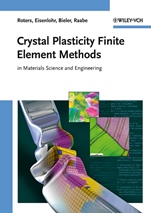
Crystal Plasticity Finite Element Methods: in Materials Science and Engineering
ISBN 9783527324477
Autor: Franz Roters, Philip Eisenlohr, Thomas R. Bieler, Dierk Raabe
Wydawca: Wiley
Dostępność: 3-6 tygodni
Cena: 665,70 zł
Przed złożeniem zamówienia prosimy o kontakt mailowy celem potwierdzenia ceny.
ISBN13: |
9783527324477 |
ISBN10: |
352732447X |
Autor: |
Franz Roters, Philip Eisenlohr, Thomas R. Bieler, Dierk Raabe |
Oprawa: |
Hardback |
Rok Wydania: |
2010-10-13 |
Ilość stron: |
208 |
Wymiary: |
249x181 |
Tematy: |
PH |
Written by the leading experts in computational materials science, this handy reference concisely reviews the most important aspects of plasticity modeling: constitutive laws, phase transformations, texture methods, continuum approaches and damage mechanisms. As a result, it provides the knowledge needed to avoid failures in critical systems under mechanical load.
With its various application examples to micro– and macrostructure mechanics, this is an invaluable resource for mechanical engineers as well as for researchers wanting to improve on this method and extend its outreach.
Spis treści:
I. Introduction
Basic Assumptions on the Continuum Theory of Continuous Distributions of Lattice Defects
Crystalline Anisotropy and the Spirit of the Crystal Plasticity Finite Element Method
The Crystal Plasticity Finite Element Method as a Multi–Mechanism and Multi–Physics Platform
II. Concise Historical Overview
III. Flow Kinematics
IV. Constitutive Models
Introduction
Phenomenological Constitutive Models
Physics–based Internal Variable Constitutive Models
V. Displacive Phase Transformations in CPFE Modeling
Introduction
Martensite Formation and Transformation–Induced Plasticity in CPFE Models
Mechanical Twinning in CPFE Models
VI. Homogenization Methods in CPFE Analysis
Introduction
Statistical Representation of Crystallographic Texture
Computational Homogenization
Mean–field Homogenization
Grain–Cluster Methods
VII. Crystal Plasticity FE Approaches to Local Damage Analysis
Continuum Approaches to Modeling Damage
Microstructurally Induced Damage
Assessment of Current Knowledge about Damage Nucleation
VIII. Numerical Aspects Associated with the CPFE Method
General Remarks
Integration Methods –
Explicit versus Implicit
Element Types
IX. Experimental Validation and Application
Introduction
Microscopic and Mes
oscopic Examples
Macroscopic Examples
X. Challenges
XI. Conclusions
Nota biograficzna:
Franz Roters heads the research group "Theory and Simulation" at the Max Planck Institute for Iron Research in Dusseldorf, Germany. After he had obtained his PhD in physics from the RWTH Aachen University, Germany, he worked for the VAW Aluminium AG in Bonn. Franz Roters serves as head of the technical committee for computer simulation of the German Society for Materials Research (DGM) and as lecturer at the RWTH.
Philip Eisenlohr is project leader of the Joint Max–Planck–Fraunhofer Initiative on Computational Mechanics of Polycrystals (CMCn) at the Max Planck Institute for Iron Research. He did his PhD at the University of Erlangen–Nurnberg elucidating the role of dislocation dipoles for the deformation of crystals. For his outstanding diploma degree he received the 2001 Young Scientist Award of the DGM.
Thomas R. Bieler is Professor at the College of Engineering of Michigan State University, USA. He received his PhD in Materials Science in 1989 from the University of California, Davis, and then went to Michigan State University, complemented by a sojourn in the Air Force Research Laboratory under the Materials and Manufacturing Directorate.
Dierk Raabe is Vice–Chief Executive of the Max Planck Institute for Iron Research and Professor at RWTH Aachen University. After his PhD he was visiting scientist in the Department of Materials Science and Engineering at the Carnegie Mellon University in Pittsburgh, USA. For his outstanding accomplishments he was honoured with numerous awards, including the Adolf Martens Award of the German Federal Institute for Materials Research and Testing and the Lee Hsun Lecture Award of the Chinese Academy of Sciences.
Koszyk
Książek w koszyku: 0 szt.
Wartość zakupów: 0,00 zł
Informacje


Kontakt
Gambit
Centrum Oprogramowania
i Szkoleń Sp. z o.o.
Al. Pokoju 29b/22-24
31-564 Kraków
Siedziba Księgarni
ul. Kordylewskiego 1
31-542 Kraków
+48 12 410 5991
+48 12 410 5987
+48 12 410 5989
Subskrypcje
Administratorem danych osobowych jest firma Gambit COiS Sp. z o.o. Na podany adres będzie wysyłany wyłącznie biuletyn informacyjny.
Autoryzacja płatności

Informacje na temat autoryzacji płatności poprzez PayU.

© Copyright 2012: GAMBIT COiS Sp. z o.o. Wszelkie prawa zastrzeżone.
Projekt i wykonanie: Alchemia Studio Reklamy