


Wydawcy
Katalog tematyczny
- Archeologia (109)
- Ekonomia, finanse, business (13704)
- Filozofia (1445)
- Historia (3040)
- Języki i językoznawstwo (2356)
- Lifestyle, hobby i rozrywka (475)
- Medycyna (9704)
- Nauki humanistyczne (4)
- Nauki o Ziemi i środowisku (2638)
- Nauki ścisłe (20412)
- Astronomia (294)
- Biologia (5119)
- Chemia (6540)
- Chemia analityczna (361)
- Chemia fizyczna (346)
- Chemia nieorganiczna (137)
- Chemia organiczna (535)
- Krystalografia (27)
- Minerologia (46)
- Fizyka (3309)
- Matematyka (4574)
- Nauki ścisłe, ogólnie (503)
- Nauki społeczne (8486)
- Nauki techniczne (13450)
- Prawo (1696)
- Publikacje informacyjne i interdyscyplinarne (1288)
- Religia i wierzenia (917)
- Technika komputerowa (4067)
- Zdrowie, relacje międzyludzkie i rozwój osobisty (657)





Informacje szczegółowe o książce
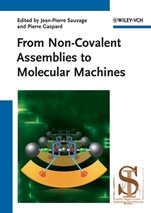
From Non–Covalent Assemblies to Molecular Machines
ISBN 9783527322770
Autor: Jean–Pierre Sauvage, Pierre Gaspard
Wydawca: Wiley
Dostępność: 3-6 tygodni
Cena: 935,55 zł
Przed złożeniem zamówienia prosimy o kontakt mailowy celem potwierdzenia ceny.
ISBN13: |
9783527322770 |
ISBN10: |
3527322779 |
Autor: |
Jean–Pierre Sauvage, Pierre Gaspard |
Oprawa: |
Hardback |
Rok Wydania: |
2010-10-27 |
Ilość stron: |
506 |
Wymiary: |
241x180 |
Tematy: |
PN |
The field of catenanes and rotaxanes has witnessed a spectacular development over the course of the past two decades. The main reason being that new template strategies have been proposed, based on the formation of noncovalent assemblies as precursors. This synthetic success has been followed by the elaboration and the study of controlled dynamic molecular systems ("molecular machines"), whose possible use in nanoscale devices, such as information storage and processing devices, has triggered much interest among various scientific communities.
Based on the 21st Solvay Conference on Chemistry, which gathers the leading scientists in the field, this monograph collects not only review articles from the six topics of the conference but also comments, discussions and debates obtained during this landmark meeting:
∗ Noncovalent Assemblies: Design and Synthesis
∗ Template Synthesis of Catenanes and Rotaxanes
∗ Molecular Machines Based on Catenanes and Rotaxanes
∗ Molecular Machines Based on Non–Interlocking Molecules
∗ Towards Molecular Logics and Artificial Photosynthesis
∗ From Single Molecules to Practical Devices
With the authors′ personal views on the future of their own research areas, this makes for novel reading for organic, inorganic and polymer chemists, as well as for materials scientists.
Spis treści:
Preface.
List of Contributors.
Description.
Opening Session.
The International Solvay Institutes.
Solvay Scientific Committee for Chemistry.
21st Solvay Conference on Chemistry.
Part One Noncovalent Assemblies: Design and Synthesis.
1 Introduction and Definition of Noncovalent Assemblies (Julius Rebek Jr).
2 Noncovalent Assemblies: Design and Synthesis (Makoto Fujita and Takashi Murase).
3 Discussion 1.A (Chairman: Julius Rebek Jr).
4 Noncovalent Synthesis of Molecular Receptors (David N. Reinhoudt).
5 Cucurbiturils: New Players in Noncovalent Assembly (Kimoon Kim).
6 Comment on the Possible Presence of Bubbles Inside Self–Assembled Molecular Cages (Josef Michl).
7 Discussion 1.B (Chairman: Julius Rebek Jr).
Part Two Template Synthesis of Catenanes and Rotaxanes.
8 A Short History of the Mechanical Bond (John–Carl Olsen, Kirsten E. Griffiths, and J. Fraser Stoddart).
9 Discussion 2.A (Chairman: Fritz Vögtle).
10 Dynamic Combinatorial Approaches to Catenanes (Jeremy K. M. Sanders).
11 Discussion 2.B (Chairman: Fritz Vögtle).
Part Three Molecular Machines Based on Catenanes and Rotaxanes.
12 Molecular Machines Based on Rotaxanes and Catenanes (Vincenzo Balzani, Alberto Credi, and Margherita Venturi).
13 Discussion 3.A (Chairman: David A. Leigh).
14 Rearrangement of a Surface–Deposited [2]catenane by Coordination to Copper(I) at the Single–Molecule Level (Jean–Pierre Sauvage).
15 A Toroidal Oxidation Catalyst (Alan E. Rowan, Johannes A.A.W. Elemans, and Roeland J.M. Nolte).
16 Discussion 3.B (Chairman: David A. Leigh).
Part Four Molecular Machines Based on Non–Interlocking Molecules.
17 Synthetic Molecular Machines Based on Non–Interlocked Systems: From Concept to Applications (Wesley R. Browne, Dirk Pijper, Michael M. Pollard, and Ben L. Feringa).
18 Discussion 4.A (Chairman: Takuzo Aida).
19 Comment on Molecular Machines Based on Non–Interlocking
Molecules (Other Than Catenanes and Rotaxanes) (Josef Michl).
20 A Few Hints Towards Artificial Active Macroscopic Systems (Jacques Prost).
21 Fluctuation Theorem, Nonequilibrium Work, and Molecular Machines (Pierre Gaspard).
22 Discussion 4.B (Chairman: Takuzo Aida).
Part Five Towards Molecular Logics and Artificial Photosynthesis.
2
3 Chairman’s Comments (A. Prasanna de Silva).
24 Towards Molecular Logic and Artificial Photosynthesis (Devens Gust, Thomas A. Moore, and Ana L. Moore).
25 Discussion 5.A (Chairman: A. Prasanna de Silva).
26 Artificial Photosynthesis: Oxygen Evolution from Photochemical Water Splitting (Vincenzo Balzani).
27 Potential Applications of Molecular Logic (Alberto Credi).
28 Discussion 5.B (Chairman: A. Prasanna de Silva).
Part Six From Single Molecules to Practical Devices.
29 From Single Molecules to Practical Devices (Jean–Pierre Launay).
30 Discussion 6.A (Chairman: Enrico Dalcanale).
31 A Spring–Loaded Device (Dariush Ajami and Julius Rebek Jr).
32 From Electrochemically–Driven Conformational Polymeric States to
Macroscopic Sensing and Tactile Muscles (Toribio F. Otero).
33 Controlling Self–Assembly in Space and Time (Ben L. Feringa
34 Discussion 6.B (Chairman: Enrico Dalcanale).
Index.
Nota biograficzna:
Jean–Pierre Sauvage preformed his studies at the Ecole Nationale Superieure de Chimie de Strasbourg where he obtained his PhD under the supervision of Prof. J.–M Lehn in 1971. After post–doctoral research with Prof. M.L.H. Green in Oxford, UK, he went back to Strasbourg as a CNRS researcher. He founded his research group in 1980, became University Professor in 1981, and also CNRS Director of research in 1988. Professor Sauvage is member of the French Academy of Science, Professor emeritus of the University of Strasbourg and currently a distinguished visiting Scholar at Northwestern University (USA). his research interest spans from artificial photosynthesis and electron transfer to porphyrin chemistry, molecular topology (catenanes and knots), and transition metal–based molecular machines.
Pierre Gaspar completed his undergraduate and graduate stud
ies at the Universite Libre de Bruxelles, receiving his doctoral degree in 1987 under the supervision of Professor Gregoire Nicolis. After a postdoctoral stay with Professor Stuart A. rice at the University of Chicago, he held a research position oat the Fonds National de la Recherche Scientifique (FNRS Belgium) from 1989 till 2004 and he became Professor at the Universite Libre de Bruxelles. In 2006, he was awarded the Francqui Prize in Exact Sciences and was elected Member of the royal Academy of Sciences, Letters and Arts of Belgium. he has organized or co–organized several international conferences, including the XXth Solvay conferences on chemistry in 1995. Professor Gaspard has published more than 150 articles in the fields of theoretical chemistry, chemical physics, nonlinear dynamics, Statistical mechanics, and thermodynamics.
Okładka tylna:
The field of catenanes and rotaxanes has witnessed a spectacular development over the course of the past two decades. The main reason being that new template strategies have been proposed, based on the formation of noncovalent assemblies as precursors. This synthetic success has been followed by the elaboration and the study of controlled dynamic molecular systems ("molecular machines"), whose possible use in nanoscale devices, such as information storage and processing devices, has triggered much interest among various scientific communities.
Based on the 21st Solvay Conference on Chemistry, which gathers the leading scientists in the field, this monograph collects not only review articles from the six topics of the conference but also comments, discussions and debates obtained during this landmark meeting:
∗ Noncovalent Assemblies: Design and Synthesis
∗ Template Synthesis of Catenanes and Rotaxanes
∗ Molecular Machines Based on Catenanes and Rotaxanes
∗ Molecular Machines Based on Non–Interlocking Molecules
∗ Towards Molecular Logics an
d Artificial Photosynthesis
∗ From Single Molecules to Practical Devices
With the authors′ personal views on the future of their own research areas, this makes for novel reading for organic, inorganic and polymer chemists, as well as for materials scientists.
Koszyk
Książek w koszyku: 0 szt.
Wartość zakupów: 0,00 zł
Informacje


Kontakt
Gambit
Centrum Oprogramowania
i Szkoleń Sp. z o.o.
Al. Pokoju 29b/22-24
31-564 Kraków
Siedziba Księgarni
ul. Kordylewskiego 1
31-542 Kraków
+48 12 410 5991
+48 12 410 5987
+48 12 410 5989
Subskrypcje
Administratorem danych osobowych jest firma Gambit COiS Sp. z o.o. Na podany adres będzie wysyłany wyłącznie biuletyn informacyjny.
Autoryzacja płatności

Informacje na temat autoryzacji płatności poprzez PayU.

© Copyright 2012: GAMBIT COiS Sp. z o.o. Wszelkie prawa zastrzeżone.
Projekt i wykonanie: Alchemia Studio Reklamy