


Wydawcy
Katalog tematyczny
- Archeologia (109)
- Ekonomia, finanse, business (13704)
- Filozofia (1445)
- Historia (3040)
- Języki i językoznawstwo (2356)
- Lifestyle, hobby i rozrywka (475)
- Medycyna (9704)
- Chirurgia (272)
- Inne gałęzie medycyny (1871)
- Medycyna kliniczna (4187)
- Choroby wewnętrzne (514)
- Dermatologia (51)
- Diagnostyka medyczna (3)
- Endokrynologia (144)
- Gastroenterologia (27)
- Geriatria (50)
- Ginekologia i położnictwo (134)
- Hematologia (46)
- Hepatologia (10)
- Kardiologia (71)
- Laryngologia (12)
- Nefrologia (10)
- Neurologia (500)
- Oftalmologia (50)
- Pediatria (33)
- Pulmunologia (32)
- Reumatologia (14)
- Terapia genowa (1)
- Układ mięśniowo-szkieletowy (1)
- Urologia (14)
- Medycyna niekonwencjonalna (14)
- Medycyna przedkliniczna (269)
- Medycyna, ogólnie (1740)
- Medyczne służby pomocnicze (745)
- Studia medyczne (16)
- Weterynaria (548)
- Nauki humanistyczne (4)
- Nauki o Ziemi i środowisku (2638)
- Nauki ścisłe (20412)
- Nauki społeczne (8486)
- Nauki techniczne (13450)
- Prawo (1696)
- Publikacje informacyjne i interdyscyplinarne (1288)
- Religia i wierzenia (917)
- Technika komputerowa (4067)
- Zdrowie, relacje międzyludzkie i rozwój osobisty (657)





Informacje szczegółowe o książce
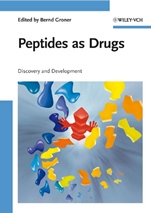
Peptides as Drugs: Discovery and Development
ISBN 9783527322053
Autor: Bernd Groner
Wydawca: Wiley
Dostępność: 3-6 tygodni
Cena: 935,55 zł
Przed złożeniem zamówienia prosimy o kontakt mailowy celem potwierdzenia ceny.
ISBN13: |
9783527322053 |
ISBN10: |
3527322051 |
Autor: |
Bernd Groner |
Oprawa: |
Hardback |
Rok Wydania: |
2009-06-24 |
Ilość stron: |
242 |
Wymiary: |
249x179 |
Tematy: |
MJ |
By covering the full spectrum of topics relevant to peptide drugs, this timely handbook serves as an introductory reference for both drug developers and biomedical researchers interested in pharmaceutically active peptides, presenting both the advantages and challenges associated with this molecular class.
The first part discusses current approaches to developing pharmaceutically active peptides, including case studies of the use of peptidic drugs in cancer and AIDS therapy. The second part surveys strategies for the development and targeting of peptidic drugs.
With its integration of biochemical, pharmaceutical and clinical research, this work reveals the full picture of modern peptide drug research in a single volume, making it an invaluable reference for medicinal chemists, biochemists, biotechnologists, and those in the pharmaceutical and biotechnological industries.
Spis treści:
Preface.
List of Contributors .
1 Peptides as Drugs: Discovery and Development (Bernd Groner).
1.1 Discovery of New Potential Drug Targets and the Limitations of Druggability.
1.2 Protein Interaction Domains Are at the Core of Signaling Pathways.
1.3 Peptides as Inhibitors of Protein Interactions.
References.
2 Mimics of Growth Factors and Cytokines (Jürgen Scheller, Joachim Grötzinger, and Stefan Rose–John).
2.1 Introduction.
2.2 The Cytokines.
2.2.1 The Receptors.
2.2.2 "Simple" Receptors.
2.2.3 "Complex" Receptors.
2.3 Defining Receptor Recognition Sites in Cytokines Using Chimeric Proteins.
2.4 Receptor Recognition Sites are Organized as Exchangeable Modules.
2.5 The Concept of Fusing the Cytokine to the Soluble Receptor: Hyper–IL–6.
2.6 Antagonists Specifically Inhibiting IL–6 Trans–Signaling.
2.7 In Vitro
Evolution of Peptides and Proteins.
2.7.1 Platforms for the Selection of High–Affinity Binders.
2.7.2 Agonists and Antagonists of Cytokines and Growth Hormones.
2.8 Concluding Remarks.
References.
3 Peptides Derived from Exon v6 of the CD44 Extracellular Domain Prevent Activation of Receptor Tyrosine Kinase and Subsequently Angiogenesis and Metastatic Spread of Tumor Cells (Helmut Ponta and Véronique Orian–Rousseau).
3.1 Introduction.
3.2 CD44 Proteins and Their Involvement in RTK Activation.
3.3 CD44v6 Acts as a Coreceptor for c–Met and Ron.
3.4 Three Amino Acids in CD44 Exon v6 Are Crucial for the CD44v6 Coreceptor Function, and Small Peptides Can Interfere with This Function.
3.5 The Ectodomain of CD44v6 Binds to HGF.
3.6 Peptides Corresponding to Exon v6 of CD44 Inhibit Metastatic Spread of Tumor Cells.
3.7 The Significance of the Collaboration between CD44v6 and c–Met In Vivo.
3.8 The CD44v6 Peptides Interfere with Angiogenesis.
3.9 Outlook.
References.
4 Peptide Aptamers Targeting the Viral E6 Oncoprotein Induce Apoptosis in HPV–positive Cancer Cells (Felix Hoppe–Seyler, Susanne Dymalla, Markus A. Moosmeier, and Karin Hoppe–Seyler).
4.1 Human Papillomaviruses and Oncogenesis.
4.1.1 Cervical Cancer.
4.1.2 The E6 and E7 Genes.
4.2 Peptide Aptamers Targeting the HPV E6 Oncoprotein.
4.3 E6–Targeting Peptide Aptamers: Therapeutic Perspectives.
4.3.1 Therapeutic Target Protein Evaluation by Peptide Aptamers.
4.3.2 The Intrinsic Therapeutic Potential of Peptide Aptamers.
4.3.3 Identification of Functional Peptide Mimics by Displacement Screening.
4.4 Perspectives.
References.
5 The Prevention of HIV Infection with Viral Entry I
nhibitors (Lisa Egerer, Anne Hubert, DorotheevonLaer, and Ursula Dietrich).
5.1 Introduction: The Potential of Peptides as Drugs in the Treatment of HIV Infection.
5.2 The HIV Entry Process.
5.3 Peptides that Inhibit Receptor or Coreceptor Binding.
5.3.1 Physiological Antimicrobial Peptides.
5.3.1.1 Defensins.
5.3.2 Chemokines.
5.3.3 Synthetic Peptides and Peptidomimetics.
5.4 Inhibitors of the Viral and Cellular Membrane Fusion Process.
5.5 Entry Inhibitory Peptides Selected by the Phage Display Technology.
5.6 Limitations of Peptides in the Treatment of HIV Infection.
5.7 Strategies to Prolong the In Vivo Half–Life of Antiviral Peptides.
5.8 Antiviral Peptides in Gene Therapy of HIV Infection.
References.
6 Intracellular Expression of Peptides (Christian Wichmann, Yvonne Becker, and Manuel Grez).
6.1 Introduction.
6.2 Peptide Design and Expression Cassettes.
6.3 Stable Delivery and Expression of Peptides: Gamma–Retro– and Lentiviral Vectors.
6.4 Gamma–Retroviral Vectors.
6.5 Lentiviral Peptide Delivery.
6.6 Vectors for Transient Expression of Peptides: Adenoviruses and Adeno–Associated Viruses.
6.7 Perspective.
Acknowledgments.
References.
7 The Internalization Mechanisms and Bioactivity of the Cell–Penetrating Peptides (Mats Hansen, Elo Eriste, and Ülo Langel).
7.1 Introduction.
7.2 Discovery and Classification of CPPs.
7.3 Internalization Mechanisms of Cell–Penetrating Peptides.
7.4 Models of CPP Uptake.
7.5 The Current View of CPP Uptake.
7.6 CPPs as Cargo Delivery Vehicles.
7.7 Delivery of Proteins.
7.8 CPPs in Gene Delivery.
7.9 Delivery of Oligonucleotides.
7.10 Cytotoxicity of Cell–Penetrating Peptides.
7.11 In Vivo Drug Delivery with CPPs.
7.12 CPPs for Targeted Delivery.
7.13 Conclusions.
Acknowledgments.
References.
Abbreviations.
8 Production and Purification of Monomeric Recombinant Peptide Aptamers: Requirements for Efficient Intracellular Uptake and Target Inhibition (Corina Borghouts and Astrid Weiss).
8.1 Introduction.
8.2 Protein Production.
8.2.1 Bacterial Systems.
8.2.2 Yeast Systems.
8.2.3 Baculovirus Systems.
8.2.4 Chemical Synthesis.
8.3 Protein Purification.
8.3.1 Ammonium Sulfate Fractionation.
8.3.2 Affinity Chromatography.
8.3.3 Buffer Exchange and Desalting.
8.3.4 Ion–Exchange Chromatography.
8.3.5 Hydrophobic Interaction Chromatography.
8.3.6 Size–Exclusion Chromatography.
8.4 Isolation of Monomeric, Natively Folded Proteins.
8.4.1 Correct Refolding versus Aggregation.
8.4.2 Techniques for Protein Folding.
8.4.3 Factors Influencing Refolding.
8.5 Increasing Peptide Production, Purification and Efficacy by Using Scaffolds.
8.5.1 Properties and Requirements of Scaffolds.
8.6 The Use of Cell–Penetrating Peptides for Cellular Uptake of Purified Proteins.
8.6.1 Uptake of Proteins by Lipid Raft–Dependent Macropinocytosis.
8.6.2 Points of Consideration for the Use of CPPs.
8.7 Classification of Therapeutic Peptides.
8.7.1 Bioactive Peptides.
8.7.2 Peptide Aptamers.
8.7.3 Designed Peptides.
8.7.4 Antibodies.
8.8 Production and Administration of Therapeutic Peptides In Vivo.
8.8.1 Extracellular Protein Therapeutics and Peptides with Extracellular Targets.
8.8.2 Peptides Targeting Intracellular
Koszyk
Książek w koszyku: 0 szt.
Wartość zakupów: 0,00 zł
Informacje


Kontakt
Gambit
Centrum Oprogramowania
i Szkoleń Sp. z o.o.
Al. Pokoju 29b/22-24
31-564 Kraków
Siedziba Księgarni
ul. Kordylewskiego 1
31-542 Kraków
+48 12 410 5991
+48 12 410 5987
+48 12 410 5989
Subskrypcje
Administratorem danych osobowych jest firma Gambit COiS Sp. z o.o. Na podany adres będzie wysyłany wyłącznie biuletyn informacyjny.
Autoryzacja płatności

Informacje na temat autoryzacji płatności poprzez PayU.

© Copyright 2012: GAMBIT COiS Sp. z o.o. Wszelkie prawa zastrzeżone.
Projekt i wykonanie: Alchemia Studio Reklamy