


Wydawcy
Katalog tematyczny
- Archeologia (109)
- Ekonomia, finanse, business (13704)
- Filozofia (1445)
- Historia (3040)
- Języki i językoznawstwo (2356)
- Lifestyle, hobby i rozrywka (475)
- Medycyna (9704)
- Nauki humanistyczne (4)
- Nauki o Ziemi i środowisku (2638)
- Nauki ścisłe (20412)
- Astronomia (294)
- Biologia (5119)
- Chemia (6540)
- Chemia analityczna (361)
- Chemia fizyczna (346)
- Chemia nieorganiczna (137)
- Chemia organiczna (535)
- Krystalografia (27)
- Minerologia (46)
- Fizyka (3309)
- Matematyka (4574)
- Nauki ścisłe, ogólnie (503)
- Nauki społeczne (8486)
- Nauki techniczne (13450)
- Prawo (1696)
- Publikacje informacyjne i interdyscyplinarne (1288)
- Religia i wierzenia (917)
- Technika komputerowa (4067)
- Zdrowie, relacje międzyludzkie i rozwój osobisty (657)





Informacje szczegółowe o książce
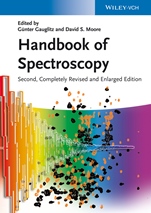
Handbook of Spectroscopy
ISBN 9783527321506
Autor: G¿nter Gauglitz, David S. Moore
Wydawca: Wiley
Dostępność: 3-6 tygodni
Cena: 2 828,70 zł
Przed złożeniem zamówienia prosimy o kontakt mailowy celem potwierdzenia ceny.
ISBN13: |
9783527321506 |
ISBN10: |
3527321500 |
Autor: |
G¿nter Gauglitz, David S. Moore |
Oprawa: |
Hardback |
Rok Wydania: |
2014-04-23 |
Numer Wydania: |
2nd, Completely Revised and Enlarged Edition |
Ilość stron: |
1993 |
Wymiary: |
288x183 |
Tematy: |
PN |
Spectroscopy, the study of the interaction between matter and radiated energy is not a new science, but it has moved on considerably from its original roots. This second, thoroughly revised, updated and enlarged edition of the classic handbook contains new themes, such as nano–optics and polymer analysis, yet provides the same wealth of information as the original book. Clearly structured in fifteen sections, covering everything from sample preparation to medicinal applications, spanning a wide range of the electromagnetic spectrum and the physical processes involved, from nuclear phenomena to molecular rotation processes. Based on the practical knowledge of spectroscopists at universities, industries and research institutes worldwide, these four volumes are a must–have companion for daily use in every laboratory.
List of Contributors XVII Preface XXIX Volume 1 Section I Sample Preparation and Sample Pretreatment 1 1 Preparation of Liquid and Solid Samples 3 Brian M. Cullum and Tuan Vo–Dinh 1.1 Introduction 3 1.2 Preparation of Samples for Analysis 3 1.2.1 Measurement Process 3 1.2.2 Preparation of Samples for Analysis 4 1.2.3 Solid Samples 5 1.2.4 Liquid Samples 10 References 13 2 Liquid and Solid Sample Collection 15 Paolo de Zorzi 2.1 Introduction 15 2.2 Sampling Process 16 2.3 Sampling Strategy and Collection 18 2.3.1 Liquid Sampling 20 2.3.2 Solid Sampling 22 2.4 QA/QC in Sampling 23 References 26 Section II Methods 1: Optical Spectroscopy 27 Introduction 29 References 30 3 Basics of Optical Spectroscopy 31 Martin Hof and Radek Mach´a¡n 3.1 Absorption of Light 31 3.2 Infrared Spectroscopy 33 3.3 Raman Spectroscopy 35 3.4 UV–vis Absorption and Luminescence 36 References 38 4 Instrumentation 39 Valdas Sablinskas 4.1 MIR Spectrometers 40 4.1.1 Dispersive Spectrometers 40 4.1.2 Fourier–Transform Spectrometers 41 4.2 NIR Spectrometers 45 4.2.1 FT–NIR Spectrometers 46 4.2.2 Scanning–Grating Spectrometers 46 4.2.3 Diode Array Spectrometers 47 4.2.4 Filter Spectrometers 47 4.2.5 LED Spectrometers 47 4.2.6 AOTF Spectrometers 47 4.3 Terahertz Spectrometers 48 4.4 Raman Spectrometers 49 4.4.1 Raman Grating Spectrometer with Single Channel Detector 49 4.4.2 FT–Raman Spectrometers with Near–Infrared Excitation 52 4.4.3 Raman Grating Polychromator with Multichannel Detector 53 4.4.4 Handheld Raman Spectrometers 55 4.5 UV/vis Spectrometers 56 4.5.1 Sources 57 4.5.2 Monochromators 57 4.5.3 Detectors 58 4.6 Fluorescence Spectrometers 59 4.7 Spectral Imaging Devices 61 4.8 Instrumentation for Nonlinear Vibrational Spectroscopy 64 4.8.1 Stimulated Raman Scattering (SRS) Spectrometers 64 4.8.2 Sum Frequency Generation (SFG) Spectrometers 65 4.8.3 Coherent Anti–Stokes Raman Scattering (CARS) Systems 66 Further Reading 69 5 Measurement Techniques 71 Gerald Steiner 5.1 Transmission Measurements 71 5.2 Reflection Measurements 74 5.2.1 External Reflection 74 5.2.2 Reflection Absorption 76 5.2.3 Attenuated Total Reflection (ATR) 76 5.2.4 Reflection at Thin Films 78 5.2.5 Diffuse Reflection 79 5.3 Spectroscopy with Polarized Light 81 5.3.1 Optical Rotatory Dispersion (ORD) 81 5.3.2 Circular Dichroism (CD) 82 5.4 Photoacoustic Measurements 83 5.5 Microscopic Measurements 85 5.5.1 Infrared Microscopes 85 5.5.2 Confocal Microscopes 86 5.5.3 Near–Field Microscopes 87 5.6 Infrared Spectroscopic Imaging 88 5.6.1 Analysis of Spectroscopic Images 89 Further Reading 94 6 Applications 95 Valdas Sablinskas, Gerald Steiner, Martin Hof, and Radek Mach´a¡n 6.1 Mid–Infrared (MIR) Spectroscopy 95 6.1.1 Sample Preparation and Measurement 95 6.1.2 Structural Analysis 104 6.1.3 Special Applications 109 6.1.4 Infrared and Raman Spectroscopic Imaging 112 6.2 Near Infrared Spectroscopy 114 6.2.1 Sample Preparation and Measurement 114 6.2.2 Application of NIR Spectroscopy 115 6.3 Raman Spectroscopy 120 6.3.1 Sample Preparation and Measurements 121 6.3.2 Special Applications 129 6.4 UV/vis Spectroscopy 135 6.4.1 Sample Preparation 136 6.4.2 Structural Analysis 136 6.4.3 Metal Complexes and Semiconductors 140 6.4.4 UV/vis Spectroscopic Imaging 145 6.4.5 Metal Nanoparticles 146 6.5 Fluorescence Spectroscopy 147 6.5.1 Sample Preparation and Measurements 148 6.5.2 Special Applications 166 Acknowledgments 174 References 174 Section III Methods 2: NMR 183 Introduction 185 7 An Introduction to Solution, Solid–State, and Imaging NMR Spectroscopy 193 Leslie G. Butler 7.1 Introduction 193 7.2 Solution–State 1HNMR 195 7.3 Solid–State NMR 203 7.3.1 Dipolar Interaction 204 7.3.2 Chemical Shift Anisotropy 206 7.3.3 Quadrupolar Interaction 207 7.3.4 Magic Angle Spinning (MAS) NMR 209 7.3.5 T1 and T1ρ Relaxation 210 7.3.6 Dynamics 214 7.4 Imaging 215 7.5 3D NMR: The HNCA Pulse Sequence 219 7.6 Conclusion 221 References 223 8 Solution NMR Spectroscopy 225 Gary E. Martin, Chad E. Hadden, and David J. Russell 8.1 Introduction 225 8.2 1D (One–Dimensional) NMR Methods 226 8.2.1 Proton Spin Decoupling Experiments 227 8.2.2 Proton Decoupled Difference Spectroscopy 227 8.2.3 Nuclear Overhauser Effect (NOE) Difference Spectroscopy 228 8.2.4 Selective Population Transfer (SPT) 228 8.2.5 J–Modulated Spin Echo Experiments 229 8.2.6 Off–Resonance Decoupling 231 8.2.7 Relaxation Measurements 232 8.3 Two–Dimensional NMR Experiments 234 8.3.1 2D J–Resolved NMR Experiments 235 8.3.2 Homonuclear 2D NMR Spectroscopy 238 8.3.3 Gradient Homonuclear 2D NMR Experiments 248 8.3.4 Heteronuclear Shift Correlation 249 8.3.5 Direct Heteronuclear Chemical Shift Correlation Methods 250 8.3.6 HSQC, Heteronuclear Single Quantum Coherence Chemical Shift Correlation Techniques 252 8.3.7 Long–Range Heteronuclear Chemical Shift Correlation 255 8.3.8 Hyphenated–2D NMR Experiments 268 8.3.9 One–Dimensional Analogs of 2D NMR Experiments 271 8.4 Conclusions 283 References 285 9 Suspended–State NMR Spectroscopy (High–Resolution Magic Angle Spinning (HR–MAS) NMR Spectroscopy) 293 Markus Kramer and Klaus Albert References 294 10 Solid–State NMR 297 Steven P. Brown and Lyndon Emsley 10.1 Introduction 297 10.2 Solid–State NMR Lineshapes 300 10.2.1 The Orientational Dependence of the NMR Resonance Frequency 300 10.2.2 Single–Crystal NMR 301 10.2.3 Powder Spectra 303 10.2.4 One–Dimensional 2HNMR 305 10.3 Magic–Angle Spinning 307 10.3.1 Cross Polarization Magic–Angle Spinning Nuclear Magnetic Resonance CP MAS NMR 309 10.3.2 1H Solid–State NMR 313 10.4 Recoupling Methods 315 10.4.1 Heteronuclear Dipolar–Coupled Spins: REDOR 315 10.4.2 Homonuclear Dipolar–Coupled Spins 317 10.4.3 The CSA: CODEX 319 10.5 Homonuclear Two–Dimensional Experiments 319 10.5.1 Establishing the Backbone Connectivity in an Organic Molecule 320 10.5.2 Dipolar–Mediated Double–Quantum Spectroscopy 324 10.5.3 High–Resolution 1H Solid–State NMR 327 10.5.4 Anisotropic–Isotropic Correlation: the Measurement of CSAs 327 10.5.5 The Investigation of Slow Dynamics: 2D Exchange 329 10.5.6 1H–1H DQ MAS Spinning–Sideband Patterns 333 10.6 Heteronuclear Two–Dimensional Experiments 335 10.6.1 Heteronuclear Correlation 335 10.6.2 The Quantitative Determination of Heteronuclear Dipolar Couplings 337 10.6.3 Torsional Angles 340 10.6.4 Oriented Samples 341 10.7 Half–Integer Quadrupole Nuclei 342 10.8 Summary 347 Acknowledgments 348 Appendix 349 Anisotropic Interactions: The Orientation Dependence of the Resonance Frequency 349 References 350 Section IV Methods 3: Mass Spectrometry 35511 Mass Spectrometry 357 Michael Przybylski 11.1 Introduction: Principles of Mass Spectrometry 357 11.1.1 Application Areas of Mass Spectrometry to Biopolymer Analysis 358 11.2 Techniques and Instrumentation of Mass Spectrometry 359 11.2.1 Sample Introduction and Ionization Methods 359 11.2.2 Mass Spectrometric Analyzers 363 11.2.3 High–Resolution Mass Spectrometers 368 11.2.4 Ion Detection and Spectra Acquisition 372 11.2.5 Sample Preparation and Handling in Bioanalytical Applications 373 11.2.6 Combination of Mass Spectrometry with Microseparation Methods and New Mass Spectrometric Hybrid Systems 376 11.3 Applications of Mass Spectrometry to Biopolymer Analysis 383 11.3.1 Introduction 383 11.3.2 Analysis of Peptide and Protein Primary Structures and Posttranslational Structure Modifications 384 11.3.3 Tertiary Structure Characterization by Chemical Modification and Mass Spectrometry 387 11.3.4 Characterization of Noncovalent Supramolecular Complexes 389 11.3.5 Mass Spectrometric Proteome Analysis 391 11.3.6 Application of Affinity–Mass Spectrometry to the Analysis of Biomolecular Recognition Structures 393 11.3.7 Identification of Oligomerization – Aggregation Structures and Pathways of Neurodegenerative Proteins by Ion Mobility Mass Spectrometry 397 Acknowledgments 398 References 399 12 Multiparametric Analysis of Mass Spectrometry–Based Proteome Profiling in Gestation–Related Diseases 407 Michael O. Glocker, Claudia R¨ower, Manja W¨olter, Cornelia Koy, Toralf Reimer, and Ulrich Pecks 12.1 Introduction on Gestational Diseases 407 12.1.1 Preeclampsia 407 12.1.2 HELLP Syndrome 409 12.1.3 Intrauterine Growth Restriction (IUGR) 410 12.2 Mass Spectrometric Data Acquisition from Plasma Samples 411 12.2.1 Mass Spectrometric Data Collection Without Sample Fractionation 412 12.2.2 Mass Spectrometric Data Collection upon Sample Fractionation 414 12.3 Multiparametric Analysis of Mass Spectrometry Data 415 12.3.1 Recalibration and Standardization Strategies 415 12.3.2 Statistical Procedures for Baseline Subtraction and Correction for Intercenter Offsets 417 12.3.3 Determination of Cut–Off Values for Ion Signal Areas 418 12.3.4 Biostatistical Assay Evaluation and Data Visualization 419 12.4 Conclusion and Clinical Relevance 422 References 423 13 Laser–Assisted Mass Spectrometry 429 David Touboul and Renato Zenobi 13.1 Introduction 429 13.2 Laser Desorption/Ionization 430 13.2.1 Laser Microprobe Mass Spectrometry 430 13.2.2 Matrix–Assisted Laser Desorption/Ionization (MALDI) 432 13.2.3 Small–Molecule Desorption/Ionization 437 13.3 Laser Ablation 438 13.4 Laser Postionization 440 13.5 Laser Ion Excitation 441 13.6 Typical Applications of Laser Mass Spectrometry 441 13.6.1 MALDI–MS in Proteomics 442 13.6.2 Imaging Mass Spectrometry 442 References 446 Volume 2 Section V Methods 4: Elemental Analysis 449 14 X–ray Fluorescence Analysis 451 Koen Janssens 15 Atomic Absorption Spectrometry (AAS) and Atomic Emission Spectrometry (AES) 507 Erwin Rosenberg and Ulrich Panne 16 Inductively Coupled Plasma Spectrometry 583 Jos´e Alfons Clement Broekaert 17 Laser Ablation Inductively Coupled Plasma Mass Spectrometry (LA–ICPMS) 647 Bodo Hattendorf and Detlef G¨unther Section VI Methods 5: Surface Analysis 699 Introduction 701 18 Electron Probe Techniques 709 Christopher George Havelock Walker 19 Ion/Neutral Probe Techniques 741 Anna Mackov´a and Andrew Pratt 20 Photon Probe Techniques 779 Simon Morton Section VII Methods 6: Spectroscopy in Nano Dimensions 821 21 Single–Molecule Spectroscopy 823 Frank Schleifenbaum, Christian Blum, Marc Brecht, and Alfred J. Meixner 22 Single–Molecule Interfacial Electron–Transfer Dynamics 877 Hong Peter Lu 23 Scanning Near–Field Gap–Mode Microscopy 911 Dai Zhang and Alfred J. Meixner Volume 3 Section VIII Applications 1: Bioanalysis 941 24 Trends in Bioanalytical Spectroscopy 943 Willem M. Albers 25 Quality Assessment of Spectroscopic Methods in Clinical Laboratories 977 Heike Schneider, Georg Kurz, and Peter B. Luppa 26 UV–Vis and NIR Fluorescence Spectroscopy 999 Gabor Patonay, Garfield Beckford, and Pekka H¨anninen 27 Principles of Vibrational Spectroscopic Methods and their Application to Bioanalysis 1037 David S. Moore, Peter Uhd Jepsen, and Karel Volka 28 Bioanalytical NMR Spectroscopy 1079 Perttu Permi 29 Direct Optical Detection in Bioanalytics 1115 G¨unter Gauglitz and Nicholas J. Goddard Section IX Applications 2: Polymer Analysis 1159 30 Surface Plasmon Spectroscopy Methods and Electrochemical Analysis 1161 Akira Baba and Rigoberto Advincula 31 Applications of Fourier Transform Infrared (FTIR) Imaging 1179 Al de Leon, Brylee Tiu, Joey Mangadlao, Katrina Pangilinan, Pengfei Cao, and Rigoberto Advincula 32 Photon Correlation Spectroscopy Coupled with Field–Flow Fractionation for Polymer Analysis 1201 J. Ray Runyon and S. Kim Ratanathanawongs Williams 33 Surface Plasmon Resonance Spectroscopy and Molecularly Imprinted Polymer (MIP) Sensors 1229 Allan Cyago and Rigoberto Advincula Section X Applications 3: Environmental Analysis 1259 34 LC–MS in Environmental Analysis 1261 Sophie Bourcier and Michel Sablier 35 Ion Attachment Mass Spectrometry for Environmental Analysis 1287 Yuki Kitahara, Seiji Takahashi, Masamichi Tsukagosi, Juh´asz M´arta, and Toshihiro Fujii 36 Immunoassays 1313 G¨unther Proll and Markus Ehni Section XI Applications 4: Process Control 1335 Introduction 1337 37 Process Control in Chemical Manufacturing 1343 Dieter Fischer, Stefan Stieler, and Stephan K¨uppers 38 Process Control Using Spectroscopic Tools in Pharmaceutical Industry and Biotechnology 1363 Michael Brudel, Uwe Schmidt, Holger Mueller, and Stephan K¨uppers 39 Applications of Optical Spectroscopy to Process Environments 1397 Stephan K¨uppers 40 Spectral Imaging in Quality and Process Control 1409 Rudolf W. Kessler and Waltraud Kessler 41 Trends in Spectroscopic Techniques for Process Control 1419 Michael Maiwald, Igor Gornushkin, and Markus Ostermann Volume 4 Section XII Applications 6: Spectroscopy at Surfaces 1439 42 Optical Spectroscopy at Surfaces 1441 Georgeta Salvan and Dietrich R. T. Zahn 43 NEXAFS Studies at Surfaces 1485 Maria Benedetta Casu and Thomas Chass´e 44 The X–Ray Standing Wave Technique 1507 Alexander Gerlach and Frank Schreiber 45 Photoelectron Spectroscopy Applications to Materials Science 1523 Maria Benedetta Casu and Thomas Chass´e Section XIII Applications 7: Nano–Optics 1557 46 Miniaturized Optical Sensors for Medical Diagnostics 1559 Seong–Soo Kim and Boris Mizaikoff 47 Tip–Enhanced Near–Field Optical Microscopy 1585 Achim Hartschuh 48 Optical Waveguide Spectroscopy 1611 James S. Wilkinson Section XIV Hyphenated Techniques 1643 49 Mass Spectral Detection 1645 John C. Fetzer 50 Optical Detection 1657 John C. Fetzer 51 Atomic Spectral Detection 1667 John C. Fetzer 52 NMR as a Chromatography Detector 1679 Klaus Albert Section XV General Data Treatment: Databases/Spectral Libraries 1717 53 Optical Spectroscopy 1719 Steffen Thiele and Reiner Salzer 54 Nuclear Magnetic Resonance Spectroscopy 1749 Wolfgang Robien 55 Mass Spectrometry 1769 Wolfgang Werther 56 Raman Spectroscopy Fundamentals 1813 David Moore Index 1831
Professor Gauglitz published over 225 publications on photokinetics, UV–VIS spectroscopy, chromatographic detection, optical sensors, modification and characterization of boundary layers, and many more topics. He is author of several books on practical spectroscopy, and basics and applications in photokinetics, among others. Professor Moore published more than 110 publications and five book chapters, as well as holder of four patents. He is presently a technical staff member at Los Alamos National Laboratory, USA. David Moore received a B.S. in Chemistry (University of Utah, 1974) and a Ph.D. in Physical Chemistry (University of Wisconsin, 1980). He was a Los Alamos National Laboratory Director–Funded Postdoctoral Fellow (1980–1981) and an Alexander von Humboldt Fellow (Essen 1993–94). in 2004 he was named Fellow of the American Physical Society.
"...the value of the work as a real encyclopedia on analytical spectroscopy, which will find appreciation both by practitioners as well as by researchers in the field." ChemPhysChem "...very comprehensive treatment of spectroscopy...highly recommended..." Choice "In general, I think this book will serve as an essential spectroscopy "encyclopedia" for experimentalists active in the field of spectroscopy or those who are planning to enter this area in an industrial as well as a university setting." Angewandte Chemie IE "...collections that seek comprehensiveness in spectroscopy, will find this a collection of practical and generally well–written articles on analytical techniques of spectroscopy." E–Streams "To sum up, this two–volume handbook provides comprehensive coverage on a variety of modern spectroscopic techniques... This is a suitable reference book for any practitioner in spectroscopic analysis, and we would recommend it for any scientific library." Journal of the American Chemical Society "...I am pleased to recommend the "Handbook of Spectroscopy "as an up–to–date, authoritative, comprehensive reference source providing rapid access to essential information for a wide audience involved in the research, teaching, learning, and practice of spectroscopic technologies both to newcomers as well as to advanced practitioners of the field and to academic, industrial, and technical libraries." The Chemical Educator "Research scientists, analytical scientists, environmental investigators, and industrial engineers, who are often confronted with the ever–increasing complexity of real–life sample analysis, will find a readily accessible source of information and authoritative guidance on how to best apply currently available spectroscopic techniques to their particular fields of interest and to their specific applications." International Journal of Environmental and Analytical Chemistry
Koszyk
Książek w koszyku: 0 szt.
Wartość zakupów: 0,00 zł
Informacje


Kontakt
Gambit
Centrum Oprogramowania
i Szkoleń Sp. z o.o.
Al. Pokoju 29b/22-24
31-564 Kraków
Siedziba Księgarni
ul. Kordylewskiego 1
31-542 Kraków
+48 12 410 5991
+48 12 410 5987
+48 12 410 5989
Subskrypcje
Administratorem danych osobowych jest firma Gambit COiS Sp. z o.o. Na podany adres będzie wysyłany wyłącznie biuletyn informacyjny.
Autoryzacja płatności

Informacje na temat autoryzacji płatności poprzez PayU.

© Copyright 2012: GAMBIT COiS Sp. z o.o. Wszelkie prawa zastrzeżone.
Projekt i wykonanie: Alchemia Studio Reklamy