


Wydawcy
Katalog tematyczny
- Archeologia (109)
- Ekonomia, finanse, business (13704)
- Filozofia (1445)
- Historia (3040)
- Języki i językoznawstwo (2356)
- Lifestyle, hobby i rozrywka (475)
- Medycyna (9704)
- Nauki humanistyczne (4)
- Nauki o Ziemi i środowisku (2638)
- Nauki ścisłe (20412)
- Astronomia (294)
- Biologia (5119)
- Chemia (6540)
- Chemia analityczna (361)
- Chemia fizyczna (346)
- Chemia nieorganiczna (137)
- Chemia organiczna (535)
- Krystalografia (27)
- Minerologia (46)
- Fizyka (3309)
- Matematyka (4574)
- Nauki ścisłe, ogólnie (503)
- Nauki społeczne (8486)
- Nauki techniczne (13450)
- Prawo (1696)
- Publikacje informacyjne i interdyscyplinarne (1288)
- Religia i wierzenia (917)
- Technika komputerowa (4067)
- Zdrowie, relacje międzyludzkie i rozwój osobisty (657)





Informacje szczegółowe o książce
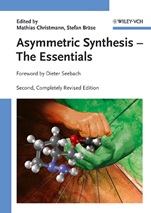
Asymmetric Synthesis: The Essentials
ISBN 9783527320936
Autor: Mathias Christmann, Stefan Bräse
Wydawca: Wiley
Dostępność: 3-6 tygodni
Cena: 729,75 zł
Przed złożeniem zamówienia prosimy o kontakt mailowy celem potwierdzenia ceny.
ISBN13: |
9783527320936 |
ISBN10: |
3527320938 |
Autor: |
Mathias Christmann, Stefan Bräse |
Oprawa: |
Paperback |
Rok Wydania: |
2007-10-17 |
Numer Wydania: |
2nd, Completely Revised Edition |
Ilość stron: |
395 |
Wymiary: |
241x170 |
Tematy: |
PN |
This "Who′s who" of asymmetric synthesis introduced the reader to the leaders in the field with a four page concentrate of their area of research along with a short biography. The book is organized into five chapters, each with an introductory preface. Starting from the key concepts of asymmetric synthesis (diastereoselective methods, asymmetric catalysis) the focus then shifts to its application to the synthesis natural products and industrial processes.
Graduate students, academic and industrial researchers will find this book a rich source of inspiration for their own works as well as an indispensable tool for the preparation of seminars and exams. A must for everyone in the field.
Spis treści:
Foreword.
Message from the Editors.
List of Abbreviations.
Named and Unnamed Reactions.
List of Contributors.
Part I Chiral Auxiliaries in Asymmetric Synthesis.
Introductory Chapter (David A. Evans, Günter Helmchen and Magnus Rüping).
Asymmetric Epoxidation of Pentadienols (Reinhard Bürckner).
Asymmetric Synthesis using Sulfur–Nitrogen Reagents (Franklin A. Davis).
Asymmetric Syntheses with SAMP–/RAMP–Hydrazones (Dieter Enders and Wolfgang Bettray).
Asymmetric Allylation Reactions (Reinhard W. Hoffmann).
Carbohydrates as Chiral Auxiliaries (Horst Kunz).
The Use of Chiral Oxazolines in early C–C Bond Forming Reactions (Albert I. Meyers).
Asymmetric Synthesis of Amines and Amino Acids from Amines (Shun–Ichi Murahashi and Yasushi Imada).
Part II Metal–catalyzed Asymmetric Synthesis.
Introductory Chapter (Masakatsu Shibasaki and Shigeki Matsunaga).
Catalytic Asymmetric Sulfur Ylide Mediated Epoxidation of Carbonyl Compounds (Varinder Aggarwal).
Asymmetric Baeyer–Villiger Reactions (Carsten Bolm).
Planar Chiral Ligands Based on [2.2]Paracyclophanes (Stefan Bräse).
Asymmetric Syntheses
of 3–(trans–2–Nitrocyclopropyl)alanine and 3–(trans–2–Aminocyclopropyl)alanine (Armin de Meijere and Oleg V. Larionov).
Copper–Bis(oxazoline) Catalyzed Synthesis of b–Lactams – Enantioselective Reaction of Alkynes with Nitrones (David A. Evans, Florian Kleinbeck and Magnus Rüping).
Catalytic Asymmetric Conjugate Addition Reactions of Organometallic Reagents (Fernando López and Ben L. Feringa).
Catalytic Asymmetric Synthesis of Allylic Alcohols via Dynamic Kinetic Resolution (Hans–Joachim Gais).
Asymmetric Cross–coupling Reactions (Tamio Hayashi).
Asymmetric Allylic Substitutions (Günter Helmchen).
Asymmetric Homoaldol Reactions (Dieter Hoppe).
Asymmetric Vinylogous Mukaiyama Aldol Reaction (Markus Kalesse and Jorma Hassfeld).
Chiral Lewis Acid Catalysis in Aqueous Media (Shu Kobayashi and Chikako Ogawa).
Asymmetric Epoxidation of Non–activated Olefins (Kazuhiro Matsumoto and Tsutomu Katsuki).
Chiral Carbonyl Lewis Acid Complexes in Asymmetric Syntheses (Keiji Maruoka and Takashi Ooi).
ZACA Reaction: Zr–catalyzed Asymmetric Carboalumination of Alkenes (Ei–ichi Negishi, Bo Liang, Tibor Novak and Ze Tan).
Bisoxazolines – a Privileged Ligand Class for Asymmetric Catalysis (Andreas Pfaltz).
Enantioselective Cycloaddition Reactions Catalyzed by Hydrogen Bonding (Viresh H. Rawal and Avinash N. Thadani).
Direct Catalytic Asymmetric Aldol–Tishchenko Reaction (Masakatsu Shibasaki and Takashi Ohshima).
Asymmetric Heck and other Palladium–catalyzed Reactions (Lutz F. Tietze and Florian Lotz).
Asymmetric Catalysis with Chiral Acid (Hisashi Yamamoto).
Part III Biocatalysis and Organocatalysis: Asymmetric Synthesis Inspired by Nature.
Introductory Chapter (Benjamin List).
Enantioselective Photochemical Reactions (Thorsten Bach).
Asymmetric Catalysis via Dynamic Kine
tic Resolution (Jan–E. Bäckvall).
Catalytic Asymmetric Epoxidation of Enones and Related Compounds (Albrecht Berkessel).
Kinetic Investigations of the Soai Autocatalytic Reaction (Donna G. Blackmond).
Planar–chiral Heterocycles as Enantioselective Organocatalysts (Gregory C. Fu).
An Organocatalytic Approach to Optically Active Six–membered Rings (Karl Anker Jørgensen).
Non–linear Effects in Asymmetric Catalysis (Henri B. Kagan).
Asymmetric Organocatalysis (Steven V. Ley).
Directed Evolution of Enzymes for Asymmetric Syntheses (Manfred T. Reetz).
Asymmetric Autocatalysis and Its Implications in the Origin of Chiral Homogeneity of Biomolecules (Kenso Soai and Tsuneomi Kawasaki).
Asymmetric Synthesis using Deoxyribose–5–phosphate Aldolase (Chi–Huey Wong and William A. Greenberg).
Part IV Asymmetric Reactions in Total Synthesis.
Introductory Chapter (K. C. Nicolaou and Paul G. Bulger).
Ring Rearrangement Metathesis (RRM) in Alkaloid Synthesis (Nicole Holub and Siegfried Blechert).
Asymmetric Synthesis of Biaryls by the ‘Lactone Method’ (Gerhard Bringmann, Tanja Gulder and Tobias A. M. Gulder).
Asymmetric Synthesis of Merrilactone A (Samuel J. Danishefsky).
Asymmetric Synthesis of Cyclic Ketal and Spiroaminal–containing Natural Products (Craig J. Forsyth).
Case Studies at the Metathesis/Asymmetric Synthesis Interface (Alois Fürstner).
Asymmetric Synthesis of Amino Acids by Rhodium and Ruthenium Catalysis (Jean Pierre Genet).
Asymmetric Syntheses of Pheromones (Kenji Mori).
Total Synthesis of Polyketides Using Asymmetric Aldol Reactions (Ian Paterson).
Asymmetric Synthesis on the Solid Phase (Torben Leßmann and Herbert Waldmann).
Part V Asymmetric Synthesis in Industry.
Introductory Chapter (Herbert Hugl).
Industrial Application of Enantioselective Catalysis (Hans–Ulrich Blaser).
Crysta
llization–Induced Diastereoselection for the Synthesis of Aprepitant (J. Brands, P. Pye and K. Rossen).
Biocatalytic Production of Optically Active Amines (Klaus Ditrich).
Asymmetric Hydrogenation through Metal–Ligand Bifunctional Catalysis (Ryoji Noyori, Takeshi Ohkuma, Christian A. Sandoval and Kilian Muñiz)
Many Ways are Leading to Rome – Today’s Variety of Competing Synthetic Methods in Industry (Andreas Job and Andreas Stolle).
Author Index.
Subject Index.
Nota biograficzna:
Mathias Christmann was born in Peine, located in Lower Saxony, Germany, in1972. He studied chemistry in Braunschweig (1993–19998) and Hannover (1998–2001) and obtained his doctorate under the guidance of Markus Kalesse. After a postdoctoral appointment with Craig J. Forsyth at the University o Minnesota (2001–2002), he began his independent research career associated with Dieter Enders at the RWTH Aachen in 2003. His research interests include organocatalysis and natural product synthesis.
Stefan Brase, born in Kiel, Germany in 1967, studied chemistry in Gottingen, Bangor (UK) and Marseille. He obtained his doctorate in 1995under the guidance of Armin de Meijere in Gottingen, Bangor (UK) and Marseille. He obtained his doctorate in 1995 under the guidance of Armin de Meijere in Gottingen. After postdoctoral appointments at Uppsala University (Jan Backvall) and The Scripps research Institute (K. C. Nicolaou), he began his independent research career at the RWTH Aachen associated with Dieter Enders in 1997 and finished his "Habilitation" in 2001. He became Professor at the University of Bonn that same year and Full Professor of Organic Chemistry at the technical University of Karlsruhe in 2003. His research interests include asymmetric metal–catalyzed processes and combinatorial chemistry towards the synthesis of biologically active compounds.
Okładka tylna:
Th
is "Who′s who" of asymmetric synthesis introduced the reader to the leaders in the field with a four page concentrate of their area of research along with a short biography. The book is organized into five chapters, each with an introductory preface. Starting from the key concepts of asymmetric synthesis (diastereoselective methods, asymmetric catalysis) the focus then shifts to its application to the synthesis natural products and industrial processes.
Graduate students, academic and industrial researchers will find this book a rich source of inspiration for their own works as well as an indispensable tool for the preparation of seminars and exams. A must for everyone in the field.
Koszyk
Książek w koszyku: 0 szt.
Wartość zakupów: 0,00 zł
Informacje


Kontakt
Gambit
Centrum Oprogramowania
i Szkoleń Sp. z o.o.
Al. Pokoju 29b/22-24
31-564 Kraków
Siedziba Księgarni
ul. Kordylewskiego 1
31-542 Kraków
+48 12 410 5991
+48 12 410 5987
+48 12 410 5989
Subskrypcje
Administratorem danych osobowych jest firma Gambit COiS Sp. z o.o. Na podany adres będzie wysyłany wyłącznie biuletyn informacyjny.
Autoryzacja płatności

Informacje na temat autoryzacji płatności poprzez PayU.

© Copyright 2012: GAMBIT COiS Sp. z o.o. Wszelkie prawa zastrzeżone.
Projekt i wykonanie: Alchemia Studio Reklamy