


Wydawcy
Katalog tematyczny
- Archeologia (109)
- Ekonomia, finanse, business (13704)
- Filozofia (1445)
- Historia (3040)
- Języki i językoznawstwo (2356)
- Lifestyle, hobby i rozrywka (475)
- Medycyna (9704)
- Nauki humanistyczne (4)
- Nauki o Ziemi i środowisku (2638)
- Nauki ścisłe (20412)
- Astronomia (294)
- Biologia (5119)
- Chemia (6540)
- Fizyka (3309)
- Elektryczność i magnetyzm (90)
- Fizyka atomowa i molekularna (110)
- Fizyka cząstek elementarnych (36)
- Fizyka jądra atomowego (36)
- Fizyka kwantowa (210)
- Fizyka matematyczna (121)
- Fizyka relatywistyczna (36)
- Fizyka statystyczna (51)
- Fizyka stosowana (498)
- Mechanika klasyczna (186)
- Optyka i światło (133)
- Stany materii (202)
- Matematyka (4574)
- Nauki ścisłe, ogólnie (503)
- Nauki społeczne (8486)
- Nauki techniczne (13450)
- Prawo (1696)
- Publikacje informacyjne i interdyscyplinarne (1288)
- Religia i wierzenia (917)
- Technika komputerowa (4067)
- Zdrowie, relacje międzyludzkie i rozwój osobisty (657)





Informacje szczegółowe o książce
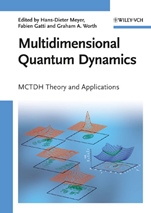
Multidimensional Quantum Dynamics: MCTDH Theory and Applications
ISBN 9783527320189
Autor: Hans–Dieter Meyer, Fabien Gatti, Graham A. Worth
Wydawca: Wiley
Dostępność: 3-6 tygodni
Cena: 1 071,00 zł
Przed złożeniem zamówienia prosimy o kontakt mailowy celem potwierdzenia ceny.
ISBN13: |
9783527320189 |
ISBN10: |
3527320180 |
Autor: |
Hans–Dieter Meyer, Fabien Gatti, Graham A. Worth |
Oprawa: |
Hardback |
Rok Wydania: |
2009-04-15 |
Ilość stron: |
442 |
Wymiary: |
248x175 |
Tematy: |
PH |
Science aims to correlate observable molecular properties with the internal workings of molecules as a means to design novel structures with specific properties. Determining atomic motion within molecules, i.e., their dynamics, is the key to this. With growing size it becomes impossible to implement the most precise and correct method, quantum mechanics. Computationally cheap classical mechanics are too crude for the finer points, which has led to the investment in improving quantum dynamical simulations for larger molecules. Better algorithms are more important than bigger computers, and MCTDH is the best to date. The first section of the book contains a comprehensive description of MCTDH and its theoretical background, and the second section a discussion of recent extensions of MCTDH, such as the treatment of identical particles, leading to the MCTDHF and MCTDHB methods for fermions and bosons. The third section presents a wide spectrum of very different applications to reflect the large diversity of problems that can be tackled by MCTDH.
The result is a handbook and ready reference for theoretical chemists, physicists, chemists, graduate students, lecturers and software producers.
Spis treści:
Preface.
List of Contributors.
List of Symbols.
Introduction (Hans–Dieter Meyer, Fabien Gatti and Graham A. Worth).
Part 1 Theory.
2 The Road to MCTDH (Hans–Dieter Meyer, Fabien Gatti and Graham A. Worth).
2.1 The Standard Method.
2.2 Time–Dependent Hartree.
3 Basic MCTDH Theory (Hans–Dieter Meyer, Fabien Gatti and Graham A. Worth).
3.1 Wavefunction Ansatz and Equations of Motion.
3.2 The Constraint Operator.
3.3 Efficiency and Memory Requirements.
3.4 Multistate Calculations.
3.5 Parametrized Basis Functions:G–MCTDH.
4 Integration Schemes (Hans–Dieter Meyer, Fabien Gatti and Graham A. Worth).
4.
1 The Variable Mean–Field (VMF) Integration Scheme.
4.2 A Simple Constant Mean–Field (CMF) Integration Scheme.
4.3 Why CMF Works.
4.4 Second–Order CMF Scheme.
5 Preparation of the Initial Wavepacket (Hans–Dieter Meyer, Fabien Gatti and Graham A. Worth).
5.1 Initial Wavepacket as Hartree Product.
5.2 Eigenstates and Operated Wavefunctions.
6 Analysis of the Propagated Wavepacket (Hans–Dieter Meyer, Fabien Gatti and Graham A. Worth).
6.1 Runtime Analysis of Accuracy.
6.2 Spectra.
6.3 Optimal Control.
6.4 State Populations.
6.5 Reaction Probabilities.
7 MCTDH for Density Operators (Hans–Dieter Meyer, Fabien Gatti and Graham A. Worth).
7.1 Wavefunctions and Density Operators.
7.2 Type I Density Operators.
7.3 Type II Density Operators.
7.4 Properties of MCTDH Density Operator Propagation.
8 Computing Eigenstates by Relaxation and Improved Relaxation (Hans–Dieter Meyer, Fabien Gatti and Graham A. Worth).
8.1 Relaxation.
8.2 Improved Relaxation.
8.3 Technical Details.
9 Iterative Diagonalzation of Operators (Fermín Huarte–Larrañaga and Uwe Manthe).
9.1 Operators Defined by Propagation.
9.2 A Modified Lanczos Scheme.
9.3 The State–Averaged MCTDH Approach.
10 Correlation Discrete Variable Represenation (Fermín Huarte–Larrañaga and Uwe Manthe).
10.1 Introduction.
10.2 Time–Dependent Discrete Variable Representation.
10.3 Correlation Discrete Variable Representation.
10.4 Symmetry–Adapted Correlation Discrete Variable Representation.
10.5 Multidimensional Correlation Discrete Variable Representation.
11 Potential Representations (potfit) (Hans–Dieter Meyer, Fabien Gatti and Graham A. Worth).
11.1 Expansion in Product Basis Sets.
11.2 Optimizing the Coefficients.
11.3 Optimizing t
he Basis.
11.4 The potfit Algorithm.
11.5 Contraction Over One Particle.
11.6 Separable Weights.
11.7 Non–Separable Weights.
11.8 Computational Effort and Memory Request.
12 Kinetic Energy Operators (Hans–Dieter Meyer, Fabien Gatti and Graham A. Worth).
12.1 Introduction.
12.2 Vector Parametrization and Properties of Angular Momenta.
12.3 General Expression of KEO in Standard Polyspherical Coordinates.
12.4 Example.
12.5 Extensions.
Part 2 Extension to New Areas.
13 Direct Dynamics With Quantum Nuclei (Benjamin Lasorne and Graham A. Worth).
13.1 Introduction.
13.2 Variational Multiconfiguration Gaussian Wavepackets.
13.3 Applications.
13.4 Conclusions.
14 Multilayer Formulation of the Multiconfiguration Time–Dependent Hartree Theory (Haobin Wang and Michael Thoss).
14.1 Introduction.
14.2 From Conventional Wavepacket Propagation to ML–MCTDH Theory: A Variational Perspective.
14.3 Concluding Remarks.
15 Shared Memory Parallelization of the Multiconfiguration Time–Dependent Hartree Method (Michael Brill and Hans–Dieter Meyer).
15.1 Motivation.
15.2 Shared Memory Parallelization of MCTDH.
15.3 Results and Conclusion.
16 Strongly Driven Few–Fermion Systems – MCTDHF (Gerald Jordan and Armin Scrinzi).
16.1 Equations of Motion for Indistinguishable Particles.
16.2 Computation of Operators.
16.3 Parallelization.
16.4 Observables and Transformations.
16.5 Applications.
17 The Multiconfigurational Time–Dependent Hartree Method for Identical Particles and Mixtures Thereof (Ofir E. Alon, Alexej I. Streltsovo and Lorenz S. Cederbaum).
17.1 Preliminary Remarks.
17.2 Bosons or Fermions? – Unifying MCTDHB and MCTDHF.
17.3 Bose–Bose, Fermi–Fermi and Bose–Fermi Mixtures.
17.4 Migher–Order Forces and Reduc
ed Density Matrices.
17.5 Illustrative Numerical Examples for Bosons: MCTDHB.
17.6 Discussion and Perspectives.
Part 3 Applications.
18 Multidimensional Non–Adiabatic Dynamics (Graham A. Worth, Horst Köppel, Etienne Gindensperger and Lorenz S. Cederbaum).
18.1 Introduction.
18.2 The Vibronic Coupling Hamiltonian.
18.3 Combining the Vibronic Coupling Model with MCTDH.
18.4 Examples.
18.5 Effective Modes.
18.6 Summary.
19 MCTDH Calculation of Flux Correlation Functions: Rates and Reaction Probabilities for Polyatomic Chemical Reactions (Fermín Huarte–Larrañaga and Uwe Manthe).
19.1 Introduction.
19.2 Flux Correlation Functions and Quantum Transition–State Concept.
19.3 Rate Constant Calculations.
19.4 Application to Polyatomic Reactions.
19.5 The Effect of Rotation–Vibration Coupling on Rater Constants.
19.6 Concluding Remarks and Outlook.
20 Reactive and Non–Reactive Scattering of Molecules From Surfaces (Geert–Jan Kroes, Rob van Harrevelt and Cédric Crespos).
20.1 Introduction.
20.2 Theory.
20.3 Applications of MCTDH Method to Molecule–Surface Scattering.
20.4 Summary and Outlook.
21 Intramolecular Vibrational Energy Redistribution and Infrared Spectroscopy (Fabien Gatti and Christophe Iung).
21.1 Introduction.
21.2 Local–Mode Excitation of CH Stretch in Fluoroform and Toluene.
21.3 Study of Highly Excited States in HFCO and DFCO.
21.4 Selective Population of Vibrational Levels in H2CS in External Field.
21.5 Cis–Trans Isomerization of HONO.
21.6 Conclusion.
22 Open System Quantum Dynamics with Discretized Environments (Mathias Nest).
22.1 Introduction.
22.2 The System–Base Ansatz.
22.3 Static and Dynamic Effects of the Bath.
22.4 Finite Temperatures.
22.5 Deriv
Koszyk
Książek w koszyku: 0 szt.
Wartość zakupów: 0,00 zł
Informacje


Kontakt
Gambit
Centrum Oprogramowania
i Szkoleń Sp. z o.o.
Al. Pokoju 29b/22-24
31-564 Kraków
Siedziba Księgarni
ul. Kordylewskiego 1
31-542 Kraków
+48 12 410 5991
+48 12 410 5987
+48 12 410 5989
Subskrypcje
Administratorem danych osobowych jest firma Gambit COiS Sp. z o.o. Na podany adres będzie wysyłany wyłącznie biuletyn informacyjny.
Autoryzacja płatności

Informacje na temat autoryzacji płatności poprzez PayU.

© Copyright 2012: GAMBIT COiS Sp. z o.o. Wszelkie prawa zastrzeżone.
Projekt i wykonanie: Alchemia Studio Reklamy