


Wydawcy
Katalog tematyczny
- Archeologia (109)
- Ekonomia, finanse, business (13704)
- Filozofia (1445)
- Historia (3040)
- Języki i językoznawstwo (2356)
- Lifestyle, hobby i rozrywka (475)
- Medycyna (9704)
- Nauki humanistyczne (4)
- Nauki o Ziemi i środowisku (2638)
- Nauki ścisłe (20412)
- Astronomia (294)
- Biologia (5119)
- Chemia (6540)
- Fizyka (3309)
- Elektryczność i magnetyzm (90)
- Fizyka atomowa i molekularna (110)
- Fizyka cząstek elementarnych (36)
- Fizyka jądra atomowego (36)
- Fizyka kwantowa (210)
- Fizyka matematyczna (121)
- Fizyka relatywistyczna (36)
- Fizyka statystyczna (51)
- Fizyka stosowana (498)
- Mechanika klasyczna (186)
- Optyka i światło (133)
- Stany materii (202)
- Matematyka (4574)
- Nauki ścisłe, ogólnie (503)
- Nauki społeczne (8486)
- Nauki techniczne (13450)
- Prawo (1696)
- Publikacje informacyjne i interdyscyplinarne (1288)
- Religia i wierzenia (917)
- Technika komputerowa (4067)
- Zdrowie, relacje międzyludzkie i rozwój osobisty (657)





Informacje szczegółowe o książce
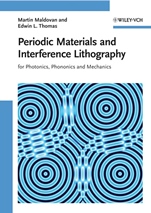
Periodic Materials and Interference Lithography: For Photonics, Phononics and Mechanics
ISBN 9783527319992
Autor: Martin Maldovan, Edwin L. Thomas
Wydawca: Wiley
Dostępność: 3-6 tygodni
Cena: 935,55 zł
Przed złożeniem zamówienia prosimy o kontakt mailowy celem potwierdzenia ceny.
ISBN13: |
9783527319992 |
ISBN10: |
3527319999 |
Autor: |
Martin Maldovan, Edwin L. Thomas |
Oprawa: |
Hardback |
Rok Wydania: |
2008-10-15 |
Ilość stron: |
331 |
Wymiary: |
251x181 |
Tematy: |
PH |
Nano and micro scale periodic materials can exhibit unique physical properties. Interference lithography is a versatile technique for fabricating these materials in a 2D and 3D. For the first time, this book presents a comprehensive study on the theoretical design, fabrication, and practical applications of periodic materials. Separated into three clearly defined parts, it sets out with a theoretical method for the design of desirable periodic structures, then presents the interference lithography technique. Subsequently, theory ad numerical data are used to demonstrate how these periodic structures control the photonic, acoustic, and mechanical properties of materials, concluding with examples of applications from these three important fields. The result is must–have knowledge for both beginners and experts in the field.
From the content:Theory: Analytical description and design of periodic structure by using Fourier series formulas.Experimental: Practical aspects of fabricating periodic structures by interference lithography.Applications: Introduction to photonic and phononic crystals, and elastic mechanical properties of materials.Appendices: Matlab programs to calculate reflectance from one–dimensional photonic and phononic crystals.
Spis treści:
Preface.
Introduction.
THEORY.
1. Structural Periodicity.
1.1 Nonperiodic versus Periodic Structures.
1.2 Two–dimensional Point Lattices.
1.3 Three–dimensional Point Lattices.
1.4 Mathematical Description of Periodic Structures.
1.5 Fourier Series.
Further Reading.
Problems.
2. Periodic Functions and Structures.
2.1 Introduction.
2.2 Creating Simple Periodic Functions in Two Dimensions.
2.3 Creating Simple Periodic Functions in Three Dimensions.
2.4 Combination of Simple Periodic Functions.
Problems.
3. Interference of Waves and interference Litho
graphy.
3.1 Electromagnetic Waves.
3.2 The Wave Equation.
3.3 Electromagnetic Plane Waves.
3.4 The Transverse Character of Electromagnetic Plane Waves.
3.5 Polarization.
3.6 Electromagnetic Energy.
3.7 Interference of Electromagnetic Plane Waves.
3.8 Interference Lithography.
Further Reading.
Problems.
4. Periodic Structures and Interference Lithography.
4.1 The Connection between the Interference of Plane Waves and Fourier Series.
4.2 Simple Periodic Structures in Two Dimensions Via Interference Lithography.
4.3 Simple Periodic Structures in Three Dimensions Via Interference Lithography.
Further Reading.
Problems.
EXPERIMENTAL.
5. Fabrication of Periodic Structures.
5.1 Introduction.
5.2 Light Beams.
5.3 Multiple Gratings and the Registration Challenge.
5.4 Beam Configuration.
5.5 Pattern Transfer: Material Platforms and Photoresists.
5.6 Practical Considerations for Interference Lithography.
5.7 Closing Remarks.
Further Reading.
APPLICATIONS.
6. Photonic Crystals.
6.1 Introduction.
6.2 One–dimensional Photonic Crystals.
6.3 Two–dimensional Photonic Crystals.
6.4 Three–dimensional Photonic Crystals.
Further Reading.
Problems.
7. Phononic Crystals.
7.1 Introduction.
7.2 Phononic Crystals.
7.3 One–dimensional Phononic Crystals.
7.4 Two–dimensional Phononic Crystals.
7.5 Three–dimensional Phononic Crystals.
Further Reading.
Problems.
8. Periodic Cellular Solids.
8.1 Introduction.
8.2 One–dimensional Hooke’s Law.
8.3 The Stress Tensor.
8.4 The Strain Tensor.
8.5 Stress–Strain Relationship: The Generalized Hooke’s Law.
8.6 The Generalized Hooke’s Law in Matrix Notation.
8.7 The Elastic Constants of Cubic Crystals.
8.8 Topological Design of Periodic Cellular Solids.
8.9 Finite Element Program t
o Calculate Linear Elastic Mechanical Properties.
8.10 Linear Elastic Mechanical Properties of Periodic Cellular Solids.
8.11 Twelve–connected Stretch–dominated Periodic Cellular Solids via Interference Lithography.
8.12 Fabrication of a Simple Cubic Cellular Solid via Interference Lithography.
8.13 Plastic Deformation of Microframes.
Further Reading.
9. Further Applications.
9.1 Controlling the Spontaneous Emission of Light.
9.2 Localization of Light: Microcavities and Waveguides.
9.3 Simultaneous Localization of Light and Sound in Photonic–Phononic Crystals: Novel Acoustic–Optical Devices.
9.4 Negative Refraction and Superlenses.
9.5 Multifunctional Periodic Structures: Maximum Transport of Heat and Electricity.
9.6 Microfluidics.
9.7 Thermoelectric Energy.
Further Reading.
Appendix A. MATLAB Program to Calculate the Optimal Electric Field Amplitude Vectors for the Interfering Light Beams.
Appendix B. MATLAB Program to Calculate Reflectance versus Frequency for One–dimensional Photonic Crystals.
Appendix C. MATLAB Program to Calculate Reflective versus Frequency for One–dimensional Phononic Crystals.
Index.
Nota biograficzna:
Martin Maldovan is currently a Post Doctoral Associate in the Department of Materials Science and Engineering at the Massachusetts Institute of Technology in Cambridge, Massachusetts, USA. He received his B.S. in Physics from the University of Buenos Aires, Argentina , and his M.S. and Ph.D. in Materials Science from the Massachusetts Institute of Technology. Dr. Martin Maldovan has authored numerous scientific publications in the fields of photonics, phononics and mechanics and obtained the 2006 Scientific Writing Award to Professionals in Acoustics from the Acoustical Society of America.
Edwin L. Thomas is currently the Department Head of Materials Science and Engineering at the Massachusetts Institute of Techn
ology in Cambridge, Massachusetts, USA. He received his B.S. in Mechanical Engineering and Engineering Science from the University of Massachusetts and his Ph.D. in Materials Science from Cornell University. Professor Thomas has authored over 300 scientific publications and has received numerous scientific awards, including the Special Creativity Award of the National Science Foundation (1996 and 1988), the High Polymer Physics Prize of the American Physical Society (1991), and the American Chemical Society Creative Polymer Chemist Award (1985).
Okładka tylna:
Nano and micro scale periodic materials can exhibit unique physical properties. Interference lithography is a versatile technique for fabricating these materials in a 2D and 3D. For the first time, this book presents a comprehensive study on the theoretical design, fabrication, and practical applications of periodic materials. Separated into three clearly defined parts, it sets out with a theoretical method for the design of desirable periodic structures, then presents the interference lithography technique. Subsequently, theory ad numerical data are used to demonstrate how these periodic structures control the photonic, acoustic, and mechanical properties of materials, concluding with examples of applications from these three important fields. The result is must–have knowledge for both beginners and experts in the field.
From the content:Theory: Analytical description and design of periodic structure by using Fourier series formulas.Experimental: Practical aspects of fabricating periodic structures by interference lithography.Applications: Introduction to photonic and phononic crystals, and elastic mechanical properties of materials.Appendices: Matlab programs to calculate reflectance from one–dimensional photonic and phononic crystals.
Koszyk
Książek w koszyku: 0 szt.
Wartość zakupów: 0,00 zł
Informacje


Kontakt
Gambit
Centrum Oprogramowania
i Szkoleń Sp. z o.o.
Al. Pokoju 29b/22-24
31-564 Kraków
Siedziba Księgarni
ul. Kordylewskiego 1
31-542 Kraków
+48 12 410 5991
+48 12 410 5987
+48 12 410 5989
Subskrypcje
Administratorem danych osobowych jest firma Gambit COiS Sp. z o.o. Na podany adres będzie wysyłany wyłącznie biuletyn informacyjny.
Autoryzacja płatności

Informacje na temat autoryzacji płatności poprzez PayU.

© Copyright 2012: GAMBIT COiS Sp. z o.o. Wszelkie prawa zastrzeżone.
Projekt i wykonanie: Alchemia Studio Reklamy