


Wydawcy
Katalog tematyczny
- Archeologia (109)
- Ekonomia, finanse, business (13704)
- Filozofia (1445)
- Historia (3040)
- Języki i językoznawstwo (2356)
- Lifestyle, hobby i rozrywka (475)
- Medycyna (9704)
- Nauki humanistyczne (4)
- Nauki o Ziemi i środowisku (2638)
- Nauki ścisłe (20412)
- Astronomia (294)
- Biologia (5119)
- Chemia (6540)
- Chemia analityczna (361)
- Chemia fizyczna (346)
- Chemia nieorganiczna (137)
- Chemia organiczna (535)
- Krystalografia (27)
- Minerologia (46)
- Fizyka (3309)
- Matematyka (4574)
- Nauki ścisłe, ogólnie (503)
- Nauki społeczne (8486)
- Nauki techniczne (13450)
- Prawo (1696)
- Publikacje informacyjne i interdyscyplinarne (1288)
- Religia i wierzenia (917)
- Technika komputerowa (4067)
- Zdrowie, relacje międzyludzkie i rozwój osobisty (657)





Informacje szczegółowe o książce
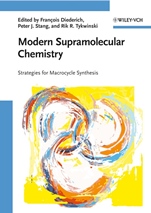
Modern Supramolecular Chemistry: Strategies for Macrocycle Synthesis
ISBN 9783527318261
Autor: François Diederich, Peter J. Stang, Rik R. Tykwinski
Wydawca: Wiley
Dostępność: 3-6 tygodni
Cena: 1 043,70 zł
Przed złożeniem zamówienia prosimy o kontakt mailowy celem potwierdzenia ceny.
ISBN13: |
9783527318261 |
ISBN10: |
3527318267 |
Autor: |
François Diederich, Peter J. Stang, Rik R. Tykwinski |
Oprawa: |
Hardback |
Rok Wydania: |
2008-02-13 |
Ilość stron: |
418 |
Wymiary: |
243x177 |
Tematy: |
PN |
Written by internationally acclaimed experts, this handy volume covers all major classes of supramolecular compounds. Chapters include cyclophanes, resorcinarene and calixarene synthesis, supramolecular metallomacrocycles and macrocycle synthesis, rotaxane and catenane synthesis, cucurbiturils and porphyrins, as well as macrocyclic drugs.
Each chapter contains experimental procedures allowing fast access to this type of synthetic chemistry.
Spis treści:
Preface.
List of Contributors.
1 Bioactive Macrocyclic Peptides and Peptide Mimics (Rob M.J. Liskamp, Dirk T.S. Rijkers, and Saskia E. Bakker).
1.1 Introduction.
1.2 Selected Cyclic Peptides.
1.3 Conclusions.
1.4 Experimental: Selected Procedures.
2 Macrocycles by Ring–closure Metathesis (Joëlle Prunet, Anderson Rouge dos Santos, and Jean–Pierre Férézou).
2.1 Introduction.
2.2 How to Cyclize?
2.3 Factors Influencing the Double–Bond Configuration.
2.4 Ene–yne M–RCM.
2.5 Tandem Processes Involving M–RCM.
2.6 Representative Synthetic Applications.
2.7 Conclusion and Perspectives.
2.8 Experimental: Selected Procedures.
3 Supramolecular Macrocycle Synthesis by H–bonding Assembly (Pablo Ballester and Javier de Mendoza).
3.1 Introduction.
3.2 Strategies to Build up Supramolecular Macrocycles Based on Hydrogen Bonds.
3.3 Strategies to Build up Supramolecular Cavities and Capsules Based on Hydrogen Bonds.
3.4 Summary and Outlook.
3.5 Experimental: Selected Procedures.
4 Cucurbit[n]urils (Wei–Hao Huang, Simin Liu, and Lyle Isaacs).
4.1 Introduction.
4.2 New Members of the Cucurbit[n]uril Family.
4.3 Applications of Members of the Cucurbit[n]uril Family.
4.4 Experimental Support for the Proposed Mechanism of CB[n] Formation.
4.5 Direct Functionalization of Cucurbit[n]urils.
4.6 Nor–Seco–Cucurbit[10]uril.
4.7 Summary
and Conclusions.
4.8 Experimental: Selected Procedures.
5 Tetra–urea Calix[4]arenes – From Dimeric Capsules to Novel Catenanes and Rotaxanes (Ganna Podoprygorina and Volker Böhmer).
5.1 Introduction.
5.2 Basics of Tetra–urea Calix[4]arenes.
5.3 Preorganization in Dimers of Tetra–urea Calix[4]arenes.
5.4 Multimacrocycles.
5.5 Multiple Catenanes Based on Calix[4]arenes.
5.6 Multiple Rotaxanes.
5.7 Self–sorting and Formation of Larger Assemblies.
5.8 Conclusions and Outlook.
5.9 Experimental: Selected Procedures.
6 Shape–Persistent Macrocycles Based on Acetylenic Scaffolding (Amber L. Sadowy and Rik R. Tykwinski).
6.1 Introduction.
6.2 Supramolecular SPMs.
6.3 Conclusions.
6.4 Experimental: Selected Procedures.
7 Supramolecular 3D Architectures by Metal–directed Assembly of Synthetic Macrocycles (Laura Pirondini and Enrico Dalcanale).
7.1 Introduction.
7.2 Coordination Cages.
7.3 Conclusion.
7.4 Experimental: Selected Procedures.
8 New Properties and Reactions in Self–assembled M6L4 Coordination Cages (Makoto Fujita and Michito Yoshizawa).
8.1 Introduction.
8.2 Self–assembly of Hollow Complexes.
8.3 Inclusion Properties.
8.4 New Physical Properties.
8.5 New Reactions.
8.6 Conclusion.
8.7 Experimental: Synthesis of M6L4 Cage 2.
9 Anion–binding Macrocycles (Evgeny A. Katayev, Patricia J. Melfi, and Jonathan L. Sessler).
9.1 Introduction.
9.2 Ditopic Receptors and Receptors for Ion Pairs.
9.3 Receptors with Different Binding Sites.
9.4 Conclusions.
9.5 Experimental: Selected Procedures.
10 Rotaxane and Catenane Synthesis (James A. Wisner and Barry A. Blight).
10.1 Introduction.
10.2 Macrocyclization Reactions Resulting in Interlocked Products.
10.3 Conclusions.
10.4 Experimental: Selected Procedures.
Index
Nota biograficzna:
François Diederich was born in 1952 in Luxembourg. He received his doctorate in 1979 from the University of Heidelberg and subsequently pursued postdoctoral studies at the University of California at Los Angeles. After gaining his lecturing qualification at the Max–Planck–Institut fizinische Forschung, he joined the Department of Chemistry and Biochemistry at UCLA in 1985, becoming full professor in 1989. In 1992, he moved to the Swiss Federal Institute of Technology (ETH), Zurich as a member of the Department of Chemistry and Applied Biosciences. Professor Diederich′s research interests, documented in more than 420 publications, span medicinal chemistry, with a focus on molecular recognition studies, to advanced fullerene and acetylene–based materials with novel optoelectronic properties. He received the Otto Hahn Medal of the Max– Planck–Society (1979), the Dreyfus Teacher–Scholar Award (1987), the ACS Arthur C. Cope Scholar Award (1992), the Otto–Bayer–Preis f?mie (1993), the Janssen Prize for Creativity in Organic Synthesis (2000) and the Havinga Medal (2000), the Humboldt Research Prize (2005), the Burkhard–Helferich Prize (2005), and the August–Wilhelm–von–Hofmann–Denkm 2006).
Peter J. Stang is a professor at the University of Utah. Beside many other prices he has received the 2003 American Chemical Society George A. Olah Award in Hydrocarbon Chemistry, the Robert W. Parry Teaching Award in Chemistry in 2000, and the American Chemical Soc. James Flack Norris Award in Physical–Organic Chemistry in 1998. Professor Stang is the author or co–author of 370 scientific publications, including six monographs and 24 reviews. He has been editor for JACS since 2002 and is member of the National Academy of Sciences and the board of directors of the AAAS.
Rik R. Tykwinski received his BSc from the University of Mi
nnesota–Duluth and his PhD from the University of Utah. After postdoctoral studies at the ETH, Zurich, he joined the faculty of the University of Alberta in 1997 where he is now an Associate Professor of Chemistry. Professor Tykwinski has published over 75 research papers.
Koszyk
Książek w koszyku: 0 szt.
Wartość zakupów: 0,00 zł
Informacje


Kontakt
Gambit
Centrum Oprogramowania
i Szkoleń Sp. z o.o.
Al. Pokoju 29b/22-24
31-564 Kraków
Siedziba Księgarni
ul. Kordylewskiego 1
31-542 Kraków
+48 12 410 5991
+48 12 410 5987
+48 12 410 5989
Subskrypcje
Administratorem danych osobowych jest firma Gambit COiS Sp. z o.o. Na podany adres będzie wysyłany wyłącznie biuletyn informacyjny.
Autoryzacja płatności

Informacje na temat autoryzacji płatności poprzez PayU.

© Copyright 2012: GAMBIT COiS Sp. z o.o. Wszelkie prawa zastrzeżone.
Projekt i wykonanie: Alchemia Studio Reklamy