


Wydawcy
Katalog tematyczny
- Archeologia (109)
- Ekonomia, finanse, business (13704)
- Filozofia (1445)
- Historia (3040)
- Języki i językoznawstwo (2356)
- Lifestyle, hobby i rozrywka (475)
- Medycyna (9704)
- Nauki humanistyczne (4)
- Nauki o Ziemi i środowisku (2638)
- Nauki ścisłe (20412)
- Astronomia (294)
- Biologia (5119)
- Chemia (6540)
- Chemia analityczna (361)
- Chemia fizyczna (346)
- Chemia nieorganiczna (137)
- Chemia organiczna (535)
- Krystalografia (27)
- Minerologia (46)
- Fizyka (3309)
- Matematyka (4574)
- Nauki ścisłe, ogólnie (503)
- Nauki społeczne (8486)
- Nauki techniczne (13450)
- Prawo (1696)
- Publikacje informacyjne i interdyscyplinarne (1288)
- Religia i wierzenia (917)
- Technika komputerowa (4067)
- Zdrowie, relacje międzyludzkie i rozwój osobisty (657)





Informacje szczegółowe o książce
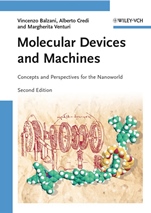
Molecular Devices and Machines: Concepts and Perspectives for the Nanoworld
ISBN 9783527318001
Autor: Vincenzo Balzani, Alberto Credi, Margherita Venturi
Wydawca: Wiley
Dostępność: 3-6 tygodni
Cena: 801,15 zł
Przed złożeniem zamówienia prosimy o kontakt mailowy celem potwierdzenia ceny.
ISBN13: |
9783527318001 |
ISBN10: |
3527318003 |
Autor: |
Vincenzo Balzani, Alberto Credi, Margherita Venturi |
Oprawa: |
Hardback |
Rok Wydania: |
2008-02-22 |
Numer Wydania: |
2nd Edition |
Ilość stron: |
588 |
Wymiary: |
243x176 |
Tematy: |
PN |
Targeted at a broad audience ranging from chemists and biochemists to physicists and engineers, Molecular Devices and Machines: Concepts and Perspectives for the Nanoworld covers advanced research while being written in an easily understandable language accessible to any interested researcher or graduate student.
Following an introduction to the general concepts, the authors go on to discuss devices for processing electrons and electronic energy, memories, logic gates and related systems, and, finally, molecular–scale machines.
Spis treści:
Preface to the Second Edition.
Glossary.
List of Abbreviations.
I General Concepts.
1 Introduction.
1.1 Devices and Machines at the Molecular Level.
1.2 Nanoscience and Nanotechnology.
1.3 Supramolecular (Multicomponent) Chemistry.
1.4 Top–Down (Large–Downward) Approach.
1.5 Bottom–Up (Small–Upward) Approach.
1.6 Bottom–up Molecule–by–Molecule Approach.
1.7 Self–Organization and Covalent Synthetic Design.
1.8 Energy and Signals.
2 Processing Energy and Signals by Molecular and Supramolecular Systems.
2.1 Introduction.
2.2 Molecular Electronics.
2.3 Molecular Photonics.
2.4 Molecular Chemionics.
2.5 Molecular Electrophotonics.
2.6 Molecular Electrochemionics.
2.7 Molecular Photoelectronics.
2.8 Molecular Photochemionics.
2.9 Molecular Chemiophotonics.
2.10 Molecular Chemioelectronics.
2.11 Multiple Input/Processes.
II Molecular Devices for Processing Electrons and Electronic Energy.
3 Fundamental Principles of Photoinduced Electron and Energy Transfer.
3.1 Molecular and Supramolecular Photochemistry.
3.2 Electron Transfer.
3.3 Energy Transfer.
3.4 Role of the Bridge.
4 Wires and Related Systems.
4.1 Introduction.
4.2 Conductivity Measurements.
4.3 Electron–Transfer Processes at Electrodes.
4.4 W
ire–Type Systems Based on Photoinduced Charge Separation.
4.5 Heterogeneous Photoinduced Electron Transfer.
4.6 Energy Transfer.
5 Switching Electron– and Energy–transfer Processes.
5.1 Introduction.
5.2 Switching of Electron–Transfer Processes.
5.3 Switching of Energy–Transfer Processes.
6 Light Harvesting Antennae.
6.1 Introduction.
6.2 Natural Antenna Systems.
6.3 Dendrimers.
6.4 Other Systems.
7 Solar Energy Conversion.
7.1 Introduction.
7.2 Natural Photosynthesis.
7.3 Artificial Photosynthesis.
7.4 Hybrid Systems.
7.5 Conversion of Light into Electricity by Photoelectrochemical Cells.
III Memories, Logic Gates, and Related Systems.
8 Bistable and Multistable Systems.
8.1 Introduction.
8.2 Energy Stimulation.
8.3 Bistable Systems.
8.4 Multistable Systems.
9 Logic Gates and Circuits.
9.1 Introduction.
9.2 Fundamental Concepts of Logic Gates.
9.3 Molecular Switches as Logic Gates.
9.4 Basic Logic Gates.
9.5 Combinational Logic Circuits.
9.6 Sequential Logic Circuits.
9.7 Neural–Type Systems.
9.8 Logic Devices Based on Biomolecules.
9.9 Heterogeneous Systems.
9.10 Applications of Molecular Logic.
9.11 Conclusions.
IV Molecular–Scale Mechanical Devices, Machines, and Motors.
10 Basic Principles.
10.1 Introduction.
10.2 Biomolecular Machines and the Brownian Motion.
10.3 Artificial Systems.
10.3.1 Terms and Definitions.
10.4 Energy Supply.
10.5 Other Features.
11 Spontaneous Mechanical–Like Motions.
11.1 Introduction.
11.2 Rotors.
11.3 Cogwheels.
11.4 Gears.
11.5 Paddle Wheels.
11.6 Turnstiles.
11.7 Brakes.
11.8 Ratchets.
11.9 Gyroscopes and Compasses.
11.10 Other Motions.
12 Movements Related to Opening, Closing, and Translocation Functions.
12.1 Introduction.
12.2 Allosteric Movements.12.3 Tweezers and Harpoons.
12.4 Controlled Assembling–Disassembling of Host–Guest Systems.
12.5 Molecular Locks.
12.6 Translocation of Metal Ions.
12.7 Ion Channels.
13 DNA–Based Nanomachines.
13.1 Introduction.
13.2 Important Features of DNA.
13.3 Simple Conformational Switches.
13.4 Walkers and Related Systems.
13.5 Rotary Devices.
13.6 Applications.
14 Linear Movements.
14.1 Introduction.
14.2 Natural Linear Motors.
14.3 Threading–Dethreading Movements.
14.4 Linear Motions in Rotaxanes.
15 Rotary Motions.
15.1 Introduction.
15.2 Natural Rotary Motors.
15.3 Hybrid Rotary Motors.
15.4 Rotary Movements in Artificial Systems.
16 From Solution to Heterogeneous Systems.
16.1 Introduction.
16.2 Rotary Motors on Surfaces.
16.3 Molecular Valves.
16.4 Molecular Muscles.
16.5 Molecular Motion Driven by STM.
16.6 Hybrid Bio–Nanodevices.
16.7 Propelling Micrometer Objects.
16.8 Changing Surface Properties.
16.9 Threaded and Interlocked Compounds on Surfaces.
16.10 Interlocked Compounds in Solid State Devices.
V Science and Society.
17 The Role of Science in Our Time.
17.1 Introduction.
17.2 Science Will Never End.
17.3 A Fragile World.
17.4 An Unsustainable Growth.
17.5 An Unequal World.
17.6 The Role of Scientists.
17.7 Conclusions.
Subject Index.
Nota biograficzna:
Vincenzo Balzani, born in 1936, received his Laurea in 1960. Since 1973 he is full professor of chemistry in Bologna, Italy. He was visiting professor at the universities in Vancouver, Canada, Jerusalem, Israel, University of Strasbourg, France, University of Leuven, Belgium, and Bordeaux, France. His research interests are molecular–level devices and machines, nanotechnology, supramolecular chemistry, photochemistry, –physics, –catalysis, electron transfer reactions, lumin
escent sensors, and solar energy conversion. He is editor of several books, member of editorial boards of prestigious journals, amoungst Chemistry – A European Journal, ChemPhysChem, Inorganic Chemistry, RSC Dalton Transacitons, Chemical Society Reviews. He received several awards, e.g. Pacific West Coast Inorganic Lectureship, USA and Canada, 1985, Gold Medal "S. Cannizzaro", Italian Chemical Society, 1988, Franqui Chair, University of Leuven, Belgium, 1991, Wenner Gren Distinguished Lectureship, Sweden, 1993, Ziegler–Natta Lecturer, Gesellschaft Deutscher Chemiker, 1994, Italgas European Prize for Research and Innovation, 1994, Centenary Lecturer, The Royal Chemical Society (U.K.), Lee Lecture, University of Chicago, 1995–96, Blacet Lecture, University of California at Los Angeles, 1998, Porter Medal for Photochemistry, 2000, Italian–French Award, Societè Française de Chimie, 2002, Upper Rhine Lectureship, France and Germany, 2002, Premio al Merito, Camera di Commercio, Industria e Agricoltura della Provincia di Forlì–Cesena, 2003.
Koszyk
Książek w koszyku: 0 szt.
Wartość zakupów: 0,00 zł
Informacje


Kontakt
Gambit
Centrum Oprogramowania
i Szkoleń Sp. z o.o.
Al. Pokoju 29b/22-24
31-564 Kraków
Siedziba Księgarni
ul. Kordylewskiego 1
31-542 Kraków
+48 12 410 5991
+48 12 410 5987
+48 12 410 5989
Subskrypcje
Administratorem danych osobowych jest firma Gambit COiS Sp. z o.o. Na podany adres będzie wysyłany wyłącznie biuletyn informacyjny.
Autoryzacja płatności

Informacje na temat autoryzacji płatności poprzez PayU.

© Copyright 2012: GAMBIT COiS Sp. z o.o. Wszelkie prawa zastrzeżone.
Projekt i wykonanie: Alchemia Studio Reklamy