


Wydawcy
Katalog tematyczny
- Archeologia (109)
- Ekonomia, finanse, business (13704)
- Filozofia (1445)
- Historia (3040)
- Języki i językoznawstwo (2356)
- Lifestyle, hobby i rozrywka (475)
- Medycyna (9704)
- Nauki humanistyczne (4)
- Nauki o Ziemi i środowisku (2638)
- Nauki ścisłe (20412)
- Astronomia (294)
- Biologia (5119)
- Chemia (6540)
- Chemia analityczna (361)
- Chemia fizyczna (346)
- Chemia nieorganiczna (137)
- Chemia organiczna (535)
- Krystalografia (27)
- Minerologia (46)
- Fizyka (3309)
- Matematyka (4574)
- Nauki ścisłe, ogólnie (503)
- Nauki społeczne (8486)
- Nauki techniczne (13450)
- Prawo (1696)
- Publikacje informacyjne i interdyscyplinarne (1288)
- Religia i wierzenia (917)
- Technika komputerowa (4067)
- Zdrowie, relacje międzyludzkie i rozwój osobisty (657)





Informacje szczegółowe o książce
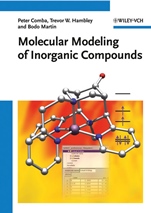
Molecular Modeling of Inorganic Compounds
ISBN 9783527317998
Autor: Peter Comba, Trevor W. Hambley, Bodo Martin
Wydawca: Wiley
Dostępność: 3-6 tygodni
Cena: 976,50 zł
Przed złożeniem zamówienia prosimy o kontakt mailowy celem potwierdzenia ceny.
ISBN13: |
9783527317998 |
ISBN10: |
3527317996 |
Autor: |
Peter Comba, Trevor W. Hambley, Bodo Martin |
Oprawa: |
Hardback |
Rok Wydania: |
2009-08-19 |
Numer Wydania: |
3rd Edition |
Ilość stron: |
344 |
Wymiary: |
248x180 |
Tematy: |
PN |
In many branches of chemistry, molecular modeling is a well–established and powerful tool for the investigation of complex structures. This book shows how the method has been and can be successfully applied to inorganic and coordination compounds.
In the first part a general introduction to molecular modeling is given which will be of use for chemists in all areas. The second part contains a discussion of many carefully selected examples, chosen to illustrate the wide range of applicability of molecular modeling to metal complexes and the approaches being taken to deal with some of the difficulties encountered. In the third part, the reader is shown how to apply molecular modeling to a new system and how to interpret the results. Using freely available software the reader can work through 20 tutorial lessons, based on examples from the literature and discussed elsewhere in the book.
The authors take special care to highlight the possible pitfalls and offer advice on how to avoid them. Therefore, this book will be invaluable to anyone working in or entering the field.
Spis treści:
Preface to the Third Edition.
Preface to the Second Edition.
Preface to the First Edition.
I Theory.
1 Introduction.
1.1 Molecular Modeling.
1.2 Historical Background.
2 Molecular Modeling Methods in Brief.
2.1 Molecular Mechanics.
2.2 Quantum Mechanics.
2.3 Other Methods.
3 Parameterization, Approximations and Limitations of Molecular Mechanics.
3.1 Concepts.
3.2 Potential Energy Functions.
3.3 Force–Field Parameters.
3.4 Spectroscopic Force Fields.
3.5 Model and Reality.
3.6 Electronic Effects.
3.7 The Environment.
3.8 Entropy Effects.
3.9 Summary.
4 Computation.
4.1 Input and Output.
4.2 Energy Minimization.
4.3 Constraints and Restraints.
5 The Multiple Minima Problem.
5.1 Deterministic Methods.
5.2 Stochastic Methods.
5.3 Molecular Dynamics.
5.4 Practical Considerations.
5.5 Making Use of Experimental Data.
6 Conclusions.
II Applications.
7 Structural Aspects.
7.1 Accuracy of Structure Prediction.
7.2 Molecular Visualization.
7.3 Isomer Analysis.
7.4 Analysis of Structural Trends.
7.5 Prediction of Complex Polymerization.
7.6 Unraveling Crystallographic Disorder.
7.7 Enhanced Structure Determination.
7.8 Comparison with Solution Properties.
8 Stereoselectivities.
8.1 Conformational Analysis.
8.2 Enantioselectivities.
8.3 Structure Evaluation.
8.4 Mechanistic Information.
9 Metal Ion Selectivity.
9.1 Chelate Ring Size.
9.2 Macrocycle Hole Size.
9.3 Preorganization.
9.4 Quantitative Correlations Between Strain and Stability Differences.
9.5 Conclusions.
10 Spectroscopy.
10.1 Vibrational Spectroscopy.
10.2 Electronic Spectroscopy.
10.3 EPR Spectroscopy.
10.4 NMR Spectroscopy.
10.5 QM–Based Methods.
11 Electron Transfer.
11.1 Redox Potentials.
11.2 Electron–Transfer Rates.
12 Electronic Effects.
12.1 d–Orbital Directionality.
12.2 The trans Influence.
12.3 Jahn–Teller Distortions.
13 Bioinorganic Chemistry.
13.1 Complexes of Amino Acids and Peptides.
13.2 Metalloproteins.
13.3 Metalloporphyrins.
13.4 Metal–Nucleotide and Metal–DNA Interactions.
13.5 Other Systems.
13.6 Conclusions.
14 Organometallics.
14.1 Metallocenes.
14.2 Transition Metal–Allyl Systems.
14.3 Transition Metal–Phosphine Compounds.
14.4 Metal–Metal Bonding.
14.5 Carbonyl Cluster Compounds.
15 Compounds with s–, p–, and f–Block Elements.
15.1 Alkali and Alkaline Earth Metals.
15.2 Main Group Elements.
15.3 Lanthanoids and Actinoids.
15.4 Conclusions.
III Practice of Molecular Mechanics.
16 Th
e Model, the Rules, and the Pitfalls.
16.1 Introduction.
16.2 The Starting Model.
16.3 The Force Field.
16.4 The Energy Minimization Procedure.
16.5 Local and Global Energy Minima.
16.6 Pitfalls, Interpretation, and Communication.
17 Tutorial.
17.1 Introduction to the Momec3 Program.
17.2 Building a Simple Metal Complex.
17.3 Optimizing the Structure.
17.4 Building a Set of Conformers.
17.5 Calculating the Strain Energies and Isomer Distribution of a Set of Conformers.
17.6 Constructing and Optimizing a Set of Isomers Automatically.
17.7 Building More Difficult Metal Complexes.
17.8 Analyzing Structures.
17.9 Potential Energy Functions I: Bond Length, Valence Angle, Torsion Angle, Twist Angle, and Out–of–Plane Deformation Functions.
17.10 Potential Energy Functions II: Non–Bonded Interactions.
17.11 Force–Field Parameters I: Developing a Force Field for Cobalt(III) Hexaamines – Normal Bond Distances.
17.12 Force–Field Parameters II: Refining the New Force Field – Very Short Bond Distances.
17.13 Force–Field Parameters III: Refining the New Force Field – Very Long Bond Distances.
17.14 Force–Field Parameters IV: Comparison of Isomer Distributions Using Various Cobalt(III) Amine Force Fields.
17.15 Force–Field Parameters V: Parameterizing a New Potential – The Tetrahedral Twist of Four–Coordinate Compounds.
17.16 Using Constraints to Compute Energy Barriers.
17.17 Using Constraints to Compute Macrocyclic Ligand Hole Sizes.
17.18 Cavity Sizes of Unsymmetrical Ligands.
17.19 Using Strain Energies to Compute Reduction Potentials of Coordination Compounds.
17.20 Using Force–Field Calculations with NMR Data.
17.21 Optimizing Structures with Rigid Groups.
Appendix 1: Glossary.
Appendix 2: Fundamental Constants, Units, and Conversion Factors.
Appendix 3: Software and Force Fields.
Appen
dix 4: Books on Molecular Modeling and Reviews on Inorganic Molecular Modeling.
References.
Index.
Nota biograficzna:
Peter Comba is Professor of Inorganic Chemistry at the University of Heidelberg, Germany. He obtained his Ph.D. in 1981 from the University of Neuchâtel, Switzerland. After postdoctoral positions at the Australian National University and the University of Lausanne and the habilitation at the University of Basel, he moved in 1992 to Heidelberg. He received the Humboldt South Africa Research Award in 2000 and had visiting professorships at the Universities of Leiden, ANU, Pretoria, Brisbane and Osaka. His research includes theory and experiments in transition metal coordination and bioinorganic chemistry – molecular modeling, spectroscopy, magnetochemistry, thermodynamics, kinetics and mechanisms, synthesis and catalysis.
Trevor Hambley is Full Professor at The University of Sydney, Australia. He received his Ph.D. in 1982 from the University of Adelaide, followed by a postdoctoral stay the Australian National University. He received the Edgeworth David Medal in 1989 and awards for Research Supervision and Teaching in 1997, 1998, and 2008. His research interests are focused on hypoxia and tumour selective agents, Pt anti–cancer drugs, matrix metalloproteinase targeting agents, and drug design and development.
Bodo Martin is a computational chemist with Peter Comba at the University of Heidelberg. He obtained his Ph.D. in organic chemistry in 2004 from the University of Erlangen, Germany in the group of Tim Clark. His research includes the application of quantum chemical methods, semi–empirical method development (polarizabilities, dispersion), molecular mechanics development and computer science.
Okładka tylna:
In many branches of chemistry, molecular modeling is a well–established and powerful tool for the investigation of complex structures. This
Koszyk
Książek w koszyku: 0 szt.
Wartość zakupów: 0,00 zł
Informacje


Kontakt
Gambit
Centrum Oprogramowania
i Szkoleń Sp. z o.o.
Al. Pokoju 29b/22-24
31-564 Kraków
Siedziba Księgarni
ul. Kordylewskiego 1
31-542 Kraków
+48 12 410 5991
+48 12 410 5987
+48 12 410 5989
Subskrypcje
Administratorem danych osobowych jest firma Gambit COiS Sp. z o.o. Na podany adres będzie wysyłany wyłącznie biuletyn informacyjny.
Autoryzacja płatności

Informacje na temat autoryzacji płatności poprzez PayU.

© Copyright 2012: GAMBIT COiS Sp. z o.o. Wszelkie prawa zastrzeżone.
Projekt i wykonanie: Alchemia Studio Reklamy