


Wydawcy
Katalog tematyczny
- Archeologia (109)
- Ekonomia, finanse, business (13704)
- Filozofia (1445)
- Historia (3040)
- Języki i językoznawstwo (2356)
- Lifestyle, hobby i rozrywka (475)
- Medycyna (9704)
- Nauki humanistyczne (4)
- Nauki o Ziemi i środowisku (2638)
- Nauki ścisłe (20412)
- Astronomia (294)
- Biologia (5119)
- Chemia (6540)
- Fizyka (3309)
- Elektryczność i magnetyzm (90)
- Fizyka atomowa i molekularna (110)
- Fizyka cząstek elementarnych (36)
- Fizyka jądra atomowego (36)
- Fizyka kwantowa (210)
- Fizyka matematyczna (121)
- Fizyka relatywistyczna (36)
- Fizyka statystyczna (51)
- Fizyka stosowana (498)
- Mechanika klasyczna (186)
- Optyka i światło (133)
- Stany materii (202)
- Matematyka (4574)
- Nauki ścisłe, ogólnie (503)
- Nauki społeczne (8486)
- Nauki techniczne (13450)
- Prawo (1696)
- Publikacje informacyjne i interdyscyplinarne (1288)
- Religia i wierzenia (917)
- Technika komputerowa (4067)
- Zdrowie, relacje międzyludzkie i rozwój osobisty (657)





Informacje szczegółowe o książce
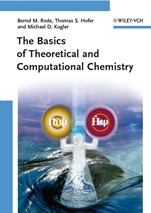
The Basics of Theoretical and Computational Chemistry
ISBN 9783527317738
Autor: Bernd Michael Rode, Thomas S. Hofer, Michael D. Kugler
Wydawca: Wiley
Dostępność: 3-6 tygodni
Cena: 455,70 zł
Przed złożeniem zamówienia prosimy o kontakt mailowy celem potwierdzenia ceny.
ISBN13: |
9783527317738 |
ISBN10: |
3527317732 |
Autor: |
Bernd Michael Rode, Thomas S. Hofer, Michael D. Kugler |
Oprawa: |
Hardback |
Rok Wydania: |
2007-01-26 |
Ilość stron: |
195 |
Wymiary: |
251x180 |
Tematy: |
PH |
This textbook does away with the classic, unimaginative approach and comes straight to the point with a bare minimum of mathematics –– emphasizing the understanding of concepts rather than presenting endless strings of formulae. It nonetheless covers all important aspects of computational chemistry, such as
vector space theory
– quantum mechanics
– approximation methods
– theoretical models
– and computational methods.
Throughout the chapters, mathematics are differentiated by necessity for understanding – fundamental formulae, and all the others. The former are explained step by step without omission, while the latter are given in the appendix for those readers who wish to delve into more complex mathematics.
The reader will find the text a lucid and innovative introduction to theoretical and computational chemistry, with food for thought given at the end of each chapter in the shape of several questions that help develop understanding of the concepts.
What the reader will not find in this book are condescending sentences such as, ′From (formula A) and (formula M) it is obvious that (formula Z)...′
Bernd M. Rode is professor of theoretical and inorganic chemistry at the University of Innsbruck, Austria. He has taught theoretical chemistry at numerous universities in Asia, where he has also built up new computational chemistry institutions. He has authored nearly 400 scientific publications and obtained numerous honours and awards, among them three honorary doctoral degrees. His present research is focused on theory of liquids and solutions, but he also maintains an experimental group studying chemical evolution towards the origin of life.
Thomas S. Hofer has graduated from a college of technology and obtained his PhD degree in chemistry at the University of Innsbruck in 2006. Since 2005, he has been working as assistant professor in theoretical chemistry at the University of Innsbruck. He has published 16 scientific articles, including two review articles. He has been awarded the Austrian nation–wide prize for outstanding studies.
Michael Kugler obtained his secondary education in Tyrol and Upper Austria and is at present a graduate student of physics and chemistry at the University of Innsbruck.
INTRODUCTION
Theory and Models –
Interpretation of Experimental Data
Notations
Vector Space and Function Space
Dual Space and Hilbert Space
The Probability Function
Operators
BASIC CONCEPTS OF VECTOR SPACE THEORY OF MATTER
The Wave Equation as Probability Function
Postulates of Quantum Mechanics
The Schrödinger Equation
Hermicity
Exact Measurability and Eigenvalue Problems
Eigenvalue Problems of Hermitian Operator
The Eigenvalue Equation of the Hamiltonian
Eigenvalue Spectrum
CONCEQUENCES OF QUANTUM MECHANICS
Geometrical Interpretation of Eigenvalue Equations in Vector Space
Commutators and Uncertainty Relations
Virtual Particles and Forces in Nature
CHEMISTRY AND QUANTUM MECHANICS
Eigenvalue Problem of Angular Momentum and ′Orbital′ Concept
Molecular Orbital and Valence Bond Models
Spin –
Antisymmetry Principle
Virial Theorem
Chemical Bond
APPROXIMATION FOR MANY–ELECTRON SYSTEMS
Non–relativistic Stationary Systems
Adiabatic /
Born–Oppenheimer Approximation
Independent Particle Approximation
Spin Orbitals and Slater Determinants
Atomic and Molecular Orbitals: The LCAO–MO Approach
Quantitative Molecular Orbital Calculations
Canonical and Localised Orbitals and Chemical Model Concepts
PERTURBATION THEORY IN QUANTUM CHEMISTRY
Projections and Projectors
Principles of Perturbation Theory
Rayleigh–Schrödinger Perturbation Theory
Application Examples
GROUP THEORY IN THEORETICAL CHEMISTRY
Definition of a Group
Symmetry Groups
Application Examples in Quantum Chemistry
Applications in Spectroscopy
METHODS IN COMPUTATIONAL QUANTUM CHEMISTRY
ab initio Methods
Semiempirical MO Methods
Density Functional Methods
FORCE FIELD METHODS AND MOLECULAR MODELLING
Empirical Force Fields
Molecular Modelling Programs
Docking
QSAR –
Quantitative Activity –
Structure Relationships
STATISTICAL SIMULATIONS: MONTE CARLO AND MOLECULAR DYNAMICS METHODS
Common Features
Monte Carlo Simulations
Molecular Dynamics Simulations
Evaluation and Visualisation of Simulation Results
Quantum Mechanical Simulations
Bernd Michael Rode is professor of theoretical and inorganic chemistry at the University of Innsbruck, Austria. He has taught theoretical chemistry at numerous universities in Asia, where he has also built up new computational chemistry institutions. He has authored nearly 400 scientific publications and obtained numerous honours and awards, among them three honorary doctoral degrees. His present research is focused on theory of liquids and solutions, but he also maintains an experimental group studying chemical evolution towards the origin of life.
Thomas S. Hofer has graduated from a college of technology and obtained his M.Sc. degree in chemistry at the University of Innsbruck. Since 2005, he has been working as assistant professor in theoretical chemistry at the University of Innsbruck and will obtain his Ph.D. degree in this field in 2006. He has published 16 scientific articles, including two review articles. He has been awarded the Austrian nation–wide prize for outstanding studies.
Michael Kugler obtained his secondary education in Tyrol and Upper Austria and is at present a graduate student of physics and chemistry at the University of Innsbruck.
Koszyk
Książek w koszyku: 0 szt.
Wartość zakupów: 0,00 zł
Informacje


Kontakt
Gambit
Centrum Oprogramowania
i Szkoleń Sp. z o.o.
Al. Pokoju 29b/22-24
31-564 Kraków
Siedziba Księgarni
ul. Kordylewskiego 1
31-542 Kraków
+48 12 410 5991
+48 12 410 5987
+48 12 410 5989
Subskrypcje
Administratorem danych osobowych jest firma Gambit COiS Sp. z o.o. Na podany adres będzie wysyłany wyłącznie biuletyn informacyjny.
Autoryzacja płatności

Informacje na temat autoryzacji płatności poprzez PayU.

© Copyright 2012: GAMBIT COiS Sp. z o.o. Wszelkie prawa zastrzeżone.
Projekt i wykonanie: Alchemia Studio Reklamy