


Wydawcy
Katalog tematyczny
- Archeologia (109)
- Ekonomia, finanse, business (13704)
- Filozofia (1445)
- Historia (3040)
- Języki i językoznawstwo (2356)
- Lifestyle, hobby i rozrywka (475)
- Medycyna (9704)
- Nauki humanistyczne (4)
- Nauki o Ziemi i środowisku (2638)
- Nauki ścisłe (20412)
- Astronomia (294)
- Biologia (5119)
- Chemia (6540)
- Chemia analityczna (361)
- Chemia fizyczna (346)
- Chemia nieorganiczna (137)
- Chemia organiczna (535)
- Krystalografia (27)
- Minerologia (46)
- Fizyka (3309)
- Matematyka (4574)
- Nauki ścisłe, ogólnie (503)
- Nauki społeczne (8486)
- Nauki techniczne (13450)
- Prawo (1696)
- Publikacje informacyjne i interdyscyplinarne (1288)
- Religia i wierzenia (917)
- Technika komputerowa (4067)
- Zdrowie, relacje międzyludzkie i rozwój osobisty (657)





Informacje szczegółowe o książce
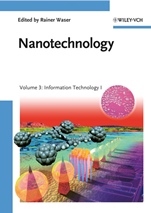
Nanotechnology: Volume 3: Information Technology I
ISBN 9783527317387
Autor: Rainer Waser
Wydawca: Wiley
Dostępność: 3-6 tygodni
Cena: 976,50 zł
Przed złożeniem zamówienia prosimy o kontakt mailowy celem potwierdzenia ceny.
ISBN13: |
9783527317387 |
ISBN10: |
3527317384 |
Autor: |
Rainer Waser |
Oprawa: |
Hardback |
Rok Wydania: |
2008-05-14 |
Ilość stron: |
563 |
Wymiary: |
249x182 |
Tematy: |
PN |
Research on the nanoscale has led to the development of completely novel materials that will undoubtedly find numerous applications. With eight volumes plus an index, the Nanotechnology series collates the entire academic knowledge on this multidisciplinary topic, linking current and future uses in engineering, electronics, medical and life sciences, chemistry, materials science and analysis.
Volume I: Principles and Fundamentals (Editor: Gunter Schmid)
Volume 2: Environmental Aspects (Editor: Harald Krug)
Volume 3: Information Technology I (Editor: Rainer Waser)
Volume 4: Information Technology II (Editor: Rainer Waser)
Volume 5: Nanomedicine and Nanobiotechnology (Editor: Viola Vogel)
Volume 6: Nanoprobes (Editor: Harald Fuchs)
Volume 7: Light and Energy (Editors: Michael Gratzel and Kuppuswamy Kalyanasundaram)
Volume 8: Nanostructured Surfaces (Editor: Lifeng Chi)
Volume 9: Index
This third volume within the series covers the concepts of potential future advances of the semiconductor technology right up to their physical limits, as well as alternative concepts which may one day augment the semiconductor technology, or even replace it in designated areas.
Spis treści:
Preface.
List of Contributors.
I Basic Principles and Theory.
1 Phase–Coherent Transport (Thomas Schäpers).
1.1 Introduction.
1.2 Characteristic Length Scales.
1.3 Ballistic Transport.
1.4 Weak Localization.
1.5 Spin–Effects: Weak Antilocalization.
1.6 Al.tshuler–Aronov–Spivak Oscillations.
1.7 The Aharonov–Bohm Effect.
1.8 Universal Conductance Fluctuations.
1.9 Concluding Remarks.
References.
2 Charge Transport and Single–Electron Effects in Nanoscale Systems (Joseph M. Thijssen and Herre S.J. van der Zant).
2.1 Introduction: Three–Terminal Devices and Quantization.
2.2 Description of Transport.
2.3 Resonant Transport.<
br>2.4 Constant Interaction Model.
2.5 Charge Transport Measurements as a Spectroscopic Tool.
2.6 Second–Order Processes.
References.
3 Spin Injection–Extraction Processes in Metallic and Semiconductor Heterostructures (Alexander M. Bratkovsky).
3.1 Introduction.
3.2 Main Spintronic Effects and Devices.
3.3 Spin–Orbital Coupling and Electron Interference Semiconductor Devices.
3.4 Tunnel Magnetoresistance.
3.5 Spin Injection/Extraction into (from) Semiconductors.
3.6 Conclusions.
References.
4 Physics of Computational Elements (Victor V. Zhirnov and Ralph K. Cavin).
4.1 The Binary Switch as a Basic Information–Processing Element.
4.2 Binary State Variables.
4.3 Energy Barriers in Binary Switches.
4.4 Energy Barrier Framework for the Operating Limits of Binary Switches.
4.5 Physics of Energy Barriers.
4.6 Conclusions.
References.
II Nanofabrication Methods.
5 Charged–Particle Lithography (Lothar Berger, Johannes Kretz, Dirk Beyer, and Anatol Schwersenz).
5.1 Survey.
5.2 Electron Beam Lithography.
5.2.1 Introduction.
5.3 Ion Beam Lithography.
5.4 Conclusions.
References.
6 Extreme Ultraviolet Lithography (Klaus Bergmann, Larissa Juschkin, and Reinhart Poprawe).
6.1 Introduction.
6.2 The Components of EUV Lithography.
6.3 Outlook.
References.
7 Non–Optical Lithography (Clivia M. Sotomayor Torres and Jouni Ahopelto).
7.1 Introduction.
7.2 Nanoimprint Lithography.
7.2.1 The Nanoimprint Process.
7.3 Discussion.
7.4 Conclusions.
References.
8 Nanomanipulation with the Atomic Force Microscope (Ari Requicha).
8.1 Introduction.
8.2 Principles of Operation of the AFM.
8.3 Nanomanipulation: Principles and Approaches.
8.4 Manipulation Systems.
8.5 Conclusion and Outlook.
References.
9 Harnessing Molecul
ar Biology to the Self–Assembly of Molecular–Scale Electronics (Uri Sivan).
9.1 Introduction.
9.2 DNA–Templated Electronics.
9.3 Recognition of Electronic Surfaces by Antibodies.
9.4 Molecular Shift–Registers and their Use as Autonomous DNA Synthesizers [11].
9.5 Future Perspectives.
References.
10 Formation of Nanostructures by Self–Assembly (Melanie Homberger, Silvia Karthäuser, Ulrich Simon, and Bert Voigtländer).
10.1 Introduction.
10.2 Self–Assembly by Epitaxial Growth.
10.3 Molecular Self–Assembly.
10.4 Preparation and Self–Assembly of Metal Nanoparticles.
10.5 Conclusions.
References.
III High–Density Memories.
11 Flash–Type Memories (Thomas Mikolajick).
11.1 Introduction.
11.2 Basics of Flash Memories.
11.3 Floating–Gate Flash Concepts.
11.4 Charge–Trapping Flash.
11.5 Nanocrystal Flash Memories.
11.6 Summary and Outlook.
References.
12 Dynamic Random Access Memory (Fumio Horiguchi).
12.1 DRAM Basic Operation.
12.2 Advanced DRAM Technology Requirements.
12.3 Capacitor Technologies.
12.4 Array Transistor Technologies.
12.5 Capacitorless DRAM (Floating Body Cell).
12.6 Summary.
References.
13 Ferroelectric Random Access Memory (Soon Oh Park, Byoung Jae Bae, Dong Chul Yoo, and U–In Chung).
13.1 An Introduction to FRAM.
13.2 Ferroelectric Capacitors.
13.3 Cell Structures.
13.4 High–Density FRAM.
13.5 Summary and Conclusions.
References.
14 Magnetoresistive Random Access Memory (Michael C. Gaidis).
14.1 Magnetoresistive Random Access Memory (MRAM).
14.2 Basic MRAM.
14.3 MTJ MRAM.
14.4 MRAM Cell Structure and Circuit Design.
14.5 MRAM Reliability.
14.6 The Future of MRAM.
References.
15 Phase–Change Memories (Andrea L. Lacaita and Dirk J. Wout
ers).
15.1 Introduction.
15.2 Basic Operation of the Phase–Change Memory Cell.
15.3 Phase–Change Memory Materials.
15.4 Physics and Modeling of PCM.
15.5 PCM Integration and Cell Structures.
15.6 Reliability.
15.7 Scaling of Phase–Change Memories.
15.8 Conclusions.
References.
16 Memory Devices Based on Mass Transport in Solid Electrolytes (Michael N. Kozicki and Maria Mitkova).
16.1 Introduction.
16.2 Solid Electrolytes.
16.3 Electrochemistry and Mass Transport.
16.4 Memory Devices.
16.5 Conclusions.
References.
Index.
Nota biograficzna:
Rainer Waser, professor at the Faculty for Electrical Engineering and Information Technology of the RWTH Aachen University and Director at the Institute of Solid State research in Julich. In his research on fundamental aspects of electronic materials and integrated devices he maintains strong collaborations with major semiconductor industries worldwide. He has published about 250 technical papers and holds ten patents. He has edited the book Nanoelectronics and information Technology, Wiley–VCH, and is member of the ITRS working group on Emerging Research Devices. Since 2002, he has been the coordinator of the research program "Nanoelectronic Systems" within the Helmholtz Association.; In 2007, he has co–founded the section "Fundamentals of Future Information Technology" of the Julich–Aachen Research Alliance (JARA).
Okładka tylna:
Research on the nanoscale has led to the development of completely novel materials that will undoubtedly find numerous applications. With eight volumes plus an index, the Nanotechnology series collates the entire academic knowledge on this multidisciplinary topic, linking current and future uses in engineering, electronics, medical and life sciences, chemistry, materials science and analysis.
Volume I: Principles and Fundamentals (Editor: Gunter Schmid)
V
olume 2: Environmental Aspects (Editor: Harald Krug)
Volume 3: Information Technology I (Editor: Rainer Waser)
Volume 4: Information Technology II (Editor: Rainer Waser)
Volume 5: Nanomedicine and Nanobiotechnology (Editor: Viola Vogel)
Volume 6: Nanoprobes (Editor: Harald Fuchs)
Volume 7: Light and Energy (Editors: Michael Gratzel and Kuppuswamy Kalyanasundaram)
Volume 8: Nanostructured Surfaces (Editor: Lifeng Chi)
Volume 9: Index
This third volume within the series covers the concepts of potential future advances of the semiconductor technology right up to their physical limits, as well as alternative concepts which may one day augment the semiconductor technology, or even replace it in designated areas.
Koszyk
Książek w koszyku: 0 szt.
Wartość zakupów: 0,00 zł
Informacje


Kontakt
Gambit
Centrum Oprogramowania
i Szkoleń Sp. z o.o.
Al. Pokoju 29b/22-24
31-564 Kraków
Siedziba Księgarni
ul. Kordylewskiego 1
31-542 Kraków
+48 12 410 5991
+48 12 410 5987
+48 12 410 5989
Subskrypcje
Administratorem danych osobowych jest firma Gambit COiS Sp. z o.o. Na podany adres będzie wysyłany wyłącznie biuletyn informacyjny.
Autoryzacja płatności

Informacje na temat autoryzacji płatności poprzez PayU.

© Copyright 2012: GAMBIT COiS Sp. z o.o. Wszelkie prawa zastrzeżone.
Projekt i wykonanie: Alchemia Studio Reklamy