


Wydawcy
Katalog tematyczny
- Archeologia (109)
- Ekonomia, finanse, business (13704)
- Filozofia (1445)
- Historia (3040)
- Języki i językoznawstwo (2356)
- Lifestyle, hobby i rozrywka (475)
- Medycyna (9704)
- Nauki humanistyczne (4)
- Nauki o Ziemi i środowisku (2638)
- Nauki ścisłe (20412)
- Nauki społeczne (8486)
- Nauki techniczne (13450)
- Prawo (1696)
- Publikacje informacyjne i interdyscyplinarne (1288)
- Religia i wierzenia (917)
- Technika komputerowa (4067)
- Zdrowie, relacje międzyludzkie i rozwój osobisty (657)





Informacje szczegółowe o książce
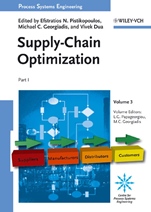
Supply–Chain Optimization, Part I
ISBN 9783527316939
Autor: Lazaros Papageorgiou, Michael C. Georgiadis, Efstratios N. Pistikopoulos, Vivek Dua
Wydawca: Wiley
Dostępność: 3-6 tygodni
Cena: 1 071,00 zł
Przed złożeniem zamówienia prosimy o kontakt mailowy celem potwierdzenia ceny.
ISBN13: |
9783527316939 |
ISBN10: |
3527316930 |
Autor: |
Lazaros Papageorgiou, Michael C. Georgiadis, Efstratios N. Pistikopoulos, Vivek Dua |
Oprawa: |
Hardback |
Rok Wydania: |
2007-10-17 |
Ilość stron: |
367 |
Wymiary: |
249x180 |
Tematy: |
KM |
This volume and the following Volume 4 present an in depth account of recent novel methodologies and algorithmic developments for the simulation, modeling and optimization of integrated supply chains. Emphasis is placed on strategic and tactical Supply Chain planning for the process industries.
Management of supply chains is a complex task mainly due to the large size of the physical supply network and inherent uncertainties. Depending on the level, one or more of the following decisions are taken:Number, size and location of manufacturing sites, warehouses and distribution centresNetwork connectivity Production decisionsManagement of inventory levels and replenishment policies Transportation decisions Sustainability aspects
The book contains high–quality works from leading researchers in the field whose expertise fits within this scope. It is intended for academics, researchers, industry practitioners in supply chain management, who are involved in model–based supply chain activities, across engineering and applied science disciplines, as well as for educational purposes both in academia and industry.
The Process Systems Engineering (PSE) Series offers an integrated and interdisciplinary approach towards the development of methodologies and tools for modelling, design, control and optimisation of enterprise–wide, process, manufacturing, energy and other such complex systems. A key theme is the systematic management of complexity in systems involving uncertainty across different time and length scales. To address this formidable challenge, the multi–disciplinary expertise of mechanical, control, chemical, molecular and biological engineers, operations researchers, mathematical programming specialists, and computer scientists is required.
Spis treści:
Preface – Volume 3: Supply Chain Optimization.
List of Authors.
1. Bridging the Gap Between Prod
uction, Finances, and Risk in Supply Chain Optimization (L. Puigjaner and G. Guillén–Gosálbez).
1.1 Introduction.
1.2 Merging Process Operations and Finances: A Literature Review.
1.3 Integrated Models for Tactical and Strategic Decisions in SCM.
1.4 SCM Under Uncertainty.
1.5 Conclusions.
2. Multiagent Framework for Modeling and Design of Supply Chain Networks (L. Puigjaner, G. Guillen–Gosalbez and F. D. Mele).
2.1 Introduction.
2.2 A Discrete Event Simulator for SCM.
2.3 A Multiagent System for SCM.
2.4 Novel Business Aspects in SCM.
2.5 Multiagent System: Integrated Framework.
2.6 Case Study.
2.7 Concluding Remarks and Future Work.
3. Environmentally Conscious Supply Chain Management (M. Türkay).
3.1 Introduction.
3.2 Closed–Loop Supply Chains.
3.3 Environmentally Conscious Production.
3.4 Sustainable Transportation.
3.5 Conclusions.
4. Optimal Deign and Operational Planning of Responsive Process Supply Chains (F. You and I . E. Grossmann).
4.1 Introduction.
4.2 Literature Review.
4.3 Motivating Example.
4.4 Problem Statement.
4.5 Model.
4.6 Numerical Example.
4.7 Conclusions.
5. Reverse Production Systems – Optimization Modeling to Support Supply Chains for Product Recovery (T. Assavapokee, M. J. Realff and J. C. Ammons).
5.1 Introduction.
5.2 Literature Review of Reverse Product System Modeling.
5.3 Carpet and Carpet Recycling.
5.4 Model Description.
5.5 Case Study Data and Scenarios.
5.6 Results and Discussion.
5.7 Conclusions.
6. Optimal Deign of Supply Chain Networks using Mathematical Programming (P. Tsiakis, L. G. Papageorgiou and M. C. Georgiadis).
6.1 Introduction.
6.2 Optimal Design of Production and Distribution Network.
6.3 Distribution Center Location Case Study.
6.4 Optimal Production Allocation and Distribution Supply Chain Networks.
6.5 Conclus
ions.
7. Design and Planning of Closed–Loop Supply Chains (A. P. Barbosa–Póvoa, M. I. Gomes Salema and A. Q. Novais).
7.1 Introduction.
7.2 Reverse Logistics.
7.3 Literature Review.
7.4 Closed–Loop Supply Chain Models.
7.5 Conclusions.
8. Combining Strategic Design and Operative Planning in the Process Industry (J. Kallrath).
8.1 Introduction.
8.2 Combined Strategic and Operative Planning.
8.3 Combined Strategic and Operative Planning – Commercial Software versus Individual Models.
8.4 Summary.
9. Chemical Supply Chain Redesign (P. K. Narahariseti, I. A. Karimi and R. Srinivasan).
9.1 Introduction.
9.2 Chemical Supply Chains.
9.3 Capacity Management.
9.4 Supply–Chain Redesign.
9.5 Problem Description.
9.6 Problem Formulation.
9.7 Example.
9.8 Conclusion.
10. A Hybrid Tabu–Branch and Bound Approach for the Solution of Large–Scale Supply Chain Management Models (J. M. Natali, P. Chen and J. M. Pinto).
10.1 Introduction.
10.2 Problem Statement.
10.3 Hybrid Tabu Search Procedure.
10.4 Results and Discussion.
10.5 Conclusions.
11. Enhancement of Oil and Gas Production via Network Optimization (N. Thijssen, K. –J. Li and I. Mittendorff).
11.1 Introduction.
11.2 Integrated Network Analysis.
11.3 High–Level Network Model.
11.4 Workflow.
11.5 Results.
11.6 Conclusions.
Index.
Nota biograficzna:
Lazaros G. Papageorgiou is a reader in the Department of Chemical Engineering at University College London (UCL). He received his Diploma in Chemical Engineering from the National technical University of Athens and a PhD in Chemical Engineering from Imperial College. Before joining UCL, he was adjunct Assistant Professor in the Department of Production Engineering and management at the technical University of Crete, and Research Associate at the centre for Process
Systems Engineering (CPSE). He is author of over 90 publications in international journals and refereed conference proceedings.
Michael C. Georgiadis is a senior researcher in the centre for Process Systems Engineering at Imperial College London and the manger of academic business development of Process Systems Enterprise (PSE) Limited in Thessaloniki, Greece. He holds a first degree in University of Thessaloniki and a MSc and PhD from Imperial college. He has authored / co–authored over 40 journal publications and two books and has a long experience in the management and participation of more than 20 collaborative research contracts and projects.
Okładka tylna:
This volume and the following Volume 4 present an in depth account of recent novel methodologies and algorithmic developments for the simulation, modeling and optimization of integrated supply chains. Emphasis is placed on strategic and tactical Supply Chain planning for the process industries.
Management of supply chains is a complex task mainly due to the large size of the physical supply network and inherent uncertainties. Depending on the level, one or more of the following decisions are taken:Number, size and location of manufacturing sites, warehouses and distribution centresNetwork connectivity Production decisionsManagement of inventory levels and replenishment policies Transportation decisions Sustainability aspects
The book contains high–quality works from leading researchers in the field whose expertise fits within this scope. It is intended for academics, researchers, industry practitioners in supply chain management, who are involved in model–based supply chain activities, across engineering and applied science disciplines, as well as for educational purposes both in academia and industry.
The Process Systems Engineering (PSE) Series offers an integrated and interdisciplinary approach towards
the development of methodologies and tools for modelling, design, control and optimisation of enterprise–wide, process, manufacturing, energy and other such complex systems. A key theme is the systematic management of complexity in systems involving uncertainty across different time and length scales. To address this formidable challenge, the multi–disciplinary expertise of mechanical, control, chemical, molecular and biological engineers, operations researchers, mathematical programming specialists, and computer scientists is required.
Koszyk
Książek w koszyku: 0 szt.
Wartość zakupów: 0,00 zł
Informacje


Kontakt
Gambit
Centrum Oprogramowania
i Szkoleń Sp. z o.o.
Al. Pokoju 29b/22-24
31-564 Kraków
Siedziba Księgarni
ul. Kordylewskiego 1
31-542 Kraków
+48 12 410 5991
+48 12 410 5987
+48 12 410 5989
Subskrypcje
Administratorem danych osobowych jest firma Gambit COiS Sp. z o.o. Na podany adres będzie wysyłany wyłącznie biuletyn informacyjny.
Autoryzacja płatności

Informacje na temat autoryzacji płatności poprzez PayU.

© Copyright 2012: GAMBIT COiS Sp. z o.o. Wszelkie prawa zastrzeżone.
Projekt i wykonanie: Alchemia Studio Reklamy