


Wydawcy
Katalog tematyczny
- Archeologia (109)
- Ekonomia, finanse, business (13704)
- Filozofia (1445)
- Historia (3040)
- Języki i językoznawstwo (2356)
- Lifestyle, hobby i rozrywka (475)
- Medycyna (9704)
- Nauki humanistyczne (4)
- Nauki o Ziemi i środowisku (2638)
- Nauki ścisłe (20412)
- Nauki społeczne (8486)
- Nauki techniczne (13450)
- Prawo (1696)
- Publikacje informacyjne i interdyscyplinarne (1288)
- Religia i wierzenia (917)
- Technika komputerowa (4067)
- Zdrowie, relacje międzyludzkie i rozwój osobisty (657)





Informacje szczegółowe o książce
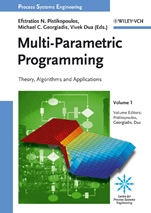
Multi–Parametric Programming: Theory, Algorithms and Applications
ISBN 9783527316915
Autor: Efstratios N. Pistikopoulos, Michael C. Georgiadis, Vivek Dua
Wydawca: Wiley
Dostępność: 3-6 tygodni
Cena: 1 043,70 zł
Przed złożeniem zamówienia prosimy o kontakt mailowy celem potwierdzenia ceny.
ISBN13: |
9783527316915 |
ISBN10: |
3527316914 |
Autor: |
Efstratios N. Pistikopoulos, Michael C. Georgiadis, Vivek Dua |
Oprawa: |
Hardback |
Rok Wydania: |
2007-02-09 |
Ilość stron: |
324 |
Wymiary: |
244x174 |
Tematy: |
KM |
This volume presents an in depth account of recent novel theoretical and algorithmic developments for different types of multi–parametric programming problems, as well as describes a number of versatile engineering applications in areas, such as design and optimization under uncertainty, energy and environmental analysis, multi–criteria optimization and model based control (which is the subject of volume 2 of this series).
Multi–parametric programming provides optimization based tools to systematically analyse the effect of uncertainty and variability in mathematical programming problems, which involved a linear, nonlinear or mixed continuous and integer mathematical model, an objective function, a set of contraints, and in which a number of parameters in the model vary between lower and upper bounds. The aimis to obtain explicit analytical, exact or approximate, expressions of the objective function and the optimization variables as a function of these parameters, and the regions in the space of the parameters where these expressions are valid.
The book is intended for academics, researchers, optimization and control practitioners, who are involved in model based activities in the presence of uncertainty, across engineering and applied science disciplines, as well as for educational purposes both in academia and industry.
The Process Systems Engineering (PSE) Series offers an integrated and interdisciplinary approach towards the development of methodologies and tools for modeling, design, control and optimization of enterprise–wide, process, manufacturing, energy and other such complex systems. A key theme is the systematic management of complexity in systems involving uncertainty across different time and length scales. To address this formidable challenge, the multi–disciplinary expertise of mechanical, control, chemical, molecular and biological engineers, operations researchers, mathematical programming specialists and co
mputer scientists is required.
Spis treści:
Preface—Volume 1: Multiparametric Programming.
List of Authors.
Related Titles.
Part I Theory and Algorithms.
1 Multiparametric Linear and Quadratic Programming.
1.1 Introduction.
1.2 Methodology.
1.3 Numerical Examples.
1.3.1 Example 1: Crude Oil Refinery.
1.3.2 Example 2: Milk Surplus.
1.3.3 Example 3: Model–Based Predictive Control.
1.4 Computational Complexity.
1.5 Concluding Remarks.
Acknowledgments.
Appendix A. Redundancy Check for a Set of Linear Constraints.
Appendix B. Definition of Rest of the Region.
Literature.
2 Multiparametric Nonlinear Programming.
2.1 Introduction.
2.1.1 Motivating Example.
2.2 The mp–NLP Algorithm.
2.3 Example.
2.4 Global Optimization Issues.
2.4.1 Remarks and Observations on the Application of the mp–NLP Algorithm for Problem (2.8).
2.4.2 Algorithm for Multiparametric Nonlinear Programming.
2.4.3 Example (2.8) Solved with the New Algorithm.
2.4.4 Extension to Higher Order Spaces and Higher Order Objective Functions.
2.5 Concluding Remarks.
Appendix A. Infeasibility of Corners.
Appendix B. Comparison Procedure.
Appendix C. Definition of the Rest of the Region.
Appendix D. Redundancy Test.
Appendix E. Vertices of a Critical Region.
Acknowledgments.
Literature.
3 Multiparametric Mixed–Integer Linear Programming.
3.1 Parametric Mixed–Integer Linear Programming.
3.2 Multiparametric Mixed–Integer Linear Programming. Branch and Bound Approach.
3.3 Multiparametric Mixed–Integer Linear Programming. Parametric and Integer Cuts.
3.3.1 Initialization.
3.3.2 Multiparametric LP Subproblem.
3.3.3 MILP Subproblem.
3.3.4 Comparison of Parametric Solutions.
3.3.5 Multiparametric MILP Algorithm.
3.4 Numerical Example.
3.5 Concluding Remarks.
Appendix A.
Definition of an Infeasible Region.
Literature.
4 Multiparametric Mixed–Integer Quadratic and Nonlinear Programming.
4.1 Introduction.
4.2 Methodology.
4.3 The mp–MIQP Algorithm.
4.3.1 Initialization.
4.3.2 Primal Subproblem.
4.3.3 Master Subproblem.
4.3.4 Strategy for the Solution of the Master Subproblem.
4.3.5 Envelope of Solutions.
4.3.6 Redundant Profiles.
4.4 The mp–MINLP Algorithm.
4.4.1 Initialization.
4.4.2 Primal Subproblem.
4.4.3 Master Subproblem 82
4.4.4 Remarks and Summary of the Algorithm.
4.5 Examples.
4.5.1 Example on mp–MIQP.
4.5.2 Example on mp–MINLP.
4.6 Concluding Remarks.
Acknowledgment.
Literature.
5 Parametric Global Optimization.
5.1 Introduction.
5.2 Parametric Global Optimization.
5.2.1 B&B Algorithm.
5.2.2 Multiparametric Convex Nonlinear Programs.
5.3 Multiparametric Nonconvex Nonlinear Programming.
5.3.1 Motivating Examples.
5.3.2 An Algorithm for Multiparametric Nonconvex Nonlinear Programming.
5.4 Multiparametric Mixed–Integer Nonconvex Programming.
5.5 Numerical Examples.
5.5.1 Example 1.
5.5.2 Example 2.
5.6 Concluding Remarks.
Acknowledgments.
Appendix A. Comparison of Parametric Solutions.
Appendix B. Definition of Rest of the Region.
Literature.
6 Bilevel and Multilevel Programming.
6.1 Introduction.
6.1.1 Global Optimum of a Bilevel Programming Problem.
6.2 Quadratic Bilevel Programming.
6.2.1 LP|LP Bilevel Programming Problem.
6.2.2 LP|QP Bilevel Programming Problem.
6.2.3 QP|QP Bilevel Programming Problem.
6.3 Bilevel Programming with Uncertainty.
6.4 Mixed–Integer Bilevel Programming.
6.5 Other Multilevel Optimization Problems.
6.5.1 Three–Level Programming Problem.
6.5.2 Bilevel Multifollower Programming Problem.
6.6 Concluding Remarks.
Acknowledgments.
Appendix A.
Literature.
7 Dynamic Programming.
7.1 Introduction.
7.2 Constrained Dynamic Programming.
7.3 Illustrative Examples.
7.4 Complexity Analysis.
7.5 Concluding Remarks.
Acknowledgments.
Literature.
Part II Applications.
8 Flexibility Analysis via Parametric Programming.
8.1 Introduction.
8.2 Flexibility Test and Index for Linear Systems.
8.2.1 Parametric Programming Approach.
8.2.2 Algorithm 8.1.
8.2.3 Illustrative Example.
8.2.4 Remarks on Algorithm 8.1.
8.2.5 Design Optimization of Linear Systems.
8.3 Stochastic Flexibility of Linear Systems.
8.3.1 Parametric Programming Approach.
8.3.2 Algorithm 8.2.
8.3.3 Illustrative Example.
8.3.4 Remarks on Algorithm 8.2.
8.4 Expected Stochastic Flexibility of Linear Systems.
8.5 Process Example 8.1: Chemical Complex.
8.5.1 Flexibility Test and Index.
8.5.2 Design with Optimal Degree of Flexibility.
8.5.3 Expected Stochastic Flexibility.
8.6 Process Example 8.2: HEN with 2 Hot, 2 Cold Streams.
8.6.1 Flexibility Test and Index.
8.6.2 Stochastic Flexibility.
8.7 Process Example 8.3: HEN with 4 Hot, 3 Cold Streams.
8.7.1 Flexibility Test and Index.
8.7.2 Stochastic Flexibility.
8.8 Incorporation of Discrete Decisions.
8.9 Extension to Multipurpose Processes.
8.10 Flexibility Test and Index for Convex Nonlinear Systems.
8.10.1 Parametric Programming Approach.
8.10.2 Algorithm 8.3.
8.10.3 Illustrative Example.
8.10.4 Remarks on Algorithm 8.3.
8.11 Design Optimization of Nonlinear Convex Systems.
8.12 Stochastic Flexibility of Nonlinear Convex Systems.
8.12.1 Algorithm 8.4.
8.12.2 Illustrative Example.
8.13 Flexibility Test and Index for Nonlinear Nonconvex Systems.
8.13.1 Parametric Programming Approach.
8.13.2 Algorithm 8.5.
8.13.3 Process Example 8.4.
8.14 Summary and Conclusions.
Literature.
9 Planning and Material Design Under Uncertainty.
9.1 Introduction.
9
.2 Process Planning Under Uncertainty.
9.3 Supply Chain Planning Under Uncertainty.
9.4 Hierarchical Decision Planning.
9.5 Material Design Under Uncertainty.
9.5.1 Material Design Example.
9.6 Concluding Remarks.
Acknowledgments.
Literature.
10 Multiobjective Energy and Environmental Analysis.
10.1 Introduction.
10.2 Review of Hydrogen Infrastructure Studies.
10.3 Motivation.
10.4 Methodology and Model Overview.
10.5 Model Formulation.
10.5.1 Centralized Production Sites and Technologies.
10.5.2 Distribution Network.
10.5.3 Forecourt Markets.
10.5.4 Net Present Value Objective Function.
10.5.5 Greenhouse Gas Emissions Objective Function.
10.5.6 Model Summary.
10.6 Solution Method.
10.6.1 Model Decomposition Algorithm.
10.6.2 Solution Time Comparison.
10.7 Illustrative Example.
10.7.1 Problem Formulation.
10.7.2 Trade–Off Analysis Results.
10.7.3 Constrained Roadmap Comparisons.
10.8 Conclusions.
Literature.
Index.
Nota biograficzna:
Efstratios N. Pistikopoulos is a Professor of Chemical Engineering at Imperial College London and the Director of its Centre for Process Systems Engineering (CPSE). He holds a first degree in Chemical Engineering from Aristotle University of Thessaloniki, Greece and a PhD from Carnegie Mellon University, USA. He has supervised more than twenty PhD students, authored/ co–authored over 150 major research journal publications and been involved in over 50 major research projects and contracts. As co–founder and Director of two successful spin–off companies from Imperial, Process Systems Enterprise (PSE) Limited and Parametric Optimization Solutions (PAROS) Limited, he consults widely to a large number of process industry companies.
Michael C. Georgiadis is a senior researcher in the Centre for Process Systems Engineering at Imperial College London and the manager of academic business
development of Process Systems Enterprise Ltd in Thessaloniki, Greece. He holds a first degree in Chemical Engineering from Aristotle University of Thessaloniki and a MSc and PhD from Imperial College. He has authored/ co–authored over 40 journal publications and two books. He has a long experience in the management and participation of more than 20 collaborative research contracts and projects.
Vivek Dua is a Lecturer in the Department of Chemical Engineering at University College London. He obtained his first degree in Chemical Engineering from Panjab University, Chandigarh, India and MTech in chemical engineering from the Indian Institute of Technology, Kanpur. He joined Kinetics Technology India Ltd. as a Process Engineer before moving to Imperial College London, where he obtained his PhD in Chemical Engineering. He was an Assistant Professor in the Department of Chemical Engineering at Indian Institute of Technology, Delhi before joining University College London. He is a co–founder of Parametric Optimization Solutions (PAROS) Ltd.
Okładka tylna:
This volume presents an in depth account of recent novel theoretical and algorithmic developments for different types of multi–parametric programming problems, as well as describes a number of versatile engineering applications in areas, such as design and optimization under uncertainty, energy and environmental analysis, multi–criteria optimization and model based control (which is the subject of volume 2 of this series).
Multi–parametric programming provides optimization based tools to systematically analyse the effect of uncertainty and variability in mathematical programming problems, which involved a linear, nonlinear or mixed continuous and integer mathematical model, an objective function, a set of contraints, and in which a number of parameters in the model vary between lower and upper bounds. The aimis to obtain explicit analytical, exact or ap
proximate, expressions of the objective function and the optimization variables as a function of these parameters, and the regions in the space of the parameters where these expressions are valid.
The book is intended for academics, researchers, optimization and control practitioners, who are involved in model based activities in the presence of uncertainty, across engineering and applied science disciplines, as well as for educational purposes both in academia and industry.
The Process Systems Engineering (PSE) Series offers an integrated and interdisciplinary approach towards the development of methodologies and tools for modeling, design, control and optimization of enterprise–wide, process, manufacturing, energy and other such complex systems. A key theme is the systematic management of complexity in systems involving uncertainty across different time and length scales. To address this formidable challenge, the multi–disciplinary expertise of mechanical, control, chemical, molecular and biological engineers, operations researchers, mathematical programming specialists and computer scientists is required.
Koszyk
Książek w koszyku: 0 szt.
Wartość zakupów: 0,00 zł
Informacje


Kontakt
Gambit
Centrum Oprogramowania
i Szkoleń Sp. z o.o.
Al. Pokoju 29b/22-24
31-564 Kraków
Siedziba Księgarni
ul. Kordylewskiego 1
31-542 Kraków
+48 12 410 5991
+48 12 410 5987
+48 12 410 5989
Subskrypcje
Administratorem danych osobowych jest firma Gambit COiS Sp. z o.o. Na podany adres będzie wysyłany wyłącznie biuletyn informacyjny.
Autoryzacja płatności

Informacje na temat autoryzacji płatności poprzez PayU.

© Copyright 2012: GAMBIT COiS Sp. z o.o. Wszelkie prawa zastrzeżone.
Projekt i wykonanie: Alchemia Studio Reklamy