


Wydawcy
Katalog tematyczny
- Archeologia (109)
- Ekonomia, finanse, business (13704)
- Filozofia (1445)
- Historia (3040)
- Języki i językoznawstwo (2356)
- Lifestyle, hobby i rozrywka (475)
- Medycyna (9704)
- Nauki humanistyczne (4)
- Nauki o Ziemi i środowisku (2638)
- Nauki ścisłe (20412)
- Astronomia (294)
- Biologia (5119)
- Chemia (6540)
- Fizyka (3309)
- Elektryczność i magnetyzm (90)
- Fizyka atomowa i molekularna (110)
- Fizyka cząstek elementarnych (36)
- Fizyka jądra atomowego (36)
- Fizyka kwantowa (210)
- Fizyka matematyczna (121)
- Fizyka relatywistyczna (36)
- Fizyka statystyczna (51)
- Fizyka stosowana (498)
- Mechanika klasyczna (186)
- Optyka i światło (133)
- Stany materii (202)
- Matematyka (4574)
- Nauki ścisłe, ogólnie (503)
- Nauki społeczne (8486)
- Nauki techniczne (13450)
- Prawo (1696)
- Publikacje informacyjne i interdyscyplinarne (1288)
- Religia i wierzenia (917)
- Technika komputerowa (4067)
- Zdrowie, relacje międzyludzkie i rozwój osobisty (657)





Informacje szczegółowe o książce
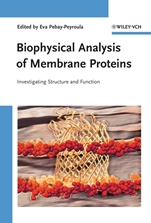
Biophysical Analysis of Membrane Proteins: Investigating Structure and Function
ISBN 9783527316779
Autor: Eva Pebay–Peyroula
Wydawca: Wiley
Dostępność: 3-6 tygodni
Cena: 882,00 zł
Przed złożeniem zamówienia prosimy o kontakt mailowy celem potwierdzenia ceny.
ISBN13: |
9783527316779 |
ISBN10: |
3527316779 |
Autor: |
Eva Pebay–Peyroula |
Oprawa: |
Hardback |
Rok Wydania: |
2007-10-24 |
Ilość stron: |
368 |
Wymiary: |
248x180 |
Tematy: |
PH |
Meeting the need for a book on developing and using new methods to investigate membrane proteins, this is a cutting–edge resource for the major biophysical methods that are – or soon will be– the major techniques used in the field. Top researchers from around the world focus on the physical principles exploited in the different techniques, and provide examples of how these can bring about important new insights. Each chapter is dedicated to a specific approach, describing the method involved, highlighting the experimental procedure and/or the basic principles, offering an up–to–date understanding of what is measured, what can be deduced from the measurements, as well as the limitations of each procedure.
Following an introduction, further sections discuss structural approaches, molecular interaction and large assemblies, dynamics and spectroscopes, finishing off with an exploration of structure–function relationships in whole cells.
Spis treści:
Preface.
The Editor.
List of Contributors.
Part I: Introduction.
1. High–Resolution Structures of Membrane Proteins: From X–Ray Crystallography to an Integrated Approach of Membranes (Eva Pebay–Peyroula).
1.1 Membranes: A Soft Medium?
1.2 Current Knowledge on Membrane Protein Structures.
1.3 X–Ray Crystallography.
1.4 Recent Examples.
1.5 Future Developments in X–Ray Crystallography of Membrane Proteins.
1.6 Conclusions.
Part II: Structural Approaches.
2. Membrane Protein Structure Determination by Electron Cryo–Microscopy (Christopher G. Tate and John L. Rubinstein).
2.1 Introduction.
2.2 Single–Particle Electron Microscopy.
2.3 Structure Determination from 2–Dimensional Crystals.
2.4 Helical Analysis of Tubes.
2.5 Conclusions.
3. Introduction to Solid–State NMR and its Application to Membran
e Protein–Ligand Binding Studies (Krisztina Varga and Anthony Watts).
3.1 Introduction.
3.2 Solid–State NMR.
3.3 Examples: Receptor–Ligand Studies by Solid–State NMR.
Part III: Molecular Interaction and Large Assemblies.
4. Analytical Ultracentrifugation: Membrane Protein Assemblies in the Presence of Detergent (Christine Ebel, Jesper V. Møller and Marc le Maire).
4.1 Introduction.
4.2 Instrumentation and the Principle of Typical Experiments.
4.3 General Theoretical Background.
4.4 Membrane Proteins: Measurement of Rs, Mb, M, and v.
4.5 Sedimentation Equilibrium Data Analysis.
4.6 Sedimentation Velocity Data Analysis.
4.7 Analytical Ultracentrifugation and SANS/SAXS.
4.8 Conclusions.
5. Probing Membrane Protein Interactions with Real–Time Biosensor Technology (Iva Navratilova, David G. Myszka and Rebecca L. Rich).
5.1 Introduction.
5.2 Interactions of Extracellular Domains.
5.3 Interactions of Soluble Proteins with Lipid Layers.
5.4 Interactions of Proteins Embedded in Lipid Layers.
5.5 Interactions of Membrane–Solubilized Proteins.
5.6 Summary.
6. Atomic Force Microscopy: High–Resolution Imaging of Structure and Assembly of Membrane Proteins (Simon Scheuring, Nikolay Buzhynskyy, Rui Pedro Gonçalves and Szymon Jaroslawski).
6.1 Atomic Force Microscopy.
6.2 Combined Imaging and Force Measurements by AFM.
6.3 High–Resolution Imaging by AFM.
6.4 Conclusions.
6.5 Feasibilities, Limitations, and Outlook.
Part IV: Dynamics.
7. Molecular Dynamics Studies of Membrane Proteins: Outer Membrane Proteins and Transporters (Syma Khalid, John Holyoake and Mark S. P. Sansom).
7.1 Introduction.
7.2 Outer Membrane Proteins.
7.3 Cytoplasmic Membrane Transport Proteins.
7.4 Conclusions.
8. Understanding St
ructure and Function of Membrane Proteins Using Free Energy Calculations (Christophe Chipot and Klaus Schulten).
8.1 Introduction.
8.2 Theoretical Underpinnings of Free Energy Calculations.
8.3 Point Mutations in Membrane Proteins.
8.4 Assisted Transport Phenomena Across Membranes.
8.5 Recognition and Association in Membrane Proteins.
8.6 Conclusions.
9. Neutrons to Study the Structure and Dynamics of Membrane Proteins (Kathleen Wood and Giuseppe Zaccai).
9.1 General Introduction.
9.2 Introduction to Neutrons.
9.3 Introduction to Bacteriorhodopsin and the Purple Membrane.
9.4 Methods for Labeling.
9.5 Neutrons for Structural Studies of Membrane Proteins.
9.6 Neutrons for Dynamical Studies of Membrane Proteins.
9.7 Take–Home Message.
Part V: Spectroscopies.
10. Circular Dichroism: Folding and Conformational Changes of Membrane Proteins (Nadège Jamin and Jean–Jacques Lacapère).
10.1 Introduction.
10.2 Secondary Structure Composition.
10.3 Tertiary Structure Fingerprint.
10.4 Extrinsic Chromophores.
10.5 Conformational Changes upon Ligand Binding.
10.6 Folding/Unfolding.
10.7 Conclusion and Perspectives.
11. Membrane Protein Structure and Conformational Change Probed using Fourier Transform Infrared Spectroscopy (John E. Baenziger and Corrie J. B. daCosta).
11.1 Introduction.
11.2 FTIR Spectroscopy.
11.3 Vibrational Spectra of Membrane Proteins.
11.4 Applications of FTIR To Membrane Proteins.
11.5 Conclusions and Future Directions.
12. Resonance Raman Spectroscopy of a Light–Harvesting Protein (Andrew Aaron Pascal and Bruno Robert).
12.1 Introduction.
12.2 Principles of Resonance Raman Spectroscopy.
12.3 Primary Processes in Photosynthesis.
12.4 Photosynthesis in Plants.
12.5 The Light–Harvesting System of Plants.
12.6 Protection against Oxidative S
tress: Light–Harvesting Regulation in Plants.
12.7 Raman studies of LHCII.
12.8 Crystallographic Structure of LHCII.
12.9 Properties of LHCII in Crystal.
12.10 Recent Developments and Perspectives.
Part VI: Exploring Structure–Function Relationships in Whole Cells.
13. Energy Transfer Technologies to Monitor the Dynamics and Signaling Properties of G–Protein–Coupled Receptors in Living Cells (Jean–Philippe Pin, Mohammed–Akli Ayoub, Damien Maurel, Julie Perroy and Eric Trinquet).
13.1 Introduction.
13.2 Fluorescence Resonance Energy Transfer (FRET).
13.3 FRET Using GFP and its Various Mutants.
13.4 BRET as an Alternative to FRET.
13.5 Time–Resolved FRET (TR–FRET) and Homogeneous Time–Resolved Fluorescence (HTRF).
13.6 New Developments in Fluorescent Labeling of Membrane Proteins.
13.7 Ligand–Receptor Interaction Monitored by FRET.
13.8 Fast GPCR Activation Process Monitored in Living Cells.
13.9 FRET and BRET Validated the Constitutive Oligomerization of GPCR in Living Cells.
13.10 FRET and BRET Changed the Concept of G–Protein Activation.
13.11 GPCRs as Part of Large Signaling Complexes.
13.12 Conclusion and Future Prospects.
Index.
Nota biograficzna:
Eva Pebay–Peyroula is a professor in the Physics Department at the University of Grenoble. Having gained her PhD in molecular physics in 1986, Prof. Pebay–Peyroula began working the Laue–Langevin Institut, where her interests shifted from physics to biology. Subsequently, after studying the structural properties of lipidic membranes, mainly by neutron diffraction, she moved into the field of protein crystallography, which in turn aroused an interest in membrane proteins. During the past years, Prof. Pebay–Peyroula′s main area of study has included light–driven mechanisms achieved by bacterial rhodopsins, membra
Koszyk
Książek w koszyku: 0 szt.
Wartość zakupów: 0,00 zł
Informacje


Kontakt
Gambit
Centrum Oprogramowania
i Szkoleń Sp. z o.o.
Al. Pokoju 29b/22-24
31-564 Kraków
Siedziba Księgarni
ul. Kordylewskiego 1
31-542 Kraków
+48 12 410 5991
+48 12 410 5987
+48 12 410 5989
Subskrypcje
Administratorem danych osobowych jest firma Gambit COiS Sp. z o.o. Na podany adres będzie wysyłany wyłącznie biuletyn informacyjny.
Autoryzacja płatności

Informacje na temat autoryzacji płatności poprzez PayU.

© Copyright 2012: GAMBIT COiS Sp. z o.o. Wszelkie prawa zastrzeżone.
Projekt i wykonanie: Alchemia Studio Reklamy