


Wydawcy
Katalog tematyczny
- Archeologia (109)
- Ekonomia, finanse, business (13704)
- Filozofia (1445)
- Historia (3040)
- Języki i językoznawstwo (2356)
- Lifestyle, hobby i rozrywka (475)
- Medycyna (9704)
- Nauki humanistyczne (4)
- Nauki o Ziemi i środowisku (2638)
- Nauki ścisłe (20412)
- Astronomia (294)
- Biologia (5119)
- Chemia (6540)
- Chemia analityczna (361)
- Chemia fizyczna (346)
- Chemia nieorganiczna (137)
- Chemia organiczna (535)
- Krystalografia (27)
- Minerologia (46)
- Fizyka (3309)
- Matematyka (4574)
- Nauki ścisłe, ogólnie (503)
- Nauki społeczne (8486)
- Nauki techniczne (13450)
- Prawo (1696)
- Publikacje informacyjne i interdyscyplinarne (1288)
- Religia i wierzenia (917)
- Technika komputerowa (4067)
- Zdrowie, relacje międzyludzkie i rozwój osobisty (657)





Informacje szczegółowe o książce
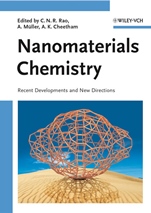
Nanomaterials Chemistry: Recent Developments and New Directions
ISBN 9783527316649
Autor: C. N. R. Rao, Achim Müller, Anthony K. Cheetham
Wydawca: Wiley
Dostępność: 3-6 tygodni
Cena: 976,50 zł
Przed złożeniem zamówienia prosimy o kontakt mailowy celem potwierdzenia ceny.
ISBN13: |
9783527316649 |
ISBN10: |
3527316647 |
Autor: |
C. N. R. Rao, Achim Müller, Anthony K. Cheetham |
Oprawa: |
Hardback |
Rok Wydania: |
2007-06-06 |
Ilość stron: |
420 |
Wymiary: |
247x179 |
Tematy: |
PN |
Although about 10,000 times smaller than the head of a pin, nanoparticles are huge compared to atoms and simple molecules. Building one by means of chemical synthesis is a complex challenge, especially when specific properties are desired. This field of nanomaterials chemistry is currently the focus of immense interest and attention, and is growing year by year.
With this book, the distinguished team of editors has combined the expertise of leading nanomaterials scientists to provide a recent overview of this field. They cover the whole spectrum of nanomaterials, ranging from theory, synthesis, properties, characterization to application, including such new developments as quantum dots, nanoparticles, nanoporous materials, nanowires, nanotubes, and nanostructured polymers.
The result is recommended reading for everybody working in nanoscience: Newcomers to the field can acquaint themselves with this exciting subject, while specialists will find answers to all their questions as well as helpful suggestions for further research.
Spis treści:
Preface.
List of Contributors.
1 Recent Developments in the Synthesis, Properties and Assemblies of Nanocrystals. (P.J. Thomas and P. O’Brien)
1.1 Introduction.
1.2 Spherical Nanocrystals.
1.2.1 Semiconductor Nanocrystals.
1.2.2 Metal Nanocrystals.
1.2.3 Nanocrystals of Metal Oxides.
1.3 Nanocrystals of Different Shapes.
1.3.1 Anisotropic Growth of Semiconductor and Oxide Nanocrystals.
1.3.2 Anisotropic Growth of Metal Nanocrystals.
1.4 Selective Growth on Nanocrystals.
1.5 Properties of Nanocrystals.
1.5.1 Electronic and Optical Properties.
1.5.2 Magnetic Properties.
1.6 Ordered Assemblies of Nanocrystals.
1.6.1 One– and Low–dimensional Arrangements.
1.6.2 Two–dimensional Arrays.
1.6.3 Three–dimensional Superlattices.
1.6.4 Colloidal Crystals.
1.7 Applications.
1.7.1 Optical and Electro–optical Devices.
1.7.2 Nanocrystal–based Optical Detection and Related Devices.
1.7.3 Nanocrystals as Fluorescent Tags.
1.7.4 Biomedical Applications of Oxide Nanoparticles.
1.7.5 Nanoelectronics and Nanoscalar Electronic Devices.
1.8 Conclusions.
References.
2 Nanotubes and Nanowires: Recent Developments. (S.R.C. Vivekchand, A. Govindaraj, and C.N.R. Rao)
2.1 Introduction.
2.2 Carbon Nanotubes.
2.2.1 Synthesis.
2.2.2 Purification.
2.2.3 Functionalization and Solubilization.
2.2.4 Properties and Applications.
2.2.4.1 Optical, Electrical and Other Properties.
2.2.4.2 Phase Transitions, Mechanical Properties, and Fluid Mechanics.
2.2.4.3 Energy Storage and Conversion.
2.2.4.4 Chemical Sensors.
2.2.5 Biochemical and Biomedical Aspects.
2.2.6 Nanocomposites.
2.2.7 Transistors and Devices.
2.3 Inorganic Nanotubes.
2.3.1 Synthesis.
2.3.2 Solubilization and Functionalization.
2.3.3 Properties and Applications.
2.4 Inorganic Nanowires.
2.4.1 Synthesis.
2.4.2 Self Assembly and Functionalization.
2.4.3 Coaxial Nanowires and Coatings on Nanowires.
2.4.4 Optical Properties.
2.4.5 Electrical and Magnetic Properties.
2.4.6 Some Chemical Aspects and Sensor Applications.
2.4.7 Mechanical Properties.
2.4.8 Transistors and Devices.
2.4.9 Biological Aspects.
References.
3 Nonaqueous Sol–Gel Routes to Nanocrystalline Metal Oxides. (M. Niederberger and M. Antonietti)
3.1 Overview.
3.2 Introduction.
3.3 Short Introduction to Aqueous and Nonaqueous Sol–Gel Chemistry.
3.4 Nonaqueous Sol–Gel Routes to Metal Oxide Nanoparticles.
3.4.1 Surfactant–controlled Synthesis of Metal Oxide Nanoparticles.
3.5 Solvent–controlled Synthesis of Metal Oxide Nanoparticles.
3.5.1 Introduction.
3.5.2 Reaction of Metal Halides with Alcohols.
3.5.3 Reaction of Metal Alkoxides with Alcohols.
3.5.4 Reaction of Metal Alkoxides with Ketones and Aldehydes.
3.5.5 Reaction of Metal Acetylacetonates with Various Organic Solvents.
3.6 Selected Reaction Mechanisms.
3.7 Summary and Outlook.
References.
4 Growth of Nanocrystals in Solution. (R. Viswanatha and D.D. Sarma)
4.1 Introduction.
4.2 Theoretical Aspects.
4.2.1 Theory of Nucleation.
4.2.2 Mechanism of Growth.
4.2.2.1 Diffusion Limited Growth: Lifshitz–Slyozov–Wagner (LSW) Theory and Post–LSW Theory.
4.2.2.2 Reaction–limited Growth.
4.2.2.3 Mixed Diffusion–Reaction Control.
4.3 Experimental Investigations.
4.3.1 Au Nanocrystals.
4.3.2 ZnO Nanocrystals.
4.3.3 Effect of Capping Agents on Growth Kinetics.
4.3.3.1 Effect of Oleic Acid on the Growth of CdSe Nanocrystals.
4.3.3.2 PVP as a Capping Agent in the Growth of ZnO Nanocrystals.
4.3.3.3 Effect of Adsorption of Thiols on ZnO Growth Kinetics.
4.4 Concluding Remarks.
References.
5 Peptide Nanomaterials: Self–assembling Peptides as Building Blocks for Novel Materials. (M. Reches and E. Gazit)
5.1 Overview.
5.2 Introduction.
5.3 Cyclic Peptide–based Nanostructures.
5.4 Linear Peptide–based Nanostructures.
5.5 Amyloid Fibrils as Bio–inspired Material: The Use of Natural Amyloid and Peptide Fragments.
5.6 From Amyloid Structures to Peptide Nanostructures.
5.7 Bioinspired Peptide–based Composite Nanomaterials.
5.8 Prospects.
References.
6 Surface Plasmon Resonances in Nanostructured Materials. (K.G. Thomas)
6.1 Introduction to Surface Plasmons.
6.1.1 Propagating Surface Plasmons.
Nota biograficzna:
C. N. R. Rao obtained his Ph.D. from Purdue University, USA, and D.Sc. from Mysore University. Apart from other appointments throughout the years, C. N. R. Rao was the Director of the Indian Institute of Science (1984–94), of which he now is an Honorary Professor, and the President of the Jawaharlal Nehru Centre for Advanced Scientific Research (1989
–99), where he holds the Linus Pauling Research Professorship and Honorary Presidency. His main research interests are in solid state and materials chemistry, molecular structure and spectroscopy. He is a member of numerous science academies worldwide and has received many national and international honours, and published over 1200 research papers.
Achim Müller studied chemistry and physics at Göttingen University and is currently Professor of Inorganic Chemsitry at Bielefeld University, bothGermany. His research interests range from problems of molecular physics, bioinorganic chemistry and metal chalcogenide compounds to popularised science. He has received many national and international recognitions.
Anthony Cheetham obtained his Ph.D. in chemistry at Oxford University in 1971 and becme a faculty member in 1974. He moved to the University of California at Santa Barbara in 1991 as Professor in the Materials Department and became Director of the newly created Materlais Research Laboratory there in 1992. His research on inorganic materials has been recognised by a number of awards, including election to Fellowships of the Royal Society (1994) and the Third World Academy of Sciences (1999). He held an International Research Chair at Blaise Pascal University, Paris, (1997–99), and an International Chair Francqui in Namur (2001).
Okładka tylna:
Although about 10,000 times smaller than the head of a pin, nanoparticles are huge compared to atoms and simple molecules. Building one by means of chemical synthesis is a complex challenge, especially when specific properties are desired. This field of nanomaterials chemistry is currently the focus of immense interest and attention, and is growing year by year.
With this book, the distinguished team of editors has combined the expertise of leading nanomaterials scientists to provide a recent overview of this field. They cover the whole spectrum of nanomaterials, ranging from
theory, synthesis, properties, characterization to application, including such new developments as quantum dots, nanoparticles, nanoporous materials, nanowires, nanotubes, and nanostructured polymers.
The result is recommended reading for everybody working in nanoscience: Newcomers to the field can acquaint themselves with this exciting subject, while specialists will find answers to all their questions as well as helpful suggestions for further research.
Koszyk
Książek w koszyku: 0 szt.
Wartość zakupów: 0,00 zł
Informacje


Kontakt
Gambit
Centrum Oprogramowania
i Szkoleń Sp. z o.o.
Al. Pokoju 29b/22-24
31-564 Kraków
Siedziba Księgarni
ul. Kordylewskiego 1
31-542 Kraków
+48 12 410 5991
+48 12 410 5987
+48 12 410 5989
Subskrypcje
Administratorem danych osobowych jest firma Gambit COiS Sp. z o.o. Na podany adres będzie wysyłany wyłącznie biuletyn informacyjny.
Autoryzacja płatności

Informacje na temat autoryzacji płatności poprzez PayU.

© Copyright 2012: GAMBIT COiS Sp. z o.o. Wszelkie prawa zastrzeżone.
Projekt i wykonanie: Alchemia Studio Reklamy