


Wydawcy
Katalog tematyczny
- Archeologia (109)
- Ekonomia, finanse, business (13704)
- Filozofia (1445)
- Historia (3040)
- Języki i językoznawstwo (2356)
- Lifestyle, hobby i rozrywka (475)
- Medycyna (9704)
- Nauki humanistyczne (4)
- Nauki o Ziemi i środowisku (2638)
- Nauki ścisłe (20412)
- Nauki społeczne (8486)
- Nauki techniczne (13450)
- Prawo (1696)
- Publikacje informacyjne i interdyscyplinarne (1288)
- Religia i wierzenia (917)
- Technika komputerowa (4067)
- Zdrowie, relacje międzyludzkie i rozwój osobisty (657)





Informacje szczegółowe o książce
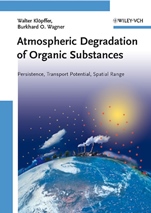
Atmospheric Degradation of Organic Substances: Persistence, Transport Potential, Spatial Range
ISBN 9783527316069
Autor: Walter Klöpffer, Burkhard O. Wagner, Klaus Günter Steinhäuser
Wydawca: Wiley
Dostępność: 3-6 tygodni
Cena: 1 125,60 zł
Przed złożeniem zamówienia prosimy o kontakt mailowy celem potwierdzenia ceny.
ISBN13: |
9783527316069 |
ISBN10: |
352731606X |
Autor: |
Walter Klöpffer, Burkhard O. Wagner, Klaus Günter Steinhäuser |
Oprawa: |
Hardback |
Rok Wydania: |
2007-02-09 |
Ilość stron: |
258 |
Wymiary: |
243x180 |
Tematy: |
AT |
Since many commercially important bulk chemicals are volatile, their eventual degradation, mostly by photochemical reactions, is a critical factor for the pollution and environmental hazards so caused.
This compilation on the breakdown of 1,100 commercially important chemical products is the first publication to make this knowledge publicly accessible in one book. The data and annotations have been painstakingly assembled over a 10–year period in a cooperation among academia and regulatory authorities. It explains in detail the methods, including computational ones, for the environmental assessment of volatile and semi–volatile substances, and is rounded off with data tables of degradation rates.
From the contents:PhotodegradationHeterogeneous degradationExperimental determinationEnvironmental relevanceData tables of degradation rates
A key resource for manufacturers and regulators of such substances.
Spis treści:
Foreword.
Preface.
Chapter 1 Significance of Photo–degradation in Environmental Risk Assessment.
1 Introduction.
2 Persistence and Long–range Transport Potential in Chemicals Regulation.
3 Multimedia Models as Tools to Estimate Persistence and Long–range Transport Potential.
4 Data Requirements for Multimedia Models.
5 Estimation of the Rate Constant of Organic Substances with Hydroxyl Radicals.
6 Research Requirements for Photo–degradation of Semi–volatile Substances.
7 Conclusions.
References.
Chapter 2 Abiotic Degradation in the Atmosphere.
1 Introduction.
2 Photo–degradation in the Homogenous Gas Phase of the Troposphere.
2.1 Indirect Photochemical Reactions.
2.1.1 The Reaction with OH–Radicals.
2.1.1.1 Sources and Sinks of the OH–Radical.
2.1.1.2 Reactions of OH with Organic Compounds.
2.1.2 The Reaction with NO<sub>3</sub&#
38;gt;–Radicals.
2.1.2.1 Sources and Sinks of the NO<sub>3</sub>–Radical.
2.1.2.2 Reactions of NO<sub>3</sub> with Organic Compounds.
2.1.3 The Reaction with Ozone.
2.1.3.1 Sources and Sinks of O<sub>3</sub> in the Troposphere.
2.1.3.2 Reactions of O3 with Organic Compounds.
2.2 Direct Photochemical Reactions.
2.2.1 Quantum Efficiency.
2.2.2 Examples of Photochemical Reactions in the Gas Phase.
3 Heterogeneous Degradation.
3.1 Degradation on Solid Surfaces.
3.1.1 Introduction.
3.1.2 Degradation on Fly Ash and Soot.
3.1.3 Degradation on Artificial Aerosols.
3.2 Degradation in Droplets.
3.2.1 Direct Photochemical Transformation.
3.2.2 Reactive Trace Compounds in Cloud, Fog and Rainwater.
3.2.3 Reactions of Organic Molecules.
3.2.4 Summary.
4 Experimental.
4.1 Indirect Photochemical Degradation.
4.1.1 Bimolecular Reaction with OH.
4.1.1.1 Direct Methods for Measuring k<sub>OH</sub>.
4.1.1.2 Indirect Methods for the Measurement of k<sub>OH</sub>.
4.1.2 Bimolecular Reaction with NO<sub>3</sub>.
4.1.2.1 Introduction.
4.1.2.2 Absolute Measurement.
4.1.2.3 Relative Measurements.
4.1.3 Bimolecular Reaction with Ozone.
4.2 Direct Photo–transformation.
4.2.1 Determination of the Quantum Efficiency in the Gas Phase.
4.2.1.1 Gas Cuvette and Monochromatic Radiation.
4.2.1.2 Smog–chamber Method.
4.2.2 Outlook.
4.3 Degradation in the Adsorbed State.
4.3.1 Introduction.
4.3.2 Aerosol Chambers.
4.3.3 Alternative Measurements of k<sub>OH,ads</sub>.
5 Additional Information Necessary for Calculating Lifetimes.
5.1 Atmospheric Lifetimes.
5.2 Indirect Photochemical Degradation.
5.2.1 Average OH Concentration in the Troposphere.5.2.2 Average NO<sub>3</sub> Concentration in the Troposphere.
5.2.3 Average O<sub>3</sub> Concentration in the Troposphere.
5.3 Direct Photochemical Degradation.
5.3.1 Introduction.
5.3.2 Absorption Spectrum.
5.3.3 Spectral Photon Irradiance.
5.3.4 Final Comments on Direct and Indirect Photochemical Transformation.
References.
Chapter 3 Table of Reaction Rate Constants of Photo–Degradation Processes.
1 Content of the Table.
2 Explanation of the Column Headings.
3 Content of the Footnotes.
4 Completeness and Accuracy.
5 Atmospheric Half–lives.
6 Selection of Substances.
7 Quality Index (QI).
8 Temperature Dependence of the Rate Constant.
9 Pressure Dependence of the Rate Constant.
10 Direct Photolysis.
Table: Reaction Rate Constants and Quantum Efficiencies for Atmospheric Photo–degradation of Chemicals.
Footnotes to the Table.
References to the Table.
Appendix: CAS Register.
Subject Index.
Nota biograficzna:
Prof. Dr. Walter Klopffer studied chemistry at the Karl–Franzens–University in Graz, Austria. He then joined the Battelle Institute in Frankfurt/Main, Germany, and since 1975 he is also Professor for Physical Chemistry at the University of Mainz.
Dr. Klopffer′s main fields of interest include the spectroscopy and photophysics of aromatic polymers, and the environmental assessment of chemicals (persistence, abiotic degradation) and products (Life Cycle Assessment).
Dr. Burkhard Wagner obtained a PhD in Chemistry from the University of Heidelberg, Germany. He completed a postdoctoral period at the California Institute of Technology with George Hammond before joining the German Federal Environmental Agency (Umweltbundesamt), where he was the long–time section head for environmental impact assessment of chemicals.
Ok&
#322;adka tylna:
Since many commercially important bulk chemicals are volatile, their eventual degradation, mostly by photochemical reactions, is a critical factor for the pollution and environmental hazards so caused.
This compilation on the breakdown of 1,100 commercially important chemical products is the first publication to make this knowledge publicly accessible in one book. The data and annotations have been painstakingly assembled over a 10–year period in a cooperation among academia and regulatory authorities. It explains in detail the methods, including computational ones, for the environmental assessment of volatile and semi–volatile substances, and is rounded off with data tables of degradation rates.
From the contents:PhotodegradationHeterogeneous degradationExperimental determinationEnvironmental relevanceData tables of degradation rates
A key resource for manufacturers and regulators of such substances.
Koszyk
Książek w koszyku: 0 szt.
Wartość zakupów: 0,00 zł
Informacje


Kontakt
Gambit
Centrum Oprogramowania
i Szkoleń Sp. z o.o.
Al. Pokoju 29b/22-24
31-564 Kraków
Siedziba Księgarni
ul. Kordylewskiego 1
31-542 Kraków
+48 12 410 5991
+48 12 410 5987
+48 12 410 5989
Subskrypcje
Administratorem danych osobowych jest firma Gambit COiS Sp. z o.o. Na podany adres będzie wysyłany wyłącznie biuletyn informacyjny.
Autoryzacja płatności

Informacje na temat autoryzacji płatności poprzez PayU.

© Copyright 2012: GAMBIT COiS Sp. z o.o. Wszelkie prawa zastrzeżone.
Projekt i wykonanie: Alchemia Studio Reklamy