


Wydawcy
Katalog tematyczny
- Archeologia (109)
- Ekonomia, finanse, business (13704)
- Filozofia (1445)
- Historia (3040)
- Języki i językoznawstwo (2356)
- Lifestyle, hobby i rozrywka (475)
- Medycyna (9704)
- Nauki humanistyczne (4)
- Nauki o Ziemi i środowisku (2638)
- Nauki ścisłe (20412)
- Astronomia (294)
- Biologia (5119)
- Chemia (6540)
- Chemia analityczna (361)
- Chemia fizyczna (346)
- Chemia nieorganiczna (137)
- Chemia organiczna (535)
- Krystalografia (27)
- Minerologia (46)
- Fizyka (3309)
- Matematyka (4574)
- Nauki ścisłe, ogólnie (503)
- Nauki społeczne (8486)
- Nauki techniczne (13450)
- Prawo (1696)
- Publikacje informacyjne i interdyscyplinarne (1288)
- Religia i wierzenia (917)
- Technika komputerowa (4067)
- Zdrowie, relacje międzyludzkie i rozwój osobisty (657)





Informacje szczegółowe o książce
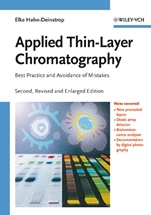
Applied Thin–Layer Chromatography: Best Practice and Avoidance of Mistakes
ISBN 9783527315536
Autor: Elke Hahn–Deinstrop
Wydawca: Wiley
Dostępność: 3-6 tygodni
Cena: 882,00 zł
Przed złożeniem zamówienia prosimy o kontakt mailowy celem potwierdzenia ceny.
ISBN13: |
9783527315536 |
ISBN10: |
3527315535 |
Autor: |
Elke Hahn–Deinstrop |
Oprawa: |
Hardback |
Rok Wydania: |
2006-11-03 |
Numer Wydania: |
2nd Edition |
Ilość stron: |
330 |
Wymiary: |
242x175 |
Tematy: |
PN |
Thin–layer chromatography (TLC) is a powerful, fast and inexpensive analytical method, which has proven its effectiveness in the analysis of pharmaceuticals, food and the environment. This new edition of the practical guide to TLC includes a completely revised chapter on documentation, which now covers the use of digital cameras, while selected new sorbents and instruments are also introduced.
This edition retains the successful features of its predecessor:Clear explanation of all steps in the analytical procedure, starting with the choice of a suitable TLC technique and finishing with data evaluation and documentation.Special emphasis on the correct choice of materials for TLC. Properties and functions of various materials and the TLC equipment are described, covering precoated layers, solvents and developing chambers, including information on suppliers, among others.Many practical hints for troubleshooting.Detailed description of using TLC in compliance with GLP/GMP regulations, including the required documentation , allowing readers to easily compile their own standard operating procedures.Numerous color illustrations.
From the reviews of the first edition:
"A clear, step–by–step practical guide to TLC, covering every stage of the process from plate selection and sample application to development and quantification. At every stage potential pitfalls are clearly signposted and each chapter contains a profusion of pracitcal tips. Even a seasoned TLC practitioner should find something of use or interest in this book which complements most existing texts."
—The Analyst
Spis treści:
1 Introduction.
1.1 What Does TLCMean?
1.2 When Is TLC Used?
1.3 Where Is TLC Used?
1.4 How Is the Result of a TLC Represented?
1.4.1 Retardation Factor.
1.4.2 Flow Constant.
1.4.3 Other TLC Parameters.
1.5 What Kinds of Reference Substances Are Used i
n TLC?
1.6 The Literature on TLC.
1.6.1 General Literature.
1.6.1.1 Books and Information Sheets in German.
1.6.1.2 Books in English.
1.6.1.3 Book in Another Language.
1.6.2 Journals.
1.6.2.1 German Language Journals Containing Articles on TLC (Selection).
1.6.2.2 English Language Journals on TLC.
1.6.2.3 English Language Journals Containing General Articles on Chromatography (Selection).
1.6.3 Abstracts.
1.6.4 Pharmacopoeias.
2 Precoated Layers.
2.1 Precoated Layers –Why?
2.2 What Are Precoated Layers Produced?
2.2.1 Sorbents.
2.2.2 Supports for Stationary Phases.
2.2.3 Additives.
2.3 What Types of Precoated Layers Are There?
2.4 What Are the Uses of Precoated Layers?
2.5 Criteria for the Selection of Stationary Phases in TLC.
2.5.1 How Can the Choice of the Stationary Phase beMade?
2.5.2 How Can the Recommendations for Stationary Phases Found in Pharmacopoeias be Applied to Precoated Layers?
2.6 Effect of the Stationary Phase When Mobile Phases Are Identical.
2.7 Advice on the Ordering and Storage of Precoated Layers.
2.8 Problems in the Naming and Arrangement of Precoated Layers.
3 Before the TLC Development Process.
3.1 Handling of Precoated Layers.
3.1.1 Film and Foil.
3.1.2 Glass Plates.
3.2 Prewashing.
3.3 Activation.
3.4 Conditioning.
3.5 Impregnation.
3.5.1 Impregnation by Dipping.
3.5.2 Impregnation by Spraying.
3.5.3 Impregnation by Predevelopment.
3.6 Application of Samples.
3.6.1 Manual Application of Samples.
3.6.2 Semiautomatic Application.
3.6.3 Fully Automatic Application.
3.7 Positioning of the Samples.
3.8 Drying Before the Development.
4 Solvent Systems, Developing Chambers and Development.
4.1 Solvent Systems.
4.1.1 Choice of Solvent Systems.
4.1.2 Preparation and Storage of Solvent Systems.
4.1.3 Problematical Solvent System Compositions.
4.2 TLC Developing Chambers.
4.2.1
What Types of TLC Developing Chambers Are There?
4.2.1.1 TLC Chambers for Vertical Development.
4.2.1.2 TLC Developing Chambers for Horizontal Development.
4.2.2 Influence of the Chamber Atmosphere.
4.2.2.1 The Unsaturated N–Chamber.
4.2.2.2 The Saturated N–Chamber.
4.2.3 Influence of Temperature in Chromatography.
4.2.4 Location and Labeling of TLC Developing Chambers.
4.3 Development of Thin–Layer Chromatograms.
4.3.1 One–Dimensional Thin–Layer Chromatography.
4.3.1.1 Vertical Development.
4.3.1.2 Horizontal Development.
4.3.2 Two–Dimensional Thin–Layer Chromatography.
4.4 Drying After Development.
5 Evaluation Without Derivatization.
5.1 Direct Visual Evaluation.
5.1.1 Detection in Daylight.
5.1.2 Detection with 254–nm UV Light.
5.1.3 Detection with 365–nm UV Light.
5.2 Direct Optical Evaluation Using Instruments.
5.2.1 Principle of Operation of a TLC Scanner.
5.2.2 Direct Optical Evaluation Above 400 nm.
5.2.3 Direct Optical Evaluation Below 400 nm.
5.2.4 Direct Optical Evaluation with 365–nm UV Light (FluorescenceMeasurement).
5.3 Diode–Array Detection.
5.4 Coupled Methods for Substance Identification.
5.5 Documentation Without or Before Derivatization.
6 Derivatization.
6.1 Thermochemical Reaction.
6.2 Irradiation with High–Energy Light.
6.3 Reaction with Reagents.
6.3.1 Spraying of TLC Plates.
6.3.1.1 Manual Spraying of TLC Plates.
6.3.1.2 Fully Automatic Spraying of TLC Plates.
6.3.2 Dipping of TLC Plates.
6.3.3 Vapor Treatment of TLC Plates.
6.3.4 Coating TLC Plates.
6.4 Special Cases of Derivatization.
6.4.1 Prechromatographic Derivatization.
6.4.1.1 Reaction with Reagents.
6.4.1.2 Incorporation of Radionuclides.
6.4.2 Simultaneous Derivatization and Development.
6.4.3 Reaction Sequences.
6.4.4 Biological–Physiological Methods of Detecti
on.
6.5 Further Treatment of Derivatized Chromatograms.
6.5.1 Effect of Heat.
6.5.2 Stabilization of Colored and Fluorescent Zones.
7 Evaluation After Derivatization.
7.1 Visual Evaluation.
7.1.1 Visual Qualitative Evaluation.
7.1.2 Visual Semiquantitative Evaluation.
7.2 Evaluation Using a TLC Scanner.
7.2.1 Qualitative Evaluation.
7.2.2 Quantitative Evaluation.
7.2.2.1 Absorption Measurement.
7.2.2.2 Fluorescence Measurement.
7.2.2.3 Comparison of “Parallel” With “Transverse” Measurement.
7.3 Evaluation Using a Video System.
7.3.1 Qualitative Video Evaluation.
7.3.2 Quantitative Video Evaluation.
7.3.3 Comparison of the TLC Scanner With Video Evaluation.
7.4 Evaluation by Flat–Bed Scanner.
7.5 Evaluation Using a Digital Camera.
8 Documentation.
8.1 Description of a Thin–Layer Chromatogram.
8.2 Documentation by Drawing, Tracing and Photocopying.
8.3 Photographic Documentation.
8.3.1 Photography Using the Polaroid Camera MP–4.
8.3.2 Photography Using 35–mm Cameras.
8.3.2.1 Photography in 254–nm UV Light.
8.3.2.2 Photographs in 365–nm UV Light.
8.3.2.3 Photographs inWhite Light.
8.3.3 Archiving of 35–mm Films.
8.4 Video Documentation.
8.5 DocumentationWith Digital Cameras.
8.6 TLC Scanner Documentation.
8.7 Flat–Bed Scanner Documentation.
8.8 Bioluminescence Measurements.
8.8.1 Toxicity Screening Using the Bioluminescent Bacteria Vibrio fischeri.
8.8.2 Detecting Bioluminescence With the BioLuminizer.
9 GMP/GLP–Conforming Operations in TLC.
9.1 Validation of TLC Methods.
9.2 Use of Qualified/Calibrated Equipment.
9.3 GMP/GLP–Conforming Raw Data Sheets.
9.4 Examples of GMP/GLP–Conforming Testing Procedures (TPs).
9.4.1 Identity and Purity of a Bulk Pharmaceutical Chemical and Determination of the Limit Values of Related Co
Koszyk
Książek w koszyku: 0 szt.
Wartość zakupów: 0,00 zł
Informacje


Kontakt
Gambit
Centrum Oprogramowania
i Szkoleń Sp. z o.o.
Al. Pokoju 29b/22-24
31-564 Kraków
Siedziba Księgarni
ul. Kordylewskiego 1
31-542 Kraków
+48 12 410 5991
+48 12 410 5987
+48 12 410 5989
Subskrypcje
Administratorem danych osobowych jest firma Gambit COiS Sp. z o.o. Na podany adres będzie wysyłany wyłącznie biuletyn informacyjny.
Autoryzacja płatności

Informacje na temat autoryzacji płatności poprzez PayU.

© Copyright 2012: GAMBIT COiS Sp. z o.o. Wszelkie prawa zastrzeżone.
Projekt i wykonanie: Alchemia Studio Reklamy