


Wydawcy
Katalog tematyczny
- Archeologia (109)
- Ekonomia, finanse, business (13704)
- Filozofia (1445)
- Historia (3040)
- Języki i językoznawstwo (2356)
- Lifestyle, hobby i rozrywka (475)
- Medycyna (9704)
- Nauki humanistyczne (4)
- Nauki o Ziemi i środowisku (2638)
- Nauki ścisłe (20412)
- Astronomia (294)
- Biologia (5119)
- Chemia (6540)
- Fizyka (3309)
- Elektryczność i magnetyzm (90)
- Fizyka atomowa i molekularna (110)
- Fizyka cząstek elementarnych (36)
- Fizyka jądra atomowego (36)
- Fizyka kwantowa (210)
- Fizyka matematyczna (121)
- Fizyka relatywistyczna (36)
- Fizyka statystyczna (51)
- Fizyka stosowana (498)
- Mechanika klasyczna (186)
- Optyka i światło (133)
- Stany materii (202)
- Matematyka (4574)
- Nauki ścisłe, ogólnie (503)
- Nauki społeczne (8486)
- Nauki techniczne (13450)
- Prawo (1696)
- Publikacje informacyjne i interdyscyplinarne (1288)
- Religia i wierzenia (917)
- Technika komputerowa (4067)
- Zdrowie, relacje międzyludzkie i rozwój osobisty (657)





Informacje szczegółowe o książce
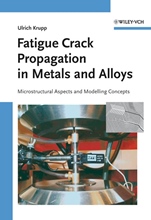
Fatigue Crack Propagation in Metals and Alloys: Microstructural Aspects and Modelling Concepts
ISBN 9783527315376
Autor: Ulrich Krupp
Wydawca: Wiley
Dostępność: 3-6 tygodni
Cena: 801,15 zł
Przed złożeniem zamówienia prosimy o kontakt mailowy celem potwierdzenia ceny.
ISBN13: |
9783527315376 |
ISBN10: |
3527315373 |
Autor: |
Ulrich Krupp |
Oprawa: |
Hardback |
Rok Wydania: |
2007-02-23 |
Ilość stron: |
311 |
Wymiary: |
302x217 |
Tematy: |
PH |
Crack initiation and early crack propagation are decisive elements of material fatigue in metallic materials, and the behavior on the microscale level in this phase greatly influences the resulting lifetime of a given material, and subsequently, its usefulness and attractiveness for specific applications. It is impossible to quantify this key phase with non–destructive testing such as ultrasonic inspection, nor are the common methods of elastic and elastic–plastic fracture mechanics applicable. Therefore, prediction possibilities and purposeful microstructure design towards improved material behavior are highly desirable. Part one of this book is a comprehensive overview on the history of fatigue and fracture research and the basic concepts of fatigue–life prediction, fracture mechanics, experimental methods, and the deformation behavior of metallic materials. The second part gives an overview on experimental studies and theoretical approaches on the interactions between the material′s microstructure, the mechanical loading conditions, and the corresponding fatigue crack propagation behavior. Thirdly, the experimental results and hypotheses presented are discussed by means of phenomenological and physical models the latter being based on the numerical boundary element method. These models are intended to be applied to future mechanism–oriented life prediction of technical materials under complex service conditions.
Spis treści:
Foreword.
Preface.
Symbols and Abbreviations.
1 Introduction.
2 Basic Concepts of Metal Fatigue and Fracture in the Engineering Design Process.
2.1 Historical Overview.
2.2 Metal Fatigue, Crack Propagation and Service–Life Prediction: A Brief Introduction.
2.2.1 Fundamental Terms in Fatigue of Materials.
2.2.2 Fatigue–Life Prediction: Total–Life and Safe–Life Approach.
2.2.3 Fatigue–Life Prediction:
Damage–Tolerant Approach.
2.2.4 Methods of Fatigue–Life Prediction at a Glance.
2.3 Basic Concepts of Technical Fracture Mechanics.
2.3.1 The K Concept of LEFM.
2.3.2 Crack–Tip Plasticity: Concepts of Plastic–Zone Size.
2.3.3 Crack–Tip Plasticity: The J Integral.
3 Experimental Approaches to Crack Propagation.
3.1 Mechanical Testing.
3.1.1 Testing Systems.
3.1.2 Specimen Geometries.
3.1.3 Local Strain Measurement: The ISDG Technique.
3.2 Crack–Propagation Measurements.
3.2.1 Potential–Drop Concepts and Fracture Mechanics Experiments.
3.2.2 In Situ Observation of the Crack Length.
3.3 Methods of Microstructural Analysis and Quantitative Characterization of Grain and Phase Boundaries.
3.3.1 Analytical SEM: Topography Contrast to Study Fracture Surfaces.
3.3.2 SEM Imaging by Backscattered Electrons and EBSD.
3.3.3 Evaluation of Kikuchi Patterns: Automated EBSD.
3.3.4 Orientation Analysis Using TEM and X–Ray Diffraction.
3.3.5 Mathematical and Graphical Description of Crystallographic Orientation Relationships.
3.3.6 Microstructure Characterization by TEM.
3.3.7 Further Methods to Characterize Mechanical Damage Mechanisms in Materials.
3.4 Reproducibility of Experimentally Studying the Mechanical Behavior of Materials.
4 Physical Metallurgy of the Deformation Behavior of Metals and Alloys.
4.1 Elastic Deformation.
4.2 Plastic Deformation by Dislocation Motion.
4.3 Activation of Slip Planes in Single– and Polycrystalline Materials.
4.4 Special Features of the Cyclic Deformation of Metallic Materials.
5 Initiation of Microcracks.
5.1 Crack Initiation: Definition and Significance.
5.1.1 Influence of Notches, Surface Treatment and Residual Stresses.
5.2 Influence of Microstructual Factors on the Initiation of Fatigue Cracks.
5.2.1 Crack Initiation at the Surface: General Remarks.
5
.2.2 Crack Initiation at Inclusions and Pores.
5.2.3 Crack Initiation at Persistent Slip Bands.
5.3 Crack Initiation by Elastic Anisotropy.
5.3.1 Definition and Significance of Elastic Anisotropy.
5.3.2 Determination of Elastic Constants and Estimation of the Elastic Anisotropy.
5.3.3 FE Calculations of Elastic Anisotropy Stresses to Predict Crack Initiation Sites.
5.3.4 Analytical Calculation of Elastic Anisotropy Stresses.
5.4 Intercrystalline and Transcrystalline Crack Initiation.
5.4.1 Influence Parameters for Intercrystalline Crack Initiation.
5.4.2 Crack Initiation at Elevated Temperature and Environmental Effects.
5.4.3 Transgranular Crack Initiation.
5.5 Microstructurally Short Cracks and the Fatigue Limit.
5.6 Crack Initiation in Inhomogeneous Materials: Cellular Metals.
6 Crack Propagation: Microstructural Aspects.
6.1 Special Features of the Propagation of Microstructurally Short Fatigue Cracks.
6.1.1 Definition of Short and Long Cracks.
6.2 Transgranular Crack Propagation.
6.2.1 Crystallographic Crack Propagation: Interactions with Grain Boundaries.
6.2.2 Mode I Crack Propagation Governed by Cyclic Crack–Tip Blunting.
6.2.3 Influence of Grain Size, Second Phases and Precipitates on the Propagation Behavior of Microstructurally Short Fatigue Cracks.
6.3 Significance of Crack–Closure Effects and Overloads.
6.3.1 General Idea of Crack Closure During Fatigue–Crack Propagation.
6.3.2 Plasticity–Induced Crack Closure.
6.3.3 Influence of Overloads in Plasticity–Induced Crack Closure.
6.3.4 Roughness–Induced Crack Closure.
6.3.5 Oxide– and Transformation–Induced Crack Closure.
6.3.6 &delta;K∗/K∗<sub>max</sub> Thresholds: An Alternative to the Crack–Closure Concept.
6.3.7 Development of Crack Closure in the Short Crack Regime.
6.4 Short and Long Fatigue Crack
s: The Transition from Mode II to Mode I Crack Propagation.
6.4.1 Development of the Crack Aspect Ratio a/c.
6.4.2 Coalescence of Short Cracks.
6.5 Intercrystalline Crack Propagation at Elevated Temperatures: The Mechanism of Dynamic Embrittlement.
6.5.1 Environmentally Assisted Intercrystalline Crack Propagation in Nickel–Based Superalloys: Possible Mechanisms.
6.5.2 Mechanism of Dynamic Embrittlement as a Generic Phenomenon: Examples.
6.5.3 Oxygen–Induced Intercrystalline Crack Propagation: Dynamic Embrittlement of Alloy 718.
6.5.4 Increasing the Resistance to Intercrystalline Crack Propagation by Dynamic Embrittlement: Grain–Boundary Engineering.
7 Modeling Crack Propagation Accounting for Microstructural Features.
7.1 General Strategies of Fatigue Life Assessment.
7.2 Modeling of Short–Crack Propagation.
7.2.1 Short–Crack Models: An Overview.
7.2.2 Model of Navarro and de los Rios.
7.3 Numerical Modeling of Short–Crack Propagation by Means of a Boundary Element Approach.
7.3.1 Basic Modeling Concept.
7.3.2 Slip Transmission in Polycrystalline Microstructures.
7.3.3 Simulation of Microcrack Propagation in Synthetic Polycrystalline Microstructures.
7.3.4 Transition from Mode II to Mode I Crack Propagation.
7.3.5 Future Aspects of Applying the Boundary Element Method to Short–Fatigue–Crack Propagation.
7.4 Modeling Dwell–Time Cracking: A Grain–Boundary Diffusion Approach.
8 Concluding Remarks.
References.
Subject Index.
Nota biograficzna:
Ulrich Krupp is Senior Engineer at the Institute of Materials Technology of Siegen University, Germany, and responsible for the research files fatigue and high–temperature corrosion of metals and alloys. He completed his Ph.D. in mechanical engineering there, and also obtained his lecturing qualification (habilitation) in 2004. He spen
Koszyk
Książek w koszyku: 0 szt.
Wartość zakupów: 0,00 zł
Informacje


Kontakt
Gambit
Centrum Oprogramowania
i Szkoleń Sp. z o.o.
Al. Pokoju 29b/22-24
31-564 Kraków
Siedziba Księgarni
ul. Kordylewskiego 1
31-542 Kraków
+48 12 410 5991
+48 12 410 5987
+48 12 410 5989
Subskrypcje
Administratorem danych osobowych jest firma Gambit COiS Sp. z o.o. Na podany adres będzie wysyłany wyłącznie biuletyn informacyjny.
Autoryzacja płatności

Informacje na temat autoryzacji płatności poprzez PayU.

© Copyright 2012: GAMBIT COiS Sp. z o.o. Wszelkie prawa zastrzeżone.
Projekt i wykonanie: Alchemia Studio Reklamy