


Wydawcy
Katalog tematyczny
- Archeologia (4)
- Ekonomia, finanse, business (1246)
- Filozofia (13)
- Historia (6)
- Języki i językoznawstwo (40)
- Lifestyle, hobby i rozrywka (31)
- Medycyna (2489)
- Nauki o Ziemi i środowisku (853)
- Nauki ścisłe (6237)
- Astronomia (18)
- Biologia (3162)
- Chemia (1365)
- Chemia analityczna (300)
- Chemia fizyczna (317)
- Chemia nieorganiczna (130)
- Chemia organiczna (515)
- Krystalografia (27)
- Minerologia (27)
- Fizyka (873)
- Matematyka (703)
- Nauki ścisłe, ogólnie (113)
- Nauki społeczne (1088)
- Nauki techniczne (6567)
- Prawo (84)
- Publikacje informacyjne i interdyscyplinarne (514)
- Religia i wierzenia (1)
- Technika komputerowa (1558)
- Zdrowie, relacje międzyludzkie i rozwój osobisty (18)





Informacje szczegółowe o książce
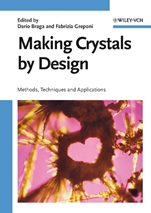
Making Crystals by Design: Methods, Techniques and Applications
ISBN 9783527315062
Autor: Dario Braga, Fabrizia Grepioni
Wydawca: Wiley
Dostępność: 3-6 tygodni
Cena: 1 017,45 zł
Przed złożeniem zamówienia prosimy o kontakt mailowy celem potwierdzenia ceny.
ISBN13: |
9783527315062 |
ISBN10: |
3527315063 |
Autor: |
Dario Braga, Fabrizia Grepioni |
Oprawa: |
Hardback |
Rok Wydania: |
2006-12-01 |
Ilość stron: |
362 |
Wymiary: |
248x180 |
Tematy: |
PN |
The field of crystal engineering has reached a new level of maturity and demands for a book that provides a state–of–art overview of the field together with a tutorial approach to methods and techniques.
From design and preparation to spectroscopy and applications, this excellent handbook both covers and evaluates all of the manifold aspects of modern crystal engineering. Clearly structured, it summarizes the current status as seen from its various angles, comparing different techniques that are required to tackle successfully solid state synthesis, characterization of solids and evaluation of properties.
An essential source of high quality information for everyone working in this booming and interdisciplinary field: spectroscopists, physical and inorganic chemists as well as materials scientists working in nanotechnology and the pharmaceutical industry.
From the Contents:GEOMETRY AND ENERGETICS: Supramolecular Interactions; Intermolecular Interactions in Molecular Crystals; Networks, Topologies and EntanglementsDESIGN AND REACTIVITY: Prediction of Reactivity in Solid–state Chemistry; Making Crystals by Reacting Crystals and by Reactions in Crystals; Making Coordination Frameworks; Assembly of Molecular Solids via Non–covalent InteractionsCHARACTERIZATIONS AND APPLICATIONS: Diffraction Studies in Crystal Engineering; Solid State NMR; Crystal Polymorphism; Nanoporosity, Gas Storage, Gas Sensing
Spis treści:
1 Geometry and Energetics.
1.1 Supramolecular Interactions: Energetic Considerations (Angelo Gavezzotti).
1.1.1 Introduction.
1.1.2 Enthalpy.
1.1.3 Entropy.
1.1.4 Free Energy.
1.1.5 Tutorial Examples.
1.2 Understanding the Nature of the Intermolecular Interactions in Molecular Crystals. A Theoretical Perspective (Juan J. Novoa, Emiliana D’Oria, and Maria A. Carvajal).
1.2.1 Introduction.
1.2.2
Intermolecular Interactions.
1.2.3 Summary.
1.3 Networks, Topologies, and Entanglements (Lucia Carlucci, Gianfranco Ciani, and Davide M. Proserpio).
1.3.1 Introduction.
1.3.2 Rationalization and Simplification of the Extended Structures.
1.3.3 Topological Classification of Networks.
1.3.4 Entangled Systems.
1.3.5 Conclusions.
2 Design and Reactivity.
2.1 Prediction of Reactivity in Solid–state Chemistry (Gerd Kaupp).
2.1.1 Introduction.
2.1.2 Topochemistry and Topotaxy.
2.1.3 Far–reaching Molecular Migrations in Solid–state Reactions (AFM, GID, SNOM) and Experimental Solid–state Mechanism.
2.1.4 Face Selectivity of Reactivity.
2.1.5 Some of the Important Failures of Topochemistry and Their Remedy by the Experimental Mechanism.
2.1.6 Molecular Migrations in the Absence of Severe Local Pressure.
2.1.7 Multiple Cleavage Planes.
2.1.8 Various Types of Cleavage Planes.
2.1.9 Channels.
2. 1.10 Closed Voids.
2. 1.11 Interpretation of Some Recent Literature Data.
2. 1.12 Applications in Addition to Solid–state Syntheses.
2. 1.13 Conclusions and Outlook.
2.2 Making Crystals by Reacting Crystals (Fumio Toda).
2.2.1 Introduction.
2.2.2 Thermal Solid–state Reactions.
2.2.3 Making Inclusion Complex Crystals by Mixing or Grinding Host and Guest Crystals.
2.2.4 Making Crystals by Phase Transition.
2.2.5 Control of Differential Inclusion Complexation by Seed Crystals.
2.2.6 Conclusions.
2.3 Making Crystals by Reactions in Crystals. Supramolecular Approaches to Crystal–to–Crystal Transformations within Molecular Co–Crystals (Tomislav Friscic and Leonard R. MacGillivray).
2.3.1 Introduction.
2.3.2 Single–component Solids.
2.3.3 Co–crystals.
2.3.4 SCSC Reactivity by Modifying Experimental Conditions.
2.3.5 Conclusion.
2.4 Making Coordination Framew
orks (Neil R. Champness).
2.4.1 Introduction.
2.4.2 Coordination Framework Design Criteria.
2.4.3 Coordination Polymer Design Approaches.
2.4.4 Synthetic Considerations and Approaches.
2.4.5 Structural Evaluation and Analysis.
2.4.6 Structural Description.
2.4.7 Conclusions.
2.5 Assembly of Molecular Solids via Non–covalent Interactions (Christer B. Aakerçy and Nate Schultheiss).
2.5.1 Introduction.
2.5.2 Directed Assembly of Homomeric Molecular Solids.
2.5.3 Design and Synthesis of Co–crystals.
3 Characterizations and Applications.
3.1 Diffraction Studies in Crystal Engineering (Guillermo Mínguez Espallargas and Lee Brammer).
3.1.1 Introduction.
3.1.2 Scope.
3.1.3 Single Crystal X–ray Diffraction.
3.1.4 Single crystal neutron diffraction.
3.1.5 Single Crystal Diffraction Studies at Low Temperatures.
3.1.6 Single Crystal Diffraction Studies at Increased Pressures.
3.1.7 Powder Diffraction.
3.1.8 Charge Density Studies.
3.1.9 Conclusions.
3.2 Solid State NMR (Roberto Gobetto).
3.2.1 Introduction.
3.2.2 The Fundamentals.
3.2.3 CPMAS.
3.2.4 Advantages and Disadvantages of Solid State NMR Spectroscopy.
3.2.5 Polymorphism.
3.2.6 Resolution of Enantiomers by Solid State NMR.
3.2.7 Distances Determined by SSNMR.
3.2.8 Hydrogen Bond.
3.3 Crystal Polymorphism: Challenges at the Crossroads of Science and Technology (Dario Braga and Joel Bernstein).
3.3.1 Introduction.
3.2.2 How Do We Detect and Characterize Multiple Crystal Forms?
3.3.3 New Developments in Detecting and Characterizing Multiple Crystal Forms.
3.3.4 Examples of Crystal Form Identification and Characterization.
3.3.5 Practical Implications and Ramifications of Multiple Crystal Forms – Pharmaceuticals.
3.3.6 Conclusions.
3.4 Nanoporosity, Gas Storage, Gas Sensing (Satoshi
Takamizawa).
3.4.1 Introduction.
3.4.2 Description of Porosity.
3.4.3 Nanoporosity for Gas Adsorption.
3.4.4 Brief Thermodynamic Description of the Gas Adsorption Phenomenon.
3.4.5 Crystalline Organic and Metal–Organic Gas Adsorbents.
3.4.6 Dawn of Metal–Organic Gas Adsorbents.
3.4.7 Design of Porosity in Coordination Polymer Systems.
3.4.8 Structural Description and Dimensionality of the Host Component.
3.4.9 Transformation of a Single–crystal Gas Adsorbent during Gas Adsorption.
3. 4.10 Abnormal Guest Diffusivity Within Pores.
3. 4.11 Method for the Accurate Detection and Measurement of the Gas Adsorbed State.
3. 4.12 Hydrogen Storage [21].
3. 4.13 Phase Transition of the Adsorbed Guest Sublattice in the Gas Inclusion Co–crystal State [23].
3. 4.14 Dynamic Change in Pore Topology by Design of Host Flexibility [24].
3. 4.15 Mass–induced Phase Transition [24].
3. 4.16 Sensing Gas by Porous Crystals.
3. 4.17 Concluding Remarks.
Nota biograficzna:
Dario Braga is Professor of Chemistry at the University of Bologna. He has published more than 300 papers in international journals and is the scientific editor of the RSC journal CrystEngComm. He has been awarded the Nasini Prize from the Inorganic Chemistry Division of the Italian Society of Chemistry and the FEDERCHIMICA prize from the Italian chemical industry. He is the current Director of the Collegio Superiore of the university of Bologna.
Fabrizia Grepioni held an associate professorship position at the University of Sassari from 1998 to 2004, and is now Associate Professor of Chemistry at the University of Bologna. She has published more than 200 papers in international journals and has won the Nasini Prize from the Inorganic Chemistry Division of the Italian Society of Chemistry.
Okładka tylna:
The field of crystal engineering has reached a new level of maturity and demands
Koszyk
Książek w koszyku: 0 szt.
Wartość zakupów: 0,00 zł
Informacje


Kontakt
Gambit
Centrum Oprogramowania
i Szkoleń Sp. z o.o.
Al. Pokoju 29b/22-24
31-564 Kraków
Siedziba Księgarni
ul. Kordylewskiego 1
31-542 Kraków
+48 12 410 5991
+48 12 410 5987
+48 12 410 5989
Subskrypcje
Administratorem danych osobowych jest firma Gambit COiS Sp. z o.o. Na podany adres będzie wysyłany wyłącznie biuletyn informacyjny.
Autoryzacja płatności

Informacje na temat autoryzacji płatności poprzez PayU.

© Copyright 2012: GAMBIT COiS Sp. z o.o. Wszelkie prawa zastrzeżone.
Projekt i wykonanie: Alchemia Studio Reklamy