


Wydawcy
Katalog tematyczny
- Archeologia (109)
- Ekonomia, finanse, business (13704)
- Filozofia (1445)
- Historia (3040)
- Języki i językoznawstwo (2356)
- Lifestyle, hobby i rozrywka (475)
- Medycyna (9704)
- Nauki humanistyczne (4)
- Nauki o Ziemi i środowisku (2638)
- Nauki ścisłe (20412)
- Astronomia (294)
- Biologia (5119)
- Chemia (6540)
- Fizyka (3309)
- Elektryczność i magnetyzm (90)
- Fizyka atomowa i molekularna (110)
- Fizyka cząstek elementarnych (36)
- Fizyka jądra atomowego (36)
- Fizyka kwantowa (210)
- Fizyka matematyczna (121)
- Fizyka relatywistyczna (36)
- Fizyka statystyczna (51)
- Fizyka stosowana (498)
- Mechanika klasyczna (186)
- Optyka i światło (133)
- Stany materii (202)
- Matematyka (4574)
- Nauki ścisłe, ogólnie (503)
- Nauki społeczne (8486)
- Nauki techniczne (13450)
- Prawo (1696)
- Publikacje informacyjne i interdyscyplinarne (1288)
- Religia i wierzenia (917)
- Technika komputerowa (4067)
- Zdrowie, relacje międzyludzkie i rozwój osobisty (657)





Informacje szczegółowe o książce
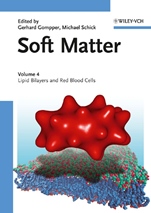
Soft Matter, Volume 4: Lipid Bilayers and Red Blood Cells
ISBN 9783527315024
Autor: Gerhard Gompper, Michael Schick
Wydawca: Wiley
Dostępność: 3-6 tygodni
Cena: 882,00 zł
Przed złożeniem zamówienia prosimy o kontakt mailowy celem potwierdzenia ceny.
ISBN13: |
9783527315024 |
ISBN10: |
3527315020 |
Autor: |
Gerhard Gompper, Michael Schick |
Oprawa: |
Hardback |
Rok Wydania: |
2008-07-23 |
Ilość stron: |
265 |
Wymiary: |
249x179 |
Tematy: |
PH |
The only major book publication on this topic, the Soft Matter series represents comprehensive coverage for readers from chemical, materials science, physical, and biological backgrounds. It carefully collates the must–have interdisciplinary information otherwise only found in textbooks or very specialized proceeding–type books. Encompassing both fundamental research as well as application potential, this field is significant for both academia as well as industry.
This fourth volume in the series focuses on biological membrane science, in particular its biophysics. Clearly divided into two parts, the first covers red blood cell shapes, while the second part on molecular simulation provides in–depth information on how to make significant progress with membrane characterization by means of models, and how to refine them by comparing them to experiments.
The result is a highly relevant monograph for both an understanding of the biophysical concepts as well as of novel applications.
Gerhard Gompper studied physics at the Ludwig–Maximilians University, Munich, where he received his PhD under Herbert Wagner. After a postdoctoral stay with Michael Schick at the University of Washington in Seattle, he returned to Munich to gain his lecturing qualification. An assignment as a staff scientist at the Max–Planck–Institute for Colloid– and Interface Science in Berlin–Teltow from 1994 to 1999 preceded his joint appointment as a director at the Institute for Solid–State Physics at the Research Center Juelich and as a full professor at the University of Cologne. He was recently honored with the Erwin–Schroedinger Award for interdisciplinary research on the efficiency–boosting effect of amphiphilic polymers in microemulsions.
Michael Schick obtained his PhD in physics at Stanford University under Felix Bloch. After a post–doctoral position with Paul Zilsel at Case Western Reserve University, he join
ed the faculty of the University of Washington in 1969. His interests have included phase transitions in lower dimensional systems, wetting phenomena, microemulsions, the phase behavior of block copolymers and of lipids, and the fusion of biological membranes. He has been honored with a fellowship from the American Physical Society, and a Humboldt Foundation Research Award spent at the Ludwig–Maximilians University Munich, where he worked with Gerhard Gompper.
Spis treści:
List of Contributors.
1. Simulations and Models of Lipid Bilayers (Sagar A. Pandit and H. Larry Scott).
1.1. Introduction.
1.2. Atomistic Models.
1.3. Coarse Grain Models.
1.4. Summary.
2.Red Blood Cell Shapes and Shape Transformations: Newtonian Mechanics of a Composite membrane (Gerald Lim H. W., Michael Wortins, and Ranjan Mukhopadhyay).
2.1. Introduction.
2.2. Structrue of the Cell Membrane; the SDE Sequence.
2.3. Membrane Energetics.
2.4. Equations of membrane Shape Mechanics.
2.5. Calculating of the Membrane Skeleton.
2.6. Predicted Shapes and Shape Transformations of the RBC.
2.7. Significant Results and Predictions.
2.8. Discussion and Conclusions: The Future.
Appendix A. Material Parameters and Related Experiments.
Appendix B. Symmetery Sets the Form of Elastic Energies.
Appendix C. Differential Geometery and Coordinate Transformations.
Appendix D. Mechanical Equattions of Membrane Equilibrium.
Index.
Nota biograficzna:
Gerhard Gompper studied Physics at the Ludwig–Maximilians–University Munich, where he received his PhD in Physics in the group of Herbert Wagner. After a postdoctoral stay with Michael Schick at the University of Washington in Seattle, he returned to Munich to earn his habilitation. An assignment as a staff scientist at the Max–Planck–Institute for Solid–State Physics at the Research Center Julich and as a full professor
at the University of Cologne. He was recently honored with the Erwin–Schroedinger–Award for interdisciplinary research on the efficiency–boosting effect of amphiphilic polymers in microemulsions.
Michael Schick obtained his PhD in Physics at Stanford University under Felix Bloch. After a post–doctoral position with Paul Zilsel at Case Western Reserve University, he joined the faculty of the University of Washington in 1969. His interests have included phase transitions in lower dimensional systems, wetting phenomena, microemulsions, the phase behavior of block copolymers and of lipids, and the fusion of biological membranes. He has been honored with Fellowship in the American Physical Society, and a Humboldt Foundation Research Award spent at the Ludwig–Maximilians–University Munich where he worked with Gerhard Gompper. He is married to the scholar o Norwegian Literature, Katherine Hanson, with Whom he lives on their floating home in Seattle′s Portage Bay. He is an avid, amateur ′cellist.
Okładka tylna:
The only major book publication on this topic, the Soft Matter series represents comprehensive coverage for readers from chemical, materials science, physical, and biological backgrounds. It carefully collates the must–have interdisciplinary information otherwise only found in textbooks or very specialized proceeding–type books. Encompassing both fundamental research as well as application potential, this field is significant for both academia as well as industry.
This fourth volume in the series focuses on biological membrane science, in particular its biophysics. Clearly divided into two parts, the first covers red blood cell shapes, while the second part on molecular simulation provides in–depth information on how to make significant progress with membrane characterization by means of models, and how to refine them by comparing them to experiments.
The result i
s a highly relevant monograph for both an understanding of the biophysical concepts as well as of novel applications.
Gerhard Gompper studied physics at the Ludwig–Maximilians University, Munich, where he received his PhD under Herbert Wagner. After a postdoctoral stay with Michael Schick at the University of Washington in Seattle, he returned to Munich to gain his lecturing qualification. An assignment as a staff scientist at the Max–Planck–Institute for Colloid– and Interface Science in Berlin–Teltow from 1994 to 1999 preceded his joint appointment as a director at the Institute for Solid–State Physics at the Research Center Juelich and as a full professor at the University of Cologne. He was recently honored with the Erwin–Schroedinger Award for interdisciplinary research on the efficiency–boosting effect of amphiphilic polymers in microemulsions.
Michael Schick obtained his PhD in physics at Stanford University under Felix Bloch. After a post–doctoral position with Paul Zilsel at Case Western Reserve University, he joined the faculty of the University of Washington in 1969. His interests have included phase transitions in lower dimensional systems, wetting phenomena, microemulsions, the phase behavior of block copolymers and of lipids, and the fusion of biological membranes. He has been honored with a fellowship from the American Physical Society, and a Humboldt Foundation Research Award spent at the Ludwig–Maximilians University Munich, where he worked with Gerhard Gompper.
Koszyk
Książek w koszyku: 0 szt.
Wartość zakupów: 0,00 zł
Informacje


Kontakt
Gambit
Centrum Oprogramowania
i Szkoleń Sp. z o.o.
Al. Pokoju 29b/22-24
31-564 Kraków
Siedziba Księgarni
ul. Kordylewskiego 1
31-542 Kraków
+48 12 410 5991
+48 12 410 5987
+48 12 410 5989
Subskrypcje
Administratorem danych osobowych jest firma Gambit COiS Sp. z o.o. Na podany adres będzie wysyłany wyłącznie biuletyn informacyjny.
Autoryzacja płatności

Informacje na temat autoryzacji płatności poprzez PayU.

© Copyright 2012: GAMBIT COiS Sp. z o.o. Wszelkie prawa zastrzeżone.
Projekt i wykonanie: Alchemia Studio Reklamy