


Wydawcy
Katalog tematyczny
- Archeologia (109)
- Ekonomia, finanse, business (13704)
- Filozofia (1445)
- Historia (3040)
- Języki i językoznawstwo (2356)
- Lifestyle, hobby i rozrywka (475)
- Medycyna (9704)
- Nauki humanistyczne (4)
- Nauki o Ziemi i środowisku (2638)
- Nauki ścisłe (20412)
- Nauki społeczne (8486)
- Nauki techniczne (13450)
- Budownictwo lądowe (1045)
- Chemia przemysłowa (2258)
- Elektronika i telekomunikacja (3287)
- Energetyka (1122)
- Inne nauki stosowane (363)
- Inżynieria biochemiczna (507)
- Inżynieria transportu (232)
- Mechanika i materiały (3316)
- Nauka o środowisku (321)
- Rolnictwo (507)
- Technika, ogólnie (475)
- Prawo (1696)
- Publikacje informacyjne i interdyscyplinarne (1288)
- Religia i wierzenia (917)
- Technika komputerowa (4067)
- Zdrowie, relacje międzyludzkie i rozwój osobisty (657)





Informacje szczegółowe o książce
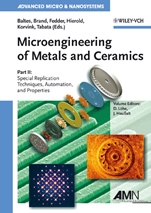
Microengineering of Metals and Ceramics: Special Replication Techniques, Automation, and Properties
ISBN 9783527314935
Autor: Henry Baltes, Oliver Brand, Gary K. Fedder, Christofer Hierold, Jan G. Korvink, Osamu Tabata, Detlef
Wydawca: Wiley
Dostępność: 3-6 tygodni
Cena: 1 098,30 zł
Przed złożeniem zamówienia prosimy o kontakt mailowy celem potwierdzenia ceny.
ISBN13: |
9783527314935 |
ISBN10: |
3527314938 |
Autor: |
Henry Baltes, Oliver Brand, Gary K. Fedder, Christofer Hierold, Jan G. Korvink, Osamu Tabata, Detlef |
Oprawa: |
Hardback |
Rok Wydania: |
2005-08-12 |
Ilość stron: |
306 |
Wymiary: |
249x183 |
Tematy: |
TG |
The gateway to the micro and nano worlds: AMN provides cutting–edge reviews and detailed case studies by top authors from science and industry, covering technologies, devices and advanced systems. Together, these have an immense innovative application potential that opens up with control of shape and function from the atomic level right up to the visible world without any technological gaps.
This and the preceeding volume cover all angles of micro–scale parts and components engineering from both metallic and ceramic materials, a very promising field which is a strong source of innovation and development for micro process technology, aerospace applications, sensors, actors, medical and dental as well as many other applications.
In this volume, readers find casting and electroforming replication techniques, automation and quality control issues, and the characterization of the microengineered components.
From the Contents:
Micro Casting
Micro Electroforming of Metals
Further Ceramic Replication Techniques
Automation PIM
Assembly
Quality Assurance
Metallic Materials
Ceramic Materials
Tribological Characterization of Mold Inserts and Materials for Micro Components
Development of a Simulation Tool for Wear in Microsystems
Part I covers the introduction to this field and leads from the design and modeling aspects to tooling, molds, and micro injection molding as a powerful replication technology.
Spis treści:
Preface.
Foreword.
List of Contributors.
IV: Replication Techniques – Micro Casting, Micro Electro Forming and Further Techniques.
13. Microcasting (G. Baumeister, J. Haußelt, S. Rath, R. Ruprecht).
14. Microelectroforming of Metals (G. Schanz, K. Bade).
15. Further Ceramic Replication Techniques (H.–J. Ritzhaupt–Kleissl, H. von Both, M. Dauscher, R. Knitter).
V: Automation and Quality Assurance.
16. Automation of the Powder Inject
ion Molding Process (H. Weule, J. Fleischer, C. Buchholz).
17. Microassembly – Approaches to Meet the Requirements of Accuracy (J. Hesselbach, J. Wrege, A. Raatz, K. Heuer, S. Soetebier).
18. Quality Assurance and Dimensional Measurement Technology (J. Fleischer, I. Behrens).
VI: Properties of Materials and Microcomponents.
19. Analysis of Microstructure, Surface Topography and Mechanical Properties of Microcast Specimens Made of the Dental Gold Alloy Stabilor G (B. Kasanická, M. Auhorn, V. Schulze, T. Beck, D. Löhe).
20. Microstructure, Surface Topography and Mechanical Properties of Molded ZrO2 Microspecimens (M. Auhorn, B. Kasanická, T. Beck, V. Schulze, D. Löhe).
21. Tribological Characterization of Mold Inserts and Materials for Microcomponents (J. Schneider, K.–H. Zum Gahr, J. Herz).
22. Development of a Simulation Tool for Wear in Microsystems (V. Hegadekatte, N. Huber, O. Kraft).
Subject Index.
Nota biograficzna:
Prof. Dr.–Ing. Detlef Löhe studied mechanical engineering at the Technical University of Karlsruhe, Germany and obtained his Ph.D. in 1980. After heading the microstructure and mechancal behaviour working group there, he was appointed in 1991 as professor for materials science at Paderborn University, Germany, where he received an award for outstanding teaching achievements in 1994. In the same year, he returned to the Institute for Materials Science and Enginering I at Karlsruhe Technical University as its Director. He is Speaker of the Collaborative Research Centre 499 "Design, production and quality assurance of molded microparts constructed of metals and ceramics" and has been a Senator of the Deutsche Forschungsgemeinschaft (DFG) since 2003.
His research interests focus on metallic and ceramic materials properties and durability under different kinds of stress, component manufacture and behaviour, optimisation of heat treatment methods, and
failure analysis.
Prof. Dr.–Ing. Jürgen Hauβelt studied Physics and Materials Sciences at the University of Erlangen, Germany. After his doctorate and a research stay at Stanford University he joined Degussa AG in 1977, starting in metals research. After having worked as technical director in Degussa´s subsidiary in New York City, he returned to Germany in 1985 and was first in charge of metals research, then managed the entire materials development und process technology of Degussa´s corporate division "Metals". In 1993 he joined Forschungszentrum Karlsruhe as head of the Institute of Materials Research III. In addition, he was appointed professor at Freiburg University as Chair for Micromaterials Process Technology at IMTEK in 1996. In 1998 he became member of the supervisory board of Norddeutsche Affinerie AG, Hamburg.
Okładka tylna:
The gateway to the micro and nano worlds: AMN provides cutting–edge reviews and detailed case studies by top authors from science and industry, covering technologies, devices and advanced systems. Together, these have an immense innovative application potential that opens up with control of shape and function from the atomic level right up to the visible world without any technological gaps.
This and the preceeding volume cover all angles of micro–scale parts and components engineering from both metallic and ceramic materials, a very promising field which is a strong source of innovation and development for micro process technology, aerospace applications, sensors, actors, medical and dental as well as many other applications.
In this volume, readers find casting and electroforming replication techniques, automation and quality control issues, and the characterization of the microengineered components.
From the Contents:
Micro Casting
Micro Electroforming of Metals
Further Ceramic Replication Techniques
Automation PIM
Assembly
Quality Assuranc
e
Metallic Materials
Ceramic Materials
Tribological Characterization of Mold Inserts and Materials for Micro Components
Development of a Simulation Tool for Wear in Microsystems
Part I covers the introduction to this field and leads from the design and modeling aspects to tooling, molds, and micro injection molding as a powerful replication technology.
Koszyk
Książek w koszyku: 0 szt.
Wartość zakupów: 0,00 zł
Informacje


Kontakt
Gambit
Centrum Oprogramowania
i Szkoleń Sp. z o.o.
Al. Pokoju 29b/22-24
31-564 Kraków
Siedziba Księgarni
ul. Kordylewskiego 1
31-542 Kraków
+48 12 410 5991
+48 12 410 5987
+48 12 410 5989
Subskrypcje
Administratorem danych osobowych jest firma Gambit COiS Sp. z o.o. Na podany adres będzie wysyłany wyłącznie biuletyn informacyjny.
Autoryzacja płatności

Informacje na temat autoryzacji płatności poprzez PayU.

© Copyright 2012: GAMBIT COiS Sp. z o.o. Wszelkie prawa zastrzeżone.
Projekt i wykonanie: Alchemia Studio Reklamy