


Wydawcy
Katalog tematyczny
- Archeologia (109)
- Ekonomia, finanse, business (13704)
- Filozofia (1445)
- Historia (3040)
- Języki i językoznawstwo (2356)
- Lifestyle, hobby i rozrywka (475)
- Medycyna (9704)
- Nauki humanistyczne (4)
- Nauki o Ziemi i środowisku (2638)
- Nauki ścisłe (20412)
- Astronomia (294)
- Biologia (5119)
- Chemia (6540)
- Chemia analityczna (361)
- Chemia fizyczna (346)
- Chemia nieorganiczna (137)
- Chemia organiczna (535)
- Krystalografia (27)
- Minerologia (46)
- Fizyka (3309)
- Matematyka (4574)
- Nauki ścisłe, ogólnie (503)
- Nauki społeczne (8486)
- Nauki techniczne (13450)
- Prawo (1696)
- Publikacje informacyjne i interdyscyplinarne (1288)
- Religia i wierzenia (917)
- Technika komputerowa (4067)
- Zdrowie, relacje międzyludzkie i rozwój osobisty (657)





Informacje szczegółowe o książce
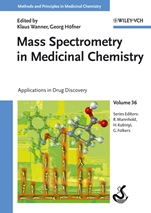
Mass Spectrometry in Medicinal Chemistry: Applications in Drug Discovery
ISBN 9783527314560
Autor: Klaus Wanner, Georg Höfner, Raimund Mannhold, Hugo Kubinyi, Gerd Folkers
Wydawca: Wiley
Dostępność: 3-6 tygodni
Cena: 1 151,85 zł
Przed złożeniem zamówienia prosimy o kontakt mailowy celem potwierdzenia ceny.
ISBN13: |
9783527314560 |
ISBN10: |
3527314563 |
Autor: |
Klaus Wanner, Georg Höfner, Raimund Mannhold, Hugo Kubinyi, Gerd Folkers |
Oprawa: |
Hardback |
Rok Wydania: |
2007-02-23 |
Ilość stron: |
460 |
Wymiary: |
249x177 |
Tematy: |
PN |
In modern medicinal chemistry, drug assays (screens) often require that thousands of compounds be detected reliably and quickly. Mass spectroscopy–based pharmaceutical analysis is the key to improved high–throughput drug screening, rational drug design and the analysis of multiple ligand–target interactions. What is more, it can be set up to work with only minute amounts of material, allowing is use in miniaturized benchtop assay systems. Its ability to discern several compounds in a single sample has made it possible to analyze complex drug–target interactions that are not easily accessible with other techniques.
This first overview of the topic opens with a general introduction to the use of mass spectrometry in pharmaceutical screening, followed by a detailed description of recently developed analytical systems for use in the pharmaceutical laboratory.
Applications range from simple binding assays to complex screens of biological activity and systems containing multiple targets or ligands –– all highly relevant techniques in the early stages in drug discovery, from target characterization to hit and lead finding.
A ready reference for medicinal and organic chemists, spectroscopists, and those working in the pharmaceutical industry.
Spis treści:
Preface.
A Personal Foreword.
List of Contributors.
I Introduction to MS in bioanalysis.
1 Mass Spectrometry in Bioanalysis – Methods, Principles and Instrumentation (Gérard Hopfgartner).
1.1 Introduction.
1.2 Fundamentals.
1.3 Ionization Techniques.
1.4 Mass Analyzers.
1.5 Ion Detectors.
1.6 Practical Aspects and Applications in Bioanalysis.
1.7 Perspectives.
1.8 Common Definitions and Abbreviations.
References.
II Studying target–ligand interactions analyzing the ligand by MS.
2 Drug Screening Using Gel Permeation Chromatography Spin Columns Coupled wit
h ESI–MS (Marshall M. Siegel).
2.1 Introduction.
2.2 Experimental.
2.3 Results.
2.4 Conclusions.
References.
3 ALIS: An Affinity Selection–Mass Spectrometry System for the Discovery and Characterization of Protein–Ligand Interactions (Allen Annis, Cheng–Chi Chuang, and Naim Nazef).
3.1 Introduction.
3.2 ALIS: An Affinity Selection–Mass Spectrometry System based on Continuous SEC.
3.3 Discovery of Ligands from Combinatorial Libraries.
3.4 Quantitative Binding Affinity Measurement.
3.5 Competition–based Binding Site Determination and Affinity Ranking in Mixtures.
3.6 Protein–Ligand Dissociation Rate Measurement.
3.7 Conclusions.
3.8 Future Directions.
References.
4 Library Screening Using Ultrafiltration and Mass Spectrometry (Timothy E. Cloutier and Kenneth M. Comess).
4.1 Introduction.
4.2 Ultra–high Throughput Filtration–based Affinity Screening as a Discovery Tool.
4.3 Additional Affinity Screening Methodology That Includes Mass Spectrometry–based Readout.
4.4 Conclusions and Future Directions.
References.
5 Continuous–flow Systems for Ligand Binding and Enzyme Inhibition Assays Based on Mass Spectrometry (Hubertus Irth).
5.1 Introduction.
5.2 Continuous–flow Enzyme Assays Based on Mass Spectrometry.
5.3 Continuous–flow Ligand Binding Assays Based on Mass Spectrometry.
5.4 MS Assay Based on Dissociation of Isolated Protein–Ligand Complexes.
5.5 Future Prospects.
References.
6 Frontal Affinity Chromatography – Mass Spectrometry for Ligand Discovery and Characterization (Nora Chan, Darren Lewis, Michele Kelly, Ella S.M. Ng, and David C. Schriemer).
6.1 Introduction.
6.2 Enabling FAC with MS Detection.
6.3 System Advancements – Fluidics, Immobilization, Detection.
6.4 Select Applications.
6.5 Summary and E
valuation.
References.
7 MS Binding Assays – An Alternative to Radioligand Binding (Georg Ho¨fner, Christine Zepperitz, and Klaus T. Wanner).
7.1 Introduction.
7.2 Radioligand Binding Assays.
7.3 MS Binding Assays.
7.4 Summary and Perspectives.
References.
8 Laser Desorption Assays – MALDI–MS, DIOS–MS, and SAMDI–MS (Martin Vogel, Andy Scheffer, Andre´ Liesener, and Uwe Karst).
8.1 MALDI–MS Assays.
8.2 DIOS: Desorption/Ionization on Silicon.
8.3 SAMDI: Self–assembled Monolayers for MALDI–MS.
8.4 Conclusion.
References.
III Studying target–ligand interactions analyzing intact target–ligand complexes by MS.
9 Tethering: Fragment–based Drug Discovery by Mass Spectrometry (Mark T. Cancilla and Daniel A. Erlanson).
9.1 Introduction.
9.2 Reduction to Practice.
9.3 Finding Fragments: Thymidylate Synthase Proof of Principle.
9.4 Finding and Linking Fragments in One Step: Tethering with Extenders.
9.5 Conclusions.
References.
10 Interrogation of Noncovalent Complexes by ESI–MS: A Powerful Platform for High Throughput Drug Discovery (Steven A. Hofstadler and Kristin A. Sannes–Lowery).
10.1 Analysis of Noncovalent Complexes by ESI–MS.
10.2 Multitarget Affinity/Specificity Screening.
10.3 Multitarget Affinity/Specificity Screening in a High Throughput Format.
10.4 Affinity/Specificity.
10.5 SAR by MS.
10.6 Future Directions.
References.
IV Studying target–ligand interactions analyzing the target binding site by MS.
11 Quantification of Protein–Ligand Interactions in Solution by Hydrogen/Deuterium Exchange (PLIMSTEX) (Mei M. Zhu, David Hambly, and Michael L. Gross).
11.1 Introduction.
11.2 The PLIMSTEX Method.
11.3 Applications of PLIMSTEX.
11.4 Features of PLIMSTEX.
11.5 Fast Radical Footprin
ting for Protein–Ligand Interaction Analysis.
11.6 Potential Applications in Drug Discovery.
References.
12 Protein–targeting Drug Discovery Guided by Hydrogen/Deuterium Exchange Mass Spectrometry (DXMS) (Yoshitomo Hamuro, Stephen J. Coales, and Virgil L. Woods Jr).
12.1 Introduction.
12.2 Theory of H/D Exchange.
12.3 Overview of H/D Exchange Technologies.
12.4 DXMS–guided Design of Well Crystallizing Proteins.
12.5 Rapid Characterization of Protein Conformational Change with DXMS.
12.6 Application of H/D Exchange to Protein–Small Molecule Ligand Interactions.
12.7 DXMS–guided Design of Small Molecules that Target Protein–Protein Interaction Surfaces.
12.8 Optimal Formulation and Quality Control of Whole–protein Therapeutics with DXMS.
12.9 Conclusions.
References.
V MS in early pharmacokinetics.
13 Mass Spectrometry in Early Pharmacokinetic Investigations (Walter A. Korfmacher).
13.1 Introduction.
13.2 HPLC–MS/MS Overview.
13.3 In Vitro Applications.
13.4 In Vivo Applications.
13.5 Rapid Method Development.
13.6 Increasing Throughput in HPLC–MS/MS.
13.7 Matrix Effects.
13.8 Discovery PK Assay Rules.
13.9 New Technology in LC–MS.
13.10 Conclusion.
References.
Index.
Nota biograficzna:
Klaus T. Wanner studied Chemistry and Pharmacy in Munich and obtained a PhD in Pharmaceutical Chemistry in 1983. He was a postdoctoral fellow in the research group of A. I. Meyers at Colorado State University before taking up a faculty position at the Free University of Berlin. Since 1994, He is a full professor for Pharmaceutical Chemistry at the University of Munich. His main interest is in ligand and inhibitor design for GABA receptors and transporters, as well as in stereochemical aspects of structure–activity relationships.
Georg C. Hofner studied Pharmacy at t
he University of Munich and obtained a PhD in Pharmaceutical Chemistry in 1989. He is a specialist on screening technology and is currently supervising the biological assay unit of the Centre of Drug Research at the University of Munich.
Okładka tylna:
In modern medicinal chemistry, drug assays (screens) often require that thousands of compounds be detected reliably and quickly. Mass spectroscopy–based pharmaceutical analysis is the key to improved high–throughput drug screening, rational drug design and the analysis of multiple ligand–target interactions. What is more, it can be set up to work with only minute amounts of material, allowing is use in miniaturized benchtop assay systems. Its ability to discern several compounds in a single sample has made it possible to analyze complex drug–target interactions that are not easily accessible with other techniques.
This first overview of the topic opens with a general introduction to the use of mass spectrometry in pharmaceutical screening, followed by a detailed description of recently developed analytical systems for use in the pharmaceutical laboratory.
Applications range from simple binding assays to complex screens of biological activity and systems containing multiple targets or ligands –– all highly relevant techniques in the early stages in drug discovery, from target characterization to hit and lead finding.
A ready reference for medicinal and organic chemists, spectroscopists, and those working in the pharmaceutical industry.
Koszyk
Książek w koszyku: 0 szt.
Wartość zakupów: 0,00 zł
Informacje


Kontakt
Gambit
Centrum Oprogramowania
i Szkoleń Sp. z o.o.
Al. Pokoju 29b/22-24
31-564 Kraków
Siedziba Księgarni
ul. Kordylewskiego 1
31-542 Kraków
+48 12 410 5991
+48 12 410 5987
+48 12 410 5989
Subskrypcje
Administratorem danych osobowych jest firma Gambit COiS Sp. z o.o. Na podany adres będzie wysyłany wyłącznie biuletyn informacyjny.
Autoryzacja płatności

Informacje na temat autoryzacji płatności poprzez PayU.

© Copyright 2012: GAMBIT COiS Sp. z o.o. Wszelkie prawa zastrzeżone.
Projekt i wykonanie: Alchemia Studio Reklamy