


Wydawcy
Katalog tematyczny
- Archeologia (109)
- Ekonomia, finanse, business (13704)
- Filozofia (1445)
- Historia (3040)
- Języki i językoznawstwo (2356)
- Lifestyle, hobby i rozrywka (475)
- Medycyna (9704)
- Nauki humanistyczne (4)
- Nauki o Ziemi i środowisku (2638)
- Nauki ścisłe (20412)
- Astronomia (294)
- Biologia (5119)
- Chemia (6540)
- Chemia analityczna (361)
- Chemia fizyczna (346)
- Chemia nieorganiczna (137)
- Chemia organiczna (535)
- Krystalografia (27)
- Minerologia (46)
- Fizyka (3309)
- Matematyka (4574)
- Nauki ścisłe, ogólnie (503)
- Nauki społeczne (8486)
- Nauki techniczne (13450)
- Prawo (1696)
- Publikacje informacyjne i interdyscyplinarne (1288)
- Religia i wierzenia (917)
- Technika komputerowa (4067)
- Zdrowie, relacje międzyludzkie i rozwój osobisty (657)





Informacje szczegółowe o książce
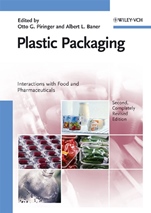
Plastic Packaging: Interactions with Food and Pharmaceuticals
ISBN 9783527314553
Autor: Otto G. Piringer, A. L. Baner
Wydawca: Wiley
Dostępność: 3-6 tygodni
Cena: 1 558,20 zł
Przed złożeniem zamówienia prosimy o kontakt mailowy celem potwierdzenia ceny.
ISBN13: |
9783527314553 |
ISBN10: |
3527314555 |
Autor: |
Otto G. Piringer, A. L. Baner |
Oprawa: |
Hardback |
Rok Wydania: |
2008-02-13 |
Numer Wydania: |
2nd, Completely Revised Edition |
Ilość stron: |
632 |
Wymiary: |
251x182 |
Tematy: |
PN |
Plastics are the most important class of packaging materials. This successful handbook, now in its second edition, covers all important aspects of plastic packaging and the interdisciplinary knowledge needed by food chemists, pharmaceutical chemists, food technologists, materials scientists, process engineers, and product developers alike.
This is an indispensable resource in the search for the optimal plastic packaging. Materials characteristics, additives and their effects, mass transport phenomena, quality assurance, and recent regulatory requirements from FDA and European Commission are covered in detail with ample data.
Spis treści:
Preface.
List of Contributors.
1 Preservation of Quality Through Packaging (Albert Baner and Otto Piringer).
1.1 Quality and Shelf–Life.
1.2 Physical and Chemical Interactions Between Plastics and Food or Pharmaceuticals.
1.3 The Organization of this Book.
2 Characteristics of Plastic Materials (Johannes Brandsch and Otto Piringer).
2.1 Classification, Manufacture, and Processing Aids.
2.2 Structure and States of Aggregation in Polymers.
2.3 The Most Important Plastics.
3 Polymer Additives (Jan Pospisil and Stanislav Nespurek)
3.1 Introduction.
3.2 Antifogging Agents.
3.3 Antistatic Agents.
3.4 Blowing Agents.
3.5 Colorants.
3.6 Fillers and Reinforcing Agents.
3.7 Lubricants.
3.8 Nucleating Agents.
3.9 Optical Brighteners.
3.10 Plasticizers.
3.11 Stabilizers.
3.12 Transformation Products of Plastic Stabilizers.
3.13 Conclusions.
4 Partition Coefficients (Albert Baner and Otto Piringer).
4.1 Experimental Determination of Polymer/Liquid Partition Coefficients.
4.2 Thermodynamics of Partition Coefficients.
4.3 Estimation of Partition Coefficients Between Polymers and Liquids.
5 Models for Diffusion in Polymers (Peter Mercea).
5.1 Diffusion in Polymers – The Classical Approach.<
br>5.2 Diffusion in Polymers – The Computational Approach.
5.3 Conclusions.
6 A Uniform Model for Prediction of Diffusion Coefficients with Emphasis on Plastic Materials (Otto Piringer).
6.1 Introduction.
6.2 Interaction Model.
6.3 Prerequisites for Diffusion Coefficients.
6.4 The Diffusion Coefficient.
7 Transport Equations and Their Solutions (Otto Piringer and Titus Beu).
7.1 The Transport Equations.
7.2 Solutions of the Diffusion Equation.
7.3 Numerical Solutions of the Diffusion Equation.
8 Solution of the Diffusion Equation for Multilayer Packaging (Valer Tosa and Peter Mercea).
8.1 Introduction.
8.2 Methods for Solving the Diffusion Problem in a Multilayer (ML) Packaging.
8.3 Solving the Diffusion Equation for a Multilayer Packaging in Contact with a Foodstuff.
8.4 Development of a User–Friendly Software for the Estimation of Migration from Multilayer Packaging.
9 User–Friendly Software for Migration Estimations (Peter Mercea, Liviu Petrescu, Otto Piringer and Valer Tosa).
9.1 Introduction.
9.2 MIGRATEST#Lite – A User–Friendly Software for Migration Estimations.
10 Permeation of Gases and Condensable Substances Through Monolayer and Multilayer Structures (Horst–Christian Langowski).
10.1 Introduction: Barrier Function of Polymer–Based Packaging.
10.2 Permeation Through Polymeric Materials.
10.3 Substance Transport Through Single and Multilayer Polymer Substrates Combined with One Inorganic Barrier Layer.
10.5 Substance Transport Through Polymers Filled with Particles.
10.6 Experimental Findings: Polymer Films and One Inorganic Barrier Layer.
10.7 Experimental Findings: Combinations of Polymer Films and More Than One Inorganic Barrier Layer.
10.8 Experimental Findings: Polymers Filled with Platelet–Shaped Particles.
10.9 Experimental Findings: Permeation of Flavors Through Mono– and Multilaye
r Films and Combinations with Inorganic Barrier Layers.
10.10 Conclusions.
11 Migration of Plastic Constituents (Roland Franz and Angela Störmer).
11.1 Definitions and Theory.
11.2 Indirect Migration Assessment.
11.3 Migration Experiment.
11.4 Analysis of Migration Solutions.
11.5 Development of Methods, Validation, and Verification.
11.6 Sources of Errors.
11.7 Migration into Food Simulants in Comparison to Foods.
11.8 Consideration of Non Intentionally Added Substances (NIAS) and Other not Regulated Migrants.
12 US FDA Food Contact Materials Regulations (Allan Bailey, Layla Batarseh, Timothy Begley and Michelle Twaroski).
12.1 Introduction.
12.2 Regulatory Authority.
12.3 Premarket Safety Assessment.
12.4 Final Thoughts.
12.5 Conclusions.
13 Community Legislation on Materials and Articles Intended to Come into Contact with Foodstuffs (Luigi Rossi).
13.1 Introduction.
13.2 Community Legislation.
13.3 National Law and European Mutual Recognition.
13.4 National Legislations and Council of Europe Resolutions.
13.5 Conclusions.
14 Packaging Related Off–Flavors in Foods (Albert Baner, Francois Chastellain and André Mandanis).
14.1 Introduction.
14.2 Sensory Evaluation.
14.3 Identification of Off–Flavor Compounds.
14.4 Physical Chemical Parameters Determining Off–Flavors.
14.5 Derivation of Threshold Concentrations of Sensory–Active Compounds.
15 Possibilities and Limitations of Migration Modeling (Peter Mercea and Otto Piringer).
15.1 Correlation of Diffusion Coefficients with Plastic Properties.
15.2 The Partition Coefficient.
Appendices.
Appendix I (Peter Mercea).
Appendix II.
Appendix III.
A Selection of Additives Used in Many Plastic Materials.
Index.
Nota biograficzna:
Dr. Piringer is a chemist working in the field of packaging since 1978 at the Fraunhofer Institu
te of Food Technology and Packaging in Munich. In 1997 he co–founded the FABES research company which specializes in analysis and evaluation of mass transfer. His main activities are testing interactions between packaging and materials intended to come into contact with food and other products like drugs, cosmetics, fuel, or chemicals. In addition he develops analytical methods for determining the migration of toxicologically relevant substances and decomposition products into packed goods as well as sources of off–flavours occurring during their storage. As a leading expert in this area he serves on national and European Committees dealing in food law for food contact packaging materials. Otto–G?Piringer is a member of the Plastics Commission of the German Federal Institute of Risk Assessment in Berlin, formerly known as the German Federal Health Office. He is author and co–author of more than 100 scientific papers.
Dr. Baner, who has degrees in food science, packaging and agricultural engineering, has been researching and working in the packaging field since 1981. He has worked at Michigan State University, the Fraunhofer Institute of Food Technology and Packaging in Munich, the Nestle Research Center in Lausanne and is currently a research packaging scientist with Nestle Purina Petcare in Saint Louis. His research areas encompass the experimental determination and estimation of permeation, diffusion, sorption and migration of flavor molecules and packaging constituents between packaged goods and their packaging. Albert Lawrence Baner is author and co–author of more than 30 scientific papers.
Koszyk
Książek w koszyku: 0 szt.
Wartość zakupów: 0,00 zł
Informacje


Kontakt
Gambit
Centrum Oprogramowania
i Szkoleń Sp. z o.o.
Al. Pokoju 29b/22-24
31-564 Kraków
Siedziba Księgarni
ul. Kordylewskiego 1
31-542 Kraków
+48 12 410 5991
+48 12 410 5987
+48 12 410 5989
Subskrypcje
Administratorem danych osobowych jest firma Gambit COiS Sp. z o.o. Na podany adres będzie wysyłany wyłącznie biuletyn informacyjny.
Autoryzacja płatności

Informacje na temat autoryzacji płatności poprzez PayU.

© Copyright 2012: GAMBIT COiS Sp. z o.o. Wszelkie prawa zastrzeżone.
Projekt i wykonanie: Alchemia Studio Reklamy