


Wydawcy
Katalog tematyczny
- Archeologia (109)
- Ekonomia, finanse, business (13704)
- Filozofia (1445)
- Historia (3040)
- Języki i językoznawstwo (2356)
- Lifestyle, hobby i rozrywka (475)
- Medycyna (9704)
- Nauki humanistyczne (4)
- Nauki o Ziemi i środowisku (2638)
- Nauki ścisłe (20412)
- Astronomia (294)
- Biologia (5119)
- Chemia (6540)
- Chemia analityczna (361)
- Chemia fizyczna (346)
- Chemia nieorganiczna (137)
- Chemia organiczna (535)
- Krystalografia (27)
- Minerologia (46)
- Fizyka (3309)
- Matematyka (4574)
- Nauki ścisłe, ogólnie (503)
- Nauki społeczne (8486)
- Nauki techniczne (13450)
- Prawo (1696)
- Publikacje informacyjne i interdyscyplinarne (1288)
- Religia i wierzenia (917)
- Technika komputerowa (4067)
- Zdrowie, relacje międzyludzkie i rozwój osobisty (657)





Informacje szczegółowe o książce
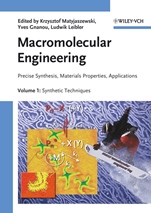
Macromolecular Engineering: Precise Synthesis, Materials Properties, Applications 4 Volume Set
ISBN 9783527314461
Autor: Krzysztof Matyjaszewski, Yves Gnanou, Ludwik Leibler
Wydawca: Wiley
Dostępność: 3-6 tygodni
Cena: 4 071,90 zł
Przed złożeniem zamówienia prosimy o kontakt mailowy celem potwierdzenia ceny.
ISBN13: |
9783527314461 |
ISBN10: |
3527314466 |
Autor: |
Krzysztof Matyjaszewski, Yves Gnanou, Ludwik Leibler |
Oprawa: |
Hardback |
Rok Wydania: |
2007-02-23 |
Numer Wydania: |
4 Volume Set |
Ilość stron: |
2982 |
Wymiary: |
345x262 |
Tematy: |
PN |
Macromolecules are essential for life and constitute the basics for molecular biology, biochemistry, biophysics and food chemistry. They are also the constituents of polymers that find applications as plastics, fibers, elastomers, coatings, and adhesives in the electrical and optical industries, as well as in many other fields.
Macromolecular engineering includes the design and preparation of well–defined macromolecules, together with their precise characterization at various stages of synthesis and processing so a to optimize their macroscopic properties for specific functions and applications.
This is a state–of–the–art description of the synthetic tools used to precisely control various aspects of macromolecular structure, as well as modern characterization techniques at molecular and macroscopic level for various properties of well–defined (co)polymers in solution, bulk and at surfaces.
Volume 1 covers synthetic techniques, while Volume 2 deals with the elements of macromolecular structural control, such as chain microstructure, chain topology and special systems. The third volume discusses investigation techniques and characterization, while the final volume looks at emerging applications.
Spis treści:
Preface.
List of Contributors.
Volume 1: Synthetic Techniques.
1 Macromolecular Engineering (Krzysztof Matyjaszewski, Yves Gnanou, and Ludwik Leibler).
2 Anionic Polymerization of Vinyl and Related Monomers (Michel Fontanille and Yves Gnanou).
3 Carbocationic Polymerization (Priyadarsi De and Rudolf Faust).
4 Ionic and Coordination Ring–opening Polymerization (Stanislaw Penczek, Andrzej Duda, Przemyslaw Kubisa, and Stanislaw Slomkowski).
5 Radical Polymerization (Krzysztof Matyjaszewski and Wade A. Braunecker).
6 Coordination Polymerization: Synthesis of New Homo– and Copolymer Architectures from Ethylene and Pr
opylene using Homogeneous Ziegler–Natta Polymerization Catalysts (Andrew F. Mason and Geoffrey W. Coates).
7 Recent Trends in Macromolecular Engineering (Damien Quémener, Valérie Héroguez, and Yves Gnanou).
8 Polycondensation (Tsutomu Yokozawa).
9 Supramolecular Polymer Engineering (G. B.W. L. Ligthart, Oren A. Scherman, Rint P. Sijbesma, and E.W. Meijer).
10 Polymer Synthesis and Modification by Enzymatic Catalysis (Shiro Kobayashi and Masashi Ohmae).
11 Biosynthesis of Protein–based Polymeric Materials (Robin S. Farmer, Manoj B. Charati, and Kristi L. Kiick).
12 Macromolecular Engineering of Polypeptides Using the Ring–opening Polymerization–Amino Acid N–Carboxyanhydrides (Harm–Anton Klok and Timothy J. Deming).
13 Segmented Copolymers by Mechanistic Transformations (M. Atilla Tasdelen and Yusuf Yagci).
14 Polymerizations in Aqueous Dispersed Media (Bernadette Charleux and François Ganachaud).
15 Polymerization Under Light and Other External Stimuli (Jean Pierre Fouassier, Xavier Allonas, and Jacques Lalevée).
16 Inorganic Polymers with Precise Structures (David A. Rider and Ian Manners).
Volume 2: Elements of Macromolecular Structural Control.
1 Tacticity (Tatsuki Kitayama).
2 Synthesis of Macromonomers and Telechelic Oligomers by Living Polymerizations (Bernard Boutevin, Cyrille Boyer, Ghislain David, and Pierre Lutz).
3 Statistical, Alternating and Gradient Copolymers (Bert Klumperman).
4 Multisegmental Block/Graft Copolymers (Constantinos Tsitsilianis).
5 Controlled Synthesis and Properties of Cyclic Polymers (Alain Deffieux and Redouane Borsali).
6 Polymers with Star–related Structures (Nikos Hadjichristidis, Marinos Pitsikalis, and Hermis Iatrou).
7 Linear Versus (Hyper)branched Polymers (Hideharu Mori, A
xel H.E. Müller, and Peter F.W. Simon).
8 From Stars to Microgels (Daniel Taton).
9 Molecular Design and Self–assembly of Functional Dendrimers (Wei–Shi Li, Woo–Dong Jang, and Takuzo Aida).
10 Molecular Brushes – Densely Grafted Copolymers (Brent S. Sumerlin and Krzysztof Matyjaszewski).
11 Grafting and Polymer Brushes on Solid Surfaces (Takeshi Fukuda, Yoshinobu Tsujii, and Kohji Ohno).
12 Hybrid Organic Inorganic Objects (Stefanie M. Gravano and Timothy E. Patten).
13 Core–Shell Particles (Anna Musyanovych and Katharina Landfester).
14 Polyelectrolyte Multilayer Films–A General Approach to (Bio)functional Coatings (Nadia Benkirane–Jessel, Philippe Lavalle, Vincent Ball, Joëlle Ogier, Bernard Senger, Catherine Picart, Pierre Schaaf, Jean–Claude Voegel, and Gero Decher).
15 Bio–inspired Complex Block Copolymers/Polymer Conjugates and Their Assembly (Markus Antonietti, Hans G. Börner, and Helmut Schlaad).
16 Complex Functional Macromolecules (Zhiyun Chen, Chong Cheng, David S. Germack, Padma Gopalan, Brooke A. van Horn, Shrinivas Venkataraman, and Karen L. Wooley).
Volume 3: Structure–Property Correlation and Characterization Techniques.
1 Self–assembly and Morphology Diagrams for Solution and Bulk Materials: Experimental Aspects (Vahik Krikorian, Youngjong Kang, and Edwin L. Thomas).
2 Simulations (Denis Andrienko and Kurt Kremer).
3 Transport and Electro–optical Properties in Polymeric Self–assembled Systems (Olli Ikkala and Gerrit ten Brinke).
4 Atomic Force Microscopy of Polymers: Imaging, Probing and Lithography (Sergei S. Sheiko and Martin Moller).
5 Scattering from Polymer Systems (Megan L. Ruegg and Nitash P. Balsara).
6 From Linear to (Hyper) Branched Polymers: Dynamics and Rheology (Thomas C. B. McLeish).
7 Determination of Bulk and Solution Morphologies by Transmission Electron Microscopy (Volker Abetz, Richard J. Spontak, and Yeshayahu Talmon).
8 Polymer Networks (Karel Dusˇek and Miroslava Dušková–Smrc˘ková).
9 Block Copolymers for Adhesive Applications (Costantino Creton).
10 Reactive Blending (Robert Jerome).
11 Predicting Mechanical Performance of Polymers (Han E.H. Meijer, Leon E. Govaert, and Tom A.P. Engels).
12 Scanning Calorimetry (René Androsch and Bernhard Wunderlich).
13 Chromatography of Polymers (Wolfgang Radke).
14 NMR Spectroscopy (Hans Wolfgang Spiess).
15 High–throughput Screening in Combinatorial Polymer Research (Michael A. R. Meier, Richard Hoogenboom, and Ulrich S. Schubert).
Volume 4: Applications.
1 Applications of Thermoplastic Elastomers Based on Styrenic Block Copolymers (Dale L. Handlin, Jr., Scott Trenor, and Kathryn Wright).
2 Nanocomposites (Michaël Alexandre and Philippe Dubois).
3 Polymer/Layered Filler Nanocomposites: An Overview from Science to Technology (Masami Okamoto).
4 Polymeric Dispersants (Frank Pirrung and Clemens Auschra).
5 Polymeric Surfactants (Henri Cramail, Eric Cloutet, and Karunakaran Radhakrishnan).
6 Molecular and Supramolecular Conjugated Polymers for Electronic Applications (Andrew C. Grimsdale and Klaus Müllen).
7 Polymers for Microelectronics (Christopher W. Bielawski and C. Grant Willson).
8 Applications of Controlled Macromolecular Architectures to Lithography (Daniel Bratton, Ramakrishnan Ayothi, Nelson Felix, and Christopher K. Ober).
9 Microelectronic Materials with Hierarchical Organization (G. Dubois, R. D. Miller and James L. Hedrick).
10 Semiconducting Polymers and their Optoelectronic Applications (Nicolas Leclerc, Thomas Heiser, Cyril Brocho
n, and Georges Hadziioannou).
11 Polymer Encapsulation of Metallic and Semiconductor Nanoparticles: Multifunctional Materials with Novel Optical, Electronic and Magnetic Properties (Jeffrey Pyun and Todd Emrick).
12 Polymeric Membranes for Gas Separation, Water Purification and Fuel Cell Technology (Kazukiyo Nagai, Young Moo Lee, and Toshio Masuda).
13 Utilization of Polymers in Sensor Devices (Basudam Adhikari and Alok Kumar Sen).
14 Polymeric Drugs (Tamara Minko, Jayant J. Khandare, and Sreeja Jayant).
15 From Biomineralization Polymers to Double Hydrophilic Block and Graft Copolymers (Helmut Cölfen).
16 Applications of Polymer Bioconjugates (Joost A. Opsteen and Jan C. M. van Hest).
17 Gel: a Potential Material as Artificial Soft Tissue (Yong Mei Chen, Jian Ping Gong, and Yoshihito Osada).
18 Polymers in Tissue Engineering (Jeffrey A. Hubbell).
IUPAC Polymer Terminology and Macromolecular Nomenclature (R. F.T. Stepto).
Subject Index.
Nota biograficzna:
Krzysztof Matyjaszewski is currently J.C. Warner University Professor of Natural Sciences at Carnegie Mellon University in Pittsburgh, USA. He is also Director of Center for Macromolecular Engineering at CMU and adjunct professor at University of Pittsburgh and at Polish Academy of Sciences. He is the editor of "Progress in Polymer Science" and "Central European Journal of Chemistry". His research group is involved in several areas of macromolecular engineering, especially in synthesis of various well–defined copolymers using atom transfer radical polymerization and other controlled/living polymerization techniques. He is author of over 400 peer–reviewed publications, over 50 book chapters, 8 books and 26 US patents.
Yves Gnanou is currently the Director of the "Laboratoire de Chimie des Polym貥s Organiques" at Bordeaux University (France) and Director of
Research with the "Centre National de la Recherche Scientifique". He is also an adjunct professor at University of Florida (Department of Chemistry–Gainesville) and was a visiting professor at the Massachussets Institute of Technology, Cambridge, USA. His research interests focus on the study of the mechanism of chain polymerizations and the development of miscellaneous polymeric architectures by novel synthetic methods. He is author of more than 160 peer–reviewed publications in the field of polymer chemistry, 1 book and 16 patents.
Ludwik Leibler is currently Director of Research with the "Centre National de la Recherche Scientifique" and Professor of Soft Matter and Chemistry at Ecole de Physique et Chimie Industrielles in Paris. His background includes stints in academia, in government, and in industrial laboratories. His current projects deal with macromolecular and supramolecular systems and in particular with blends, copolymers, and networks. He authored more than 130 papers in peer–reviewed journals. In 2004, Dr. Leibler has been elected as Foreign Associate of National Academy of Engineering (USA).
Okładka tylna:
Macromolecules are essential for life and constitute the basics for molecular biology, biochemistry, biophysics and food chemistry. They are also the constituents of polymers that find applications as plastics, fibers, elastomers, coatings, and adhesives in the electrical and optical industries, as well as in many other fields.
Macromolecular engineering includes the design and preparation of well–defined macromolecules, together with their precise characterization at various stages of synthesis and processing so a to optimize their macroscopic properties for specific functions and applications.
This is a state–of–the–art description of the synthetic tools used to precisely control various aspects of macromolecular structure, as well as modern characterization techniqu
es at molecular and macroscopic level for various properties of well–defined (co)polymers in solution, bulk and at surfaces.
Volume 1 covers synthetic techniques, while Volume 2 deals with the elements of macromolecular structural control, such as chain microstructure, chain topology and special systems. The third volume discusses investigation techniques and characterization, while the final volume looks at emerging applications.
Koszyk
Książek w koszyku: 0 szt.
Wartość zakupów: 0,00 zł
Informacje


Kontakt
Gambit
Centrum Oprogramowania
i Szkoleń Sp. z o.o.
Al. Pokoju 29b/22-24
31-564 Kraków
Siedziba Księgarni
ul. Kordylewskiego 1
31-542 Kraków
+48 12 410 5991
+48 12 410 5987
+48 12 410 5989
Subskrypcje
Administratorem danych osobowych jest firma Gambit COiS Sp. z o.o. Na podany adres będzie wysyłany wyłącznie biuletyn informacyjny.
Autoryzacja płatności

Informacje na temat autoryzacji płatności poprzez PayU.

© Copyright 2012: GAMBIT COiS Sp. z o.o. Wszelkie prawa zastrzeżone.
Projekt i wykonanie: Alchemia Studio Reklamy