


Wydawcy
Katalog tematyczny
- Archeologia (109)
- Ekonomia, finanse, business (13704)
- Filozofia (1445)
- Historia (3040)
- Języki i językoznawstwo (2356)
- Lifestyle, hobby i rozrywka (475)
- Medycyna (9704)
- Nauki humanistyczne (4)
- Nauki o Ziemi i środowisku (2638)
- Nauki ścisłe (20412)
- Astronomia (294)
- Biologia (5119)
- Chemia (6540)
- Chemia analityczna (361)
- Chemia fizyczna (346)
- Chemia nieorganiczna (137)
- Chemia organiczna (535)
- Krystalografia (27)
- Minerologia (46)
- Fizyka (3309)
- Matematyka (4574)
- Nauki ścisłe, ogólnie (503)
- Nauki społeczne (8486)
- Nauki techniczne (13450)
- Prawo (1696)
- Publikacje informacyjne i interdyscyplinarne (1288)
- Religia i wierzenia (917)
- Technika komputerowa (4067)
- Zdrowie, relacje międzyludzkie i rozwój osobisty (657)





Informacje szczegółowe o książce
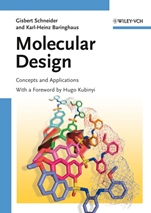
Molecular Design: Concepts and Applications
ISBN 9783527314324
Autor: Gisbert Schneider, Karl–Heinz Baringhaus, Hugo Kubinyi
Wydawca: Wiley
Dostępność: 3-6 tygodni
Cena: 368,55 zł
Przed złożeniem zamówienia prosimy o kontakt mailowy celem potwierdzenia ceny.
ISBN13: |
9783527314324 |
ISBN10: |
3527314326 |
Autor: |
Gisbert Schneider, Karl–Heinz Baringhaus, Hugo Kubinyi |
Oprawa: |
Paperback |
Rok Wydania: |
2008-01-16 |
Ilość stron: |
277 |
Wymiary: |
245x171 |
Tematy: |
PN |
Molecular Design Provides an easy–to–read introduction to the principles and concepts of computer–assisted drug discovery. Written by leading experts in the field, this book is a must–have for students of biological and chemical sciences and for researchers working in drug discovery. Emphasis is on design techniques complemented by carefully selected practical examples and case studies.
Richly illustrated, the beginner is guided from first principles to state–of–the–art techniques in virtual screening and molecular design.
Thus, this monograph is considered to be of utmost importance, not only for the beginner and the experienced modeler, but also for all interested medicinal chemists, biochemists and biologists.
Spis treści:
Foreword.
Preface.
1 Molecular Objects and Design Objectives.
1.1 What is a Molecule?
1.2 Simplistic Molecular Representations.
1.3 The Molecular Surface.
1.4 Molecular Shape.
1.5 The Topological Molecular Graph.
1.6 Molecular Properties and Graph Invariants.
1.7 The Drug–likeness Concept.
1.8 Scaffolds, Linkers, and Side–chains.
1.9 Substructure Similarity and "Privileged Motifs".
1.10 Molecules as Strings.
1.11 Constructing Molecules from Strings.
1.12 From Elements to Atom Types.
1.13 Entering the Third Dimension: Automatic Conformer Generation.
1.14 The "Bioactive" Conformation.
Literature.
2 Receptor–Ligand Interaction.
2.1 The Thermodynamics of Protein–Ligand Interaction.
2.2 The Entropic Contribution.
2.3 From Theory to Experiment: Ki and IC50.
2.4 QSAR: Estimating Quantitative Structure–Activity Relationships.
2.4.1 Free–Wilson Analysis.
2.4.2 The Hansch Model.
2.4.3 3D–QSAR.
2.5 Types of Receptor–Ligand Interaction.
2.6 The "Biophore" Concept.
2.7 Potential Pharmacophoric Points.
2.8 The Correlation Vector Approach to P
harmacophore Modeling.
2.9 "Hard Sphere" and "Fuzzy" Pharmacophore Models.
2.10 Lessons from Automated Ligand Docking and Scoring: What Works and What Does Not.
2.11 Fits Like a Glove: Alternative Ligand Binding Modes and Induced Fit Effects.
Literature.
3 Creating the Design.
3.1 Why We Need Computer–assisted Molecular Design.
3.2 The Number of Drug Targets is Limited.
3.3 Ligand Binding Sites.
3.4 Ligand–based Design of Compound Libraries.
3.5 Similar Compounds Do Not Necessarily Interact with Their Target in Similar Ways.
3.6 The Same Ligand Can Adopt Multiple Binding Modes.
3.7 GPCRs Represent a Challenging Target Family.
3.8 Natural Products Are a Source of Inspiration.
3.9 Transition State Analogs Are Potent Enzyme Inhibitors.
3.10 New Targets Sometimes Require a New Ligand Design Concept.
3.11 De novo Design Concepts.
3.12 Primary and Secondary Constraints in de novo Design.
Literature.
4 Virtual Screening Triage.
4.1 The Drug Discovery Pipeline.
4.2 High–throughput Screening (HTS): Why Is It Successful?
4.3 From Hit to Lead.
4.4 Rationalizing the Design Process.
4.5 From High to Low Diversity.
4.6 Quantifying Diversity is Difficult.
4.7 From Negative Design to Positive Design.
4.8 Watch Out for Frequent Hitters!
4.9 Shape–matching: A Coarse–grained Filtering Step.
4.10 The Ultimate Goal: Scaffold–hopping.
4.11 Assessing Chemotype Diversity in Focused Libraries.
4.12 It Works! Examples of Successful Scaffold–hops Found by Virtual Screening.
4.13 Case Studies.
4.13.1 Design of Kv1.5 Ion Channel Modulators.
4.13.2 Virtual Screening of a Natural–product–derived Combinatorial Library for Novel 5–Lipoxygenase Inhibitors.
4.13.3 Scaffold de novo Design for Cannabinoid–1 (CB–1) Receptor Ligands.
Literature.
5 Secondary Design Constraints and Machine Learning.
5.
1 Physicochemistry and Pharmacokinetics.
5.2 The "Rule of 5".
5.3 Pharmacokinetics.
5.4 Absorption.
5.5 Distribution.
5.6 Metabolism.
5.7 Elimination.
5.8 Toxicity.
5.9 Prodrugs and Bioisosteres.
5.10 Machine Learning Methods Support Lead Finding and Optimization.
5.11 An Important Step: Data Scaling.
5.12 Application of Machine Learning to Compound Library Design.
5.13 A "Pharmacophore Road Map".
5.14 Case Studies.
5.14.1 Predicting Cross–activities of Allosteric Modulators of Metabotropic Glutamate Receptors (mGluR).
5.14.2 Dopamine D3 Antagonists and ACE Inhibitors.
5.14.3 An Artificial Ant System for Combinatorial Optimization.
Literature.
Subject Index.
Nota biograficzna:
Gisbert Schneider is Professor for Chemoinformatics and Bioinformatics at the University of Frankfurt (Germany). He studied Biochemistry, Medicine and Computer Science at the University of Berlin where he also obtained his PhD. He spent postdoctoral terms at the MIT in Cambridge, in Stockholm and Frankfurt before joining Hoffmann–La Roche in Basel. After five years in pharmaceutical research, he became the first Beilstein Professor for Chemoinformatics at the University of Franfurt. In 2006 he won the title "Professor of the Year" in the annual national contest run by the journal "Unicum".
Karl–Heinz Baringhaus is the Head of Computational Chemistry at Aventis Pharma in Frankfurt (Germany). He studied Chemistry at the University of M? where he also obtained his PhD degree. After a postdoctoral term at Stanford University he joined the Hoechst AG, where he was appointed head of Molecular Modeling and Computational Chemistry.
Okładka tylna:
Molecular Design Provides an easy–to–read introduction to the principles and concepts of computer–assisted drug discovery. Written by leading experts in the field, this book is a must–have for students of bio
logical and chemical sciences and for researchers working in drug discovery. Emphasis is on design techniques complemented by carefully selected practical examples and case studies.
Richly illustrated, the beginner is guided from first principles to state–of–the–art techniques in virtual screening and molecular design.
Thus, this monograph is considered to be of utmost importance, not only for the beginner and the experienced modeler, but also for all interested medicinal chemists, biochemists and biologists.
Koszyk
Książek w koszyku: 0 szt.
Wartość zakupów: 0,00 zł
Informacje


Kontakt
Gambit
Centrum Oprogramowania
i Szkoleń Sp. z o.o.
Al. Pokoju 29b/22-24
31-564 Kraków
Siedziba Księgarni
ul. Kordylewskiego 1
31-542 Kraków
+48 12 410 5991
+48 12 410 5987
+48 12 410 5989
Subskrypcje
Administratorem danych osobowych jest firma Gambit COiS Sp. z o.o. Na podany adres będzie wysyłany wyłącznie biuletyn informacyjny.
Autoryzacja płatności

Informacje na temat autoryzacji płatności poprzez PayU.

© Copyright 2012: GAMBIT COiS Sp. z o.o. Wszelkie prawa zastrzeżone.
Projekt i wykonanie: Alchemia Studio Reklamy