


Wydawcy
Katalog tematyczny
- Archeologia (109)
- Ekonomia, finanse, business (13704)
- Filozofia (1445)
- Historia (3040)
- Języki i językoznawstwo (2356)
- Lifestyle, hobby i rozrywka (475)
- Medycyna (9704)
- Nauki humanistyczne (4)
- Nauki o Ziemi i środowisku (2638)
- Nauki ścisłe (20412)
- Astronomia (294)
- Biologia (5119)
- Chemia (6540)
- Chemia analityczna (361)
- Chemia fizyczna (346)
- Chemia nieorganiczna (137)
- Chemia organiczna (535)
- Krystalografia (27)
- Minerologia (46)
- Fizyka (3309)
- Matematyka (4574)
- Nauki ścisłe, ogólnie (503)
- Nauki społeczne (8486)
- Nauki techniczne (13450)
- Prawo (1696)
- Publikacje informacyjne i interdyscyplinarne (1288)
- Religia i wierzenia (917)
- Technika komputerowa (4067)
- Zdrowie, relacje międzyludzkie i rozwój osobisty (657)





Informacje szczegółowe o książce
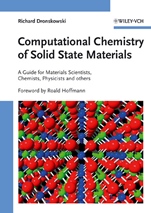
Computational Chemistry of Solid State Materials: A Guide for Materials Scientists, Chemists, Physicists and others
ISBN 9783527314102
Autor: Richard Dronskowski, Roald Hoffmann
Wydawca: Wiley
Dostępność: 3-6 tygodni
Cena: 746,55 zł
Przed złożeniem zamówienia prosimy o kontakt mailowy celem potwierdzenia ceny.
ISBN13: |
9783527314102 |
ISBN10: |
3527314105 |
Autor: |
Richard Dronskowski, Roald Hoffmann |
Oprawa: |
Hardback |
Rok Wydania: |
2005-12-13 |
Ilość stron: |
300 |
Wymiary: |
251x177 |
Tematy: |
PN |
Describing solid state materials with computational and theoretical models is now an important tool for solid state chemists, making it possible to gain an insight into electronic and magnetic structure, as well as chemical bonding. In addition, chemists are now able to make a prediction about materials that are yet to be synthesized, such that a systematic and successful synthesis of new materials with specific properties and attributes is possible.
This is the first book to present both classical practical approaches as well as practical quantum–chemical approaches, incorporating the many new methods developed over the last few years. Written especially for "non"–theoretical readers in a very comprehensible and readily implemental style, it includes numerous practical examples of varying degrees of difficulty. Similarly, the use of mathematical equations is reduced to a minimum, focusing only on that which is important for experimentalists.
Backed by many extensive tables containing detailed data for direct use in the calculations, this is the ideal companion for theoretical and solid state chemists, physicochemists, crystallographers and materials scientists, wishing to improve their work in solid state research by using computational methods.
Spis treści:
Foreword.
Preface.
1. CLASSICAL APPROACHES.
Ionic Radii Concepts.
Electrostatics.
Pauling′s Rules.
Volume Increments.
The Bond–Valence Method.
Symmetry Principles.
2. QUANTUM–CHEMICAL APPROACHES.
Schrödinger′s Equation.
Basis Sets for Molecules.
Three Myths of Chemical Bonding.
Bloch?s Theorem.
Reciprocal Space and the k Quantum Number.
Band Structure.
Density–of–States and Basic Electron Partitioning.
Exchange and Correlation.
Electron Localization.
How to deal with Exchange and Correlation.
DFT.
Beyond DFT.
Absolute Electronegativity and Hardness.
Potentials
and Basic Sets in Solids.
Structure Optimization.
Molecular Dynamics.
Practical Aspects.
Computer Implementations.
3. THE THEORETICAL MACHINERY AT WORK.
Structure and Energetics.
Structural Alternatives: Transition–Metal Nitrides.
Structure and Physical Properties: Cerium Pnictides.
Structures by Peiersl Distortions: Tellurium.
Itinerant Magnetism: The Transition–Metals.
Itinerant Magnetism: Transition Metal Compounds.
Atomic Dynamics in Fe:AlN Nanocomposites.
Structural versus Electronic Distortions: MnAl.
Challenging Theory:Mercury Carbodiimide and Cyanamide.
Quasi–Binary Oxynitrides.
Into the Valid: The Sn/Zn System.
Predicting Oxynitrides: VON and High–Pressure Phases.
Predicting Magnetic Cyanamides and Carbodiimides.
Predicting Magnetic Nitrides.
4. EPILOGUE.
Epilogue.
Bibliography.
Index.
Acknowledgments.
Nota biograficzna:
Richard Dronskowski studied chemistry and physics at M? University and gained his PhD from the Max Planck Institute for Solid State Research in Stuttgart. After one year as a Visiting Scientist at Cornell University and completing his lecturing qualification in 1995, he took up the chair of Inorganic and Analytical Chemistry at RWTH Aachen University in 1997, as head of its Institute of Inorganic Chemistry. He has won the Kekule and Liebig scholarships, the Otto Hahn medal awarded by the Max Planck Society, and the Chemistry Lecturer prize. In 2004, he became Visiting Professor at the Center of Interdisciplinary Research at Tohoku University, Sendai. Professor Dronskowski′s research interests originate in the area of "theorimental" solid state chemistry, in particular the design, synthesis and structural as well as quantum–chemical characterization of low–valent, metastable, nitrogen–based, intermetallic and magnetic compounds.
Okładka tylna:
Describing solid sta
te materials with computational and theoretical models is now an important tool for solid state chemists, making it possible to gain an insight into electronic and magnetic structure, as well as chemical bonding. In addition, chemists are now able to make a prediction about materials that are yet to be synthesized, such that a systematic and successful synthesis of new materials with specific properties and attributes is possible.
This is the first book to present both classical practical approaches as well as practical quantum–chemical approaches, incorporating the many new methods developed over the last few years. Written especially for "non"–theoretical readers in a very comprehensible and readily implemental style, it includes numerous practical examples of varying degrees of difficulty. Similarly, the use of mathematical equations is reduced to a minimum, focusing only on that which is important for experimentalists.
Backed by many extensive tables containing detailed data for direct use in the calculations, this is the ideal companion for theoretical and solid state chemists, physicochemists, crystallographers and materials scientists, wishing to improve their work in solid state research by using computational methods.
Koszyk
Książek w koszyku: 0 szt.
Wartość zakupów: 0,00 zł
Informacje


Kontakt
Gambit
Centrum Oprogramowania
i Szkoleń Sp. z o.o.
Al. Pokoju 29b/22-24
31-564 Kraków
Siedziba Księgarni
ul. Kordylewskiego 1
31-542 Kraków
+48 12 410 5991
+48 12 410 5987
+48 12 410 5989
Subskrypcje
Administratorem danych osobowych jest firma Gambit COiS Sp. z o.o. Na podany adres będzie wysyłany wyłącznie biuletyn informacyjny.
Autoryzacja płatności

Informacje na temat autoryzacji płatności poprzez PayU.

© Copyright 2012: GAMBIT COiS Sp. z o.o. Wszelkie prawa zastrzeżone.
Projekt i wykonanie: Alchemia Studio Reklamy