


Wydawcy
Katalog tematyczny
- Archeologia (109)
- Ekonomia, finanse, business (13704)
- Filozofia (1445)
- Historia (3040)
- Języki i językoznawstwo (2356)
- Lifestyle, hobby i rozrywka (475)
- Medycyna (9704)
- Nauki humanistyczne (4)
- Nauki o Ziemi i środowisku (2638)
- Nauki ścisłe (20412)
- Astronomia (294)
- Biologia (5119)
- Chemia (6540)
- Chemia analityczna (361)
- Chemia fizyczna (346)
- Chemia nieorganiczna (137)
- Chemia organiczna (535)
- Krystalografia (27)
- Minerologia (46)
- Fizyka (3309)
- Matematyka (4574)
- Nauki ścisłe, ogólnie (503)
- Nauki społeczne (8486)
- Nauki techniczne (13450)
- Prawo (1696)
- Publikacje informacyjne i interdyscyplinarne (1288)
- Religia i wierzenia (917)
- Technika komputerowa (4067)
- Zdrowie, relacje międzyludzkie i rozwój osobisty (657)






Informacje szczegółowe o książce
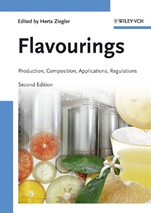
Flavourings: Production, Composition, Applications, Regulations
ISBN 9783527314065
Autor: Herta Ziegler
Wydawca: Wiley
Dostępność: 3-6 tygodni
Cena: 1 584,45 zł
Przed złożeniem zamówienia prosimy o kontakt mailowy celem potwierdzenia ceny.
ISBN13: |
9783527314065 |
ISBN10: |
3527314067 |
Autor: |
Herta Ziegler |
Oprawa: |
Hardback |
Rok Wydania: |
2007-01-26 |
Numer Wydania: |
2nd Edition |
Ilość stron: |
852 |
Wymiary: |
249x171 |
Tematy: |
PN |
The demand for flavourings has been constantly growing over the last years as a result of the dramatic changes caused by an increasingly industrialized way–of–life: The consumer is attracted to taste experiences which are not only pleasurable, interesting, exciting and new, but also combine convenience with today′s expectations of a healthy, well–balanced life–style. In this second revised and updated edition, the book once again draws on the expert knowledge of more than 40 contributors with backgrounds in both industry and academia to grant a comprehensive overview of the production, processing, composition and application of various food flavourings. The reader is provided with up–to–date information on raw materials of natural, biotechnological and synthetic origin. Additionally, the authors focus on toxicological, legal, and ethical aspects, quality control methods and systems, as well as the conventional and innovative analytical techniques employed in this field. This expanded edition discusses in detail the manifold advances in processing and applications, including an extensive evaluation of the use of flavourings in convenience foods, plus the topic of aroma analysis. Up–to–date references to pertinent literature and an in–depth subject index complete this overview of the captivating world of flavourings.
Spis treści:
Preface.
Index of Authors.
List of Companies.
1 Introduction.
A Dynamic Business With Taste – The Flavour Industry (Herta Ziegler).
2 Manufacturing Processes.
2.1 Physical Processes.
2.1.1 Extraction (Manfred Ziegler).
2.1.2 Supercritical Fluid Extraction (SFE) (Karl–Werner Quirin, Dieter Gerard).
2.1.3 Distillation (Manfred Ziegler, Martin Reichelt).
2.1.4 Spray Drying and Other Methods for Encapsulation of Flavourings (Uwe–Jens Salzer).
2.1.5 Freeze Drying (
Karl Heinz Deicke).
2.2 Biotechnological Processes (Joachim Tretzel, Stefan Marx).
2.2.1 Introduction.
2.2.2 Flavour Generation by Fermentation of Food Raw Materials.
2.2.3 Flavour Generation in Bioreactors.
2.2.4 Surface Fermentation.
2.2.5 Submerged Fermentation.
2.2.6 Downstream Processing.
2.2.7 Enzyme Reactors.
2.2.8 Cell Culture Reactors.
2.2.9 Genetic Engineering.
3 Raw Materials for Flavourings.
3.1 Introduction (Günter Matheis).
3.2 Flavouring Ingredients
3.2.1 Chemically Defined Flavouring Substances.
3.2.2 Flavouring Preparations and Some Source Materials.
3.2.3 Process Flavourings (Christoph Cerny).
3.2.4 Smoke Flavourings.
3.3 Non–flavouring Ingredients.
3.3.1 Extraction Solvents (Howard D. Preston, Robert F. van Croonenborgh).
3.3.2 Permitted Carriers and Carrier Solvents (Howard D. Preston).
3.3.3 Emulsifiers – Stabilisers – Enzymes (William J. N. Marsden).
3.3.4 Flavour Modifiers (Günter Matheis).
3.3.5 Antioxidants and Preservatives.
4 Blended Flavourings (Willi Grab).
4.1 Introduction.
4.1.1 Flavour Analysis.
4.1.2 Flavour Profiles.
4.1.3 Flavouring Raw Materials.
4.1.4 Flavouring Composition.
4.1.5 Flavour Release.
4.1.6 Application of Flavourings.
4.1.7 Flavouring Production.
4.1.8 Flavouring Stability.
4.2 Fruit Flavours.
4.2.1 The Flavour of Natural Fruits.
4.2.2 World of Commercially Important Fruit Flavours.
4.2.3 Sensorially Interesting Fruit Flavours.
4.3 Other Blended Flavourings.
4.3.1 Processed Flavourings.
4.3.2 Fermented Flavourings.
4.3.2.1 Alcoholic Flavourings.
4.3.2.2 Dairy Flavourings.
4.3.3 Vegetable Flavourings.
4.3.4 Vanilla Flavourings.
4.3.5 Fantasy Flavourings.
5 Application.
5.1 Introduction (Günter Matheis).
5.1.1 Flavour Binding and Release.
5.1.2 Interactio
ns with Carbohydrates.
5.1.3 Interactions with Proteins.
5.1.4 Interactions with Free Amino Acids.
5.1.5 Interactions with Lipids.
5.1.6 Interactions with Inorganic Salts, Fruit Acids, Purine Alkaloids, Phenolic Compounds and Ethanol.
5.1.7 Interactions with Fat Replacers.
5.1.8 Interactions with Complex Systems and with Foodstuffs.
5.1.9 Conclusion.
5.2 Flavourings for Beverages.
5.2.1 Soft Drinks (Matthias Sass).
5.2.2 Alcoholic Beverages (Günther Zach).
5.3 Flavourings for Confectioneries, Baked Goods, Ice–cream and Dairy Products.
5.3.1 Flavourings for Confectioneries (Jan–Pieter Miedema).
5.3.2 Flavourings for Baked Goods (Jan–Pieter Miedema).
5.3.3 Flavourings for Ice–Cream (Alan D. Ellison, John E. Jackson, Jan–Pieter Miedema, Jürgen Brand).
5.3.4 Flavourings for Dairy Products and Desserts (Jan–Pieter Miedema, Eckhard Schildknecht).
5.4 Flavouring of Dehydrated Convenience Food and Kitchen Aids (Chahan Yeretzian, Imre Blank, Stefan Palzer).
5.4.1 Introduction.
5.4.2 Savoury Flavours.
5.4.3 Manufacturing of Dehydrated Convenience Foods.
5.4.4 Conclusions.
6 Quality Control.
6.1 Sensory Analysis in Quality Control (Helmut Grüb).
6.1.1 Introduction.
6.1.2 “Sensory”.
6.1.3 The Senses.
6.1.4 Man as a Measuring Instrument.
6.1.5 Sensory Quality Measuring Methods.
6.2 Analytical Methods.
6.2.1 General Methods (Dirk Achim Müller).
6.2.2 Stable Isotope Ratio Analysis in Quality Control of Flavourings (Hanns–Ludwig Schmidt, Robert A. Werner, Andreas Rossmann, Armin Mosandl, Peter Schreier).
6.2.3 Enantioselective Analysis (Armin Mosandl).
6.2.4 Key Odorants of Food Identified by Aroma Analysis (Werner Grosch).
6.3 Microbiological Testing (Heinz–Jürgen Lögtenbörger).
7 Legisl
ation / Toxicology (Uwe–Jens Salzer).
7.1 Introduction / Definitions.
7.2 Toxicological Considerations.
7.3 FAO/WHO and Council of Europe.
7.4 European Union.
7.4.1 General.
7.4.2 Flavour Legislation.
7.4.3 Food Additive Legislation.
7.4.4 Other Rules Concerning Flavourings.
7.5 America.
7.5.1 Introduction.
7.5.2 The NAFTA Countries.
7.5.3 South American Countries.
7.6 Asia.
7.6.1 General.
7.6.2 The "Middle East".
7.6.3 The "Far East".
7.7 South Africa, Australia and New Zealand.
7.8 Religious Dietary Rules.
7.8.1 Introduction.
7.8.2 "Kosher".
7.8.3 "Halal".
7.8.4 Comparison of Kosher and Halal Requirements.
Index.
Nota biograficzna:
Born near Munich in 1961, Dr. Herta Ziegler studied chemistry at the University of Bayreuth, Germany, focusing on analytical chemistry. She soon discovered her profound interest for the organic analysis of complex natural matrices, which were also the subjects of her master and doctoral theses with Prof. Gerhard Spiteller. Her position as head of corporate research at Erich Ziegler GmbH since 1992 allowed her to combine her penchant for citrus oils with her professional activities
In the 1980s, Erich Ziegler laid the foundation for ′Flavourings′ with his book ′Die nat?en und k?chen Aromen′ (′Natural and Artificial Aromas′). He contributed this expertise to the first edition, when in continuation of the family tradition, ′Flavourings′, addressed an international audience under the auspices of Herta Ziegler in 1998. With the present second edition, dedicated to Erich Ziegler on the occasion of his 80th birthday, she presents an updated version of her comprehensive overview of the flavour & fragrance industry.
Okładka tylna:
The demand for flavourings has been constantly growing over the last years as a result of the dramatic changes caused
Koszyk
Książek w koszyku: 0 szt.
Wartość zakupów: 0,00 zł
Informacje


Kontakt
Gambit
Centrum Oprogramowania
i Szkoleń Sp. z o.o.
Al. Pokoju 29b/22-24
31-564 Kraków
Siedziba Księgarni
ul. Kordylewskiego 1
31-542 Kraków
+48 12 410 5991
+48 12 410 5987
+48 12 410 5989
Subskrypcje
Administratorem danych osobowych jest firma Gambit COiS Sp. z o.o. Na podany adres będzie wysyłany wyłącznie biuletyn informacyjny.
Autoryzacja płatności

Informacje na temat autoryzacji płatności poprzez PayU.

© Copyright 2012: GAMBIT COiS Sp. z o.o. Wszelkie prawa zastrzeżone.
Projekt i wykonanie: Alchemia Studio Reklamy