


Wydawcy
Katalog tematyczny
- Archeologia (109)
- Ekonomia, finanse, business (13704)
- Filozofia (1445)
- Historia (3040)
- Języki i językoznawstwo (2356)
- Lifestyle, hobby i rozrywka (475)
- Medycyna (9704)
- Nauki humanistyczne (4)
- Nauki o Ziemi i środowisku (2638)
- Nauki ścisłe (20412)
- Astronomia (294)
- Biologia (5119)
- Chemia (6540)
- Fizyka (3309)
- Elektryczność i magnetyzm (90)
- Fizyka atomowa i molekularna (110)
- Fizyka cząstek elementarnych (36)
- Fizyka jądra atomowego (36)
- Fizyka kwantowa (210)
- Fizyka matematyczna (121)
- Fizyka relatywistyczna (36)
- Fizyka statystyczna (51)
- Fizyka stosowana (498)
- Mechanika klasyczna (186)
- Optyka i światło (133)
- Stany materii (202)
- Matematyka (4574)
- Nauki ścisłe, ogólnie (503)
- Nauki społeczne (8486)
- Nauki techniczne (13450)
- Prawo (1696)
- Publikacje informacyjne i interdyscyplinarne (1288)
- Religia i wierzenia (917)
- Technika komputerowa (4067)
- Zdrowie, relacje międzyludzkie i rozwój osobisty (657)





Informacje szczegółowe o książce
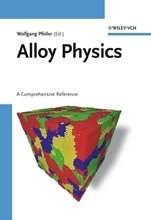
Alloy Physics: A Comprehensive Reference
ISBN 9783527313211
Autor: Wolfgang Pfeiler
Wydawca: Wiley
Dostępność: 3-6 tygodni
Cena: 2 181,90 zł
Przed złożeniem zamówienia prosimy o kontakt mailowy celem potwierdzenia ceny.
ISBN13: |
9783527313211 |
ISBN10: |
3527313214 |
Autor: |
Wolfgang Pfeiler |
Oprawa: |
Hardback |
Rok Wydania: |
2007-07-11 |
Ilość stron: |
1003 |
Wymiary: |
247x185 |
Tematy: |
PH |
The question of how alloys behave under mechanical or energetic loading is very important for their use as structural materials in a whole spectrum of applications, from engines or turbine blades, right up to such biomaterials as hip replacements.
This comprehensive book covers the current research in ally physics together with the basic principles necessary. It offers readers a sound understanding of the structural changes in metals and alloys, ranging from plastic deformation, deformation dynamics and ordering kinetics up to atom jump processes, first principle calculation and simulation techniques. Alongside fundamental topics, including crystal defects, phase transformations and statistical thermodynamics, the team of international authors treats such hot topics as nana–size effects, thin films and interfaces as well as self–organization, technical applications of modern alloys, and the opportunities presented by materials design.
Spis treści:
Preface.
Foreword by Robert W. Cahn.
Motto.
List of Contributors.
1 Introduction (Wolfgang Pfeiler).
1.1 The Importance of Alloys at the Beginning of the Third Millennium.
1.2 Historical Development.
1.3 Atom Kinetics.
1.4 The Structure of this Book.
References.
2 Crystal Structure and Chemical Bonding (Yuri Grin, Ulrich Schwarz, and Walter Steurer).
2.1 Introduction.
2.2 Factors Governing Formation, Composition and Crystal Structure of Intermetallic Phases.
2.3 Models of Chemical Bonding in Intermetallic Phases.
2.4 Structure Types of Intermetallic Compounds.
2.5 Quasicrystals.
2.6 Outlook.
References.
3 Solidi.cation and Grown–in Defects (Thierry Duffar).
3.1 Introduction: the Solid–Liquid Interface.
3.2 Solidi.cation Structures.
3.3 Defects in Single and Polycrystals.
3.4 Outlook.
References.
4 Lattice Statics and Lattice Dynamics (Véronique Pierron–Bohnes and T
arik Mehaddene)
4.1 Introduction: The Binding and Atomic Interaction Energies.
4.2 Elasticity of Crystalline Lattices.
4.3 Lattice Dynamics and Thermal Properties of Alloys.
4.4 Beyond the Harmonic Approximation.
4.5 Experimental Investigation of the Normal Modes of Vibration.
4.6 Phonon Spectra and Migration Energy.
4.7 Outlook.
References.
5 Point Defects, Atom Jumps, and Diffusion (Wolfgang Püschl, Hiroshi Numakura, and Wolfgang Pfeiler).
5.1 Point Defects.
5.2 Defect Migration: Microscopic Di.usion.
5.3 Statistical Methods: from Single Jump to Configuration Changes.
5.4 Macroscopic Diffusion.
5.5 Outlook.
References.
6 Dislocations and Mechanical Properties (Daniel Caillard).
6.1 Introduction.
6.2 Thermally Activated Mechanisms.
6.3 Hardening and Recovery.
6.4 Complex Behavior.
6.5 Outlook.
References.
7 Phase Equilibria and Phase Transformations (Brent Fultz and Jeffrey J. Hoyt).
7.1 Alloy Phase Diagrams.
7.2 Kinetics and the Approach to Equilibrium.
7.3 Nucleation and Growth Transformations.
7.4 Spinodal Decomposition.
7.5 Martensitic Transformations.
7.6 Outlook.
References.
8 Kinetics in Nonequilibrium Alloys (Pascal Bellon and Georges Martin).
8.1 Relaxation of Nonequilibrium Alloys.
8.2 Driven Alloys.
8.3 Outlook.
References.
9 Change of Alloy Properties under Dimensional Restrictions (Hirotaro Mori and Jung–Goo Lee).
9.1 Introduction.
9.2 Instrumentation for in–situ Observation of Phase Transformation of Nanometer–Sized Alloy Particles.
9.3 Depression of the Eutectic Temperature and its Relevant Phenomena.
9.4 Solid/Liquid Two–Phase Microstructure.
9.5 Solid Solubility in Nanometer–Sized Alloy Particles.
9.6 Summary and Future Perspectives.
References.
10 Statistical Thermodynamics and Model Calculations (Tetsuo Mohri).
10.1 Introduction.
10.2
Statistical Thermodynamics on a Discrete Lattice.
10.3 Statistical Thermodynamics on Continuous Media.
10.4 Model Calculations.
10.5 Future Scope and Outlook.
Appendix: CALPHAD Free Energy.
References.
11 Ab–Initio Methods and Applications (Stefan Müller, Walter Wolf, and Raimund Podloucky).
11.1 Introduction.
11.2 Theoretical Background.
11.3 Applications.
11.4 Outlook.
References.
12 Simulation Techniques (Ferdinand Haider, Rafal Kozubski, and T.A. Abinandanan).
12.1 Introduction.
12.2 Molecular Dynamics Simulations.
12.3 Monte Carlo Simulations.
12.4 Phase Field Models.
12.5 Outlook.
Appendix.
References.
13 High–Resolution Experimental Methods.
13.1 High–Resolution Scattering Methods and Time–Resolved Diffraction (Bogdan Sepiol and Karl F. Ludwig).
13.2 High–Resolution Microscopy (Guido Schmitz and James M. Howe).
References.
14 Materials and Process Design.
14.1 Soft and Hard Magnets (Roland Grössinger).
14.2 Invar Alloys (Peter Mohn).
14.3 Magnetic Media (Laurent Ranno).
14.4 Spin Electronics (Spintronics) (Laurent Ranno).
14.5 Phase–Change Media (Takeo Ohta).
14.6 Superconductors (Harald W. Weber).
Further Reading.
Index.
Nota biograficzna:
Wolfgang Pfeiler is professor at the Institute of Materials Physics of the University of Vienna. He is mainly working on investigating the microstructure of alloys, as well as the kinetics of structural changes with a focus on atomic ordering.
Okładka tylna:
The question of how alloys behave under mechanical or energetic loading is very important for their use as structural materials in a whole spectrum of applications, from engines or turbine blades, right up to such biomaterials as hip replacements.
This comprehensive book covers the current research in ally physics together with the basic principles nec
essary. It offers readers a sound understanding of the structural changes in metals and alloys, ranging from plastic deformation, deformation dynamics and ordering kinetics up to atom jump processes, first principle calculation and simulation techniques. Alongside fundamental topics, including crystal defects, phase transformations and statistical thermodynamics, the team of international authors treats such hot topics as nana–size effects, thin films and interfaces as well as self–organization, technical applications of modern alloys, and the opportunities presented by materials design.
Koszyk
Książek w koszyku: 0 szt.
Wartość zakupów: 0,00 zł
Informacje


Kontakt
Gambit
Centrum Oprogramowania
i Szkoleń Sp. z o.o.
Al. Pokoju 29b/22-24
31-564 Kraków
Siedziba Księgarni
ul. Kordylewskiego 1
31-542 Kraków
+48 12 410 5991
+48 12 410 5987
+48 12 410 5989
Subskrypcje
Administratorem danych osobowych jest firma Gambit COiS Sp. z o.o. Na podany adres będzie wysyłany wyłącznie biuletyn informacyjny.
Autoryzacja płatności

Informacje na temat autoryzacji płatności poprzez PayU.

© Copyright 2012: GAMBIT COiS Sp. z o.o. Wszelkie prawa zastrzeżone.
Projekt i wykonanie: Alchemia Studio Reklamy