


Wydawcy
Katalog tematyczny
- Archeologia (109)
- Ekonomia, finanse, business (13704)
- Filozofia (1445)
- Historia (3040)
- Języki i językoznawstwo (2356)
- Lifestyle, hobby i rozrywka (475)
- Medycyna (9704)
- Nauki humanistyczne (4)
- Nauki o Ziemi i środowisku (2638)
- Nauki ścisłe (20412)
- Astronomia (294)
- Biologia (5119)
- Chemia (6540)
- Chemia analityczna (361)
- Chemia fizyczna (346)
- Chemia nieorganiczna (137)
- Chemia organiczna (535)
- Krystalografia (27)
- Minerologia (46)
- Fizyka (3309)
- Matematyka (4574)
- Nauki ścisłe, ogólnie (503)
- Nauki społeczne (8486)
- Nauki techniczne (13450)
- Prawo (1696)
- Publikacje informacyjne i interdyscyplinarne (1288)
- Religia i wierzenia (917)
- Technika komputerowa (4067)
- Zdrowie, relacje międzyludzkie i rozwój osobisty (657)





Informacje szczegółowe o książce
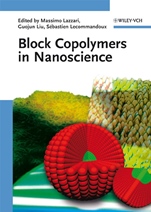
Block Copolymers in Nanoscience
ISBN 9783527313099
Autor: Massimo Lazzari, Guojun Liu, Sebastién Lecommandoux
Wydawca: Wiley
Dostępność: 3-6 tygodni
Cena: 1 071,00 zł
Przed złożeniem zamówienia prosimy o kontakt mailowy celem potwierdzenia ceny.
ISBN13: |
9783527313099 |
ISBN10: |
3527313095 |
Autor: |
Massimo Lazzari, Guojun Liu, Sebastién Lecommandoux |
Oprawa: |
Hardback |
Rok Wydania: |
2006-10-10 |
Ilość stron: |
447 |
Wymiary: |
242x177 |
Tematy: |
PN |
Taking a detailed look at one of the key focal points where nanotechnology and block copolymers meet, this first book in the field provides both an introductory view for beginners as well as in–depth knowledge for specialists in the various research areas involved. It investigates all types of applications for block copolymers ranging from physics and chemistry to biology, medicine, and engineering. Specifically, their use is discussed as tools or templates for fabricating polymeric and hybrid nanostructures, as precursors for carbon nanostructures, and as functional materials in fuel cells, stimuli–responsive materials, in drug delivery, diagnostics, and sensoring.
All stages of block copolymer studies from synthesis, characterization, and assembly to nanostructure fabrication and applications are covered in a multidisciplinary approach which provides vital reading to materials scientists and engineers, chemists, physicists and biologists alike.
Massimo Lazzari received his PhD in Macromolecular Chemistry at the University of Torino (Italy) under the supervision of Prof. O. Chiantore. After a two years postdoctoral work with Prof. K. Hatada at the Osaka University (Japan), where he learned the secrets of anionic polymerisation, in 1998 he became assistant professor at the University of Torino, working on the characterisation and degradation of complex polymer systems. After several stays at the University of Santiago de Compostela (Spain), he is actually in the Institute of Technological Investigacions. His current research interests are focused on the synthesis of self–assembling block copolymers, with a special attention on their use as templates and for the hierarchical self–assembly of metal nanoparticles.
Guojun Liu received his Ph.D. degree from the University of Toronto in 1989. After 8 months as a post–doctoral fellow in the University of Toronto, he joined McGill University for another post–doctoral year. He
was appointed assistant professor at the University of Calgary in 1990, promoted to associate professor in 1995 and full professor in 1999. Since 2004 he has been serving the Department of Chemistry at Queen′s University as Tier I (senior) Canada Research Chair in Materials Science. He has published more than 100 papers mostly on block copolymer nanomaterials.
Sébastien Lecommandoux prepared his Master and his Diploma Thesis (1996) in Chemistry and Physics in the Centre de Recherche Paul Pascal. He went to the Material Research Laboratory (UIUC, USA), as a Post–Doc in the group of Professor Samuel I. Stupp, and learned the Art of Supramolecular Chemistry in 1998. Then, he joined the Laboratoire de Chimie des Polymères Organiques (CNRS, University of Bordeaux, France) as Associate Professor in 1998 and became Professor in 2005. He received the Bronze Medal Award from the CNRS in 2004 for the work he did on the self–assembly of polypeptide–based block copolymers. His current research interests mainly focus on macromolecular engineering via block copolymer self–assembly in solution and in bulk, and their impact in nanobiotechnologies.
Spis treści:
Preface.
List of Contributors.
1. An Introduction to Block Copolymer Applications: State–of–the–art and Future Developments.
2. Guidelines for Synthesizing Block Copolymers.
3. Block Copolymer Vesicles.
4. Block Copolymer Micelles for Drug Delivery in Nanoscience.
5. Stimuli–responsive Block Copolymer Assemblies.
6. Self–assembly of Linear Polypeptide–based Block Copolymers.
7. Synthesis, Self–assembly and Applications of Polyferrocenylsilane (PFS) Block Copolymers.
8. Supramolecular Block Polymers Containing Metal–Ligand Binding Sites: From Synthesis to Properties.
9. Methods for the Alignment and the Large–scale Ordering of Block Copolymer Morphologies.
10. Block Copolyme
r Nanofibers and Nanotubes.
11. Nanostructured Carbons from Block Coplymers.
12. Block Copolymers at Interfaces.
13. Block Copolymers as Templates for the Generation of Mesostructured Inorganic Materials.
14. Mesostructured Polymers–Inorganic Hybrid Materials from Blocked Macromolecular Architectures and Nanoparticles.
15. Block Ionomers for Fuel Cell Application.
16. Structure, Properties and Applications of Crystallizable ABA and ABC Triblock Copolymers with Hydrogenated Polybutadiene Blocks.
17. Basic Understanding of Phase Behavior and Structure of Silicone Block Copolymers and Surfactant–Block Copolymer Mixtures.
Subject Index.
Nota biograficzna:
Massimo Lazzari received his PhD in Macromolecular Chemistry at the University of Torino (Italy) under the supervision of Prof. O. Chiantore. After a two years postdoctoral work with Prof. K. Hatada at the Osaka University (Japan), where he learned the secrets of anionic polymerisation, in 1998 he became assistant professor at the University of Torino, working on the characterisation and degradation of complex polymer systems. After several stays at the University of Santiago de Compostela (Spain), he is actually in the Institute of Technological Investigacions. His current research interests are focused on the synthesis of self–assembling block copolymers, with a special attention on their use as templates and for the hierarchical self–assembly of metal nanoparticles.
Guojun Liu received his Ph.D. degree from the University of Toronto in 1989. After 8 months as a post–doctoral fellow in the University of Toronto, he joined McGill University for another post–doctoral year. He was appointed assistant professor at the University of Calgary in 1990, promoted to associate professor in 1995 and full professor in 1999. Since 2004 he has been serving the Department of Chemistry at Queen′s University as Tier I (senior) Canada R
esearch Chair in Materials Science. He has published more than 100 papers mostly on block copolymer nanomaterials.
Physico–chemist of formation, Sebasstien Lecommandoux has integrated the Centre de Recherche Paul Pascal (group of Professor Franz Hardouin, Bordeaux, France) in 1992 to prepare his Master and his Diploma Thesis in Chemistry and Physics (1996) on Liquid Crystal Polymers. Then, he went to the Material Research Laboratory and the Beckman Institute (University of Illinois at Urbana–Champaign, USA), as a Post–Doc in the group of Professor Samuel I. Stupp, and learned the Art of Supramolecular Chemistry from January to December 1998. He joined the Laboratoire de Chimie des Polymeres Organiques (CNRS, University of Bordeaux, France) as Associate Professor in 1998 and became Professor in 2005. He received the Bronze Medal Award from the CNRS in 2004 for the work he did on the self–assembly of polypeptide–based block copolymers. His current research interests mainly focus on macromolecular engineering via block copolymer self–assembly in solution and in bulk, with a special attention on the relation–ship between nanostructures and biological functions.
Okładka tylna:
Taking a detailed look at one of the key focal points where nanotechnology and block copolymers meet, this first book in the field provides both an introductory view for beginners as well as in–depth knowledge for specialists in the various research areas involved. It investigates all types of applications for block copolymers ranging from physics and chemistry to biology, medicine, and engineering. Specifically, their use is discussed as tools or templates for fabricating polymeric and hybrid nanostructures, as precursors for carbon nanostructures, and as functional materials in fuel cells, stimuli–responsive materials, in drug delivery, diagnostics, and sensoring.
All stages of block copolymer studies from s
ynthesis, characterization, and assembly to nanostructure fabrication and applications are covered in a multidisciplinary approach which provides vital reading to materials scientists and engineers, chemists, physicists and biologists alike.
Massimo Lazzari received his PhD in Macromolecular Chemistry at the University of Torino (Italy) under the supervision of Prof. O. Chiantore. After a two years postdoctoral work with Prof. K. Hatada at the Osaka University (Japan), where he learned the secrets of anionic polymerisation, in 1998 he became assistant professor at the University of Torino, working on the characterisation and degradation of complex polymer systems. After several stays at the University of Santiago de Compostela (Spain), he is actually in the Institute of Technological Investigacions. His current research interests are focused on the synthesis of self–assembling block copolymers, with a special attention on their use as templates and for the hierarchical self–assembly of metal nanoparticles.
Guojun Liu received his Ph.D. degree from the University of Toronto in 1989. After 8 months as a post–doctoral fellow in the University of Toronto, he joined McGill University for another post–doctoral year. He was appointed assistant professor at the University of Calgary in 1990, promoted to associate professor in 1995 and full professor in 1999. Since 2004 he has been serving the Department of Chemistry at Queen′s University as Tier I (senior) Canada Research Chair in Materials Science. He has published more than 100 papers mostly on block copolymer nanomaterials.
Sébastien Lecommandoux prepared his Master and his Diploma Thesis (1996) in Chemistry and Physics in the Centre de Recherche Paul Pascal. He went to the Material Research Laboratory (UIUC, USA), as a Post–Doc in the group of Professor Samuel I. Stupp, and learned the Art of Supramolecular Chemistry in 1998. Then, he joined the Laboratoire de Chimi
e des Polymères Organiques (CNRS, University of Bordeaux, France) as Associate Professor in 1998 and became Professor in 2005. He received the Bronze Medal Award from the CNRS in 2004 for the work he did on the self–assembly of polypeptide–based block copolymers. His current research interests mainly focus on macromolecular engineering via block copolymer self–assembly in solution and in bulk, and their impact in nanobiotechnologies.
Koszyk
Książek w koszyku: 0 szt.
Wartość zakupów: 0,00 zł
Informacje


Kontakt
Gambit
Centrum Oprogramowania
i Szkoleń Sp. z o.o.
Al. Pokoju 29b/22-24
31-564 Kraków
Siedziba Księgarni
ul. Kordylewskiego 1
31-542 Kraków
+48 12 410 5991
+48 12 410 5987
+48 12 410 5989
Subskrypcje
Administratorem danych osobowych jest firma Gambit COiS Sp. z o.o. Na podany adres będzie wysyłany wyłącznie biuletyn informacyjny.
Autoryzacja płatności

Informacje na temat autoryzacji płatności poprzez PayU.

© Copyright 2012: GAMBIT COiS Sp. z o.o. Wszelkie prawa zastrzeżone.
Projekt i wykonanie: Alchemia Studio Reklamy