


Wydawcy
Katalog tematyczny
- Archeologia (109)
- Ekonomia, finanse, business (13704)
- Filozofia (1445)
- Historia (3040)
- Języki i językoznawstwo (2356)
- Lifestyle, hobby i rozrywka (475)
- Medycyna (9704)
- Nauki humanistyczne (4)
- Nauki o Ziemi i środowisku (2638)
- Nauki ścisłe (20412)
- Nauki społeczne (8486)
- Edukacja (229)
- Kryminologia, opieka spełeczna (284)
- Obronność (10)
- Polityka (1389)
- Psychologia (777)
- Socjologia (410)
- Społeczeństwo i kultura (187)
- Nauki techniczne (13450)
- Prawo (1696)
- Publikacje informacyjne i interdyscyplinarne (1288)
- Religia i wierzenia (917)
- Technika komputerowa (4067)
- Zdrowie, relacje międzyludzkie i rozwój osobisty (657)





Informacje szczegółowe o książce
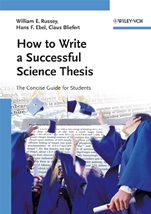
How to Write a Successful Science Thesis: The Concise Guide for Students
ISBN 9783527312986
Autor: William E. Russey, Hans F. Ebel, Claus Bliefert
Wydawca: Wiley
Dostępność: 3-6 tygodni
Cena: 178,50 zł
Przed złożeniem zamówienia prosimy o kontakt mailowy celem potwierdzenia ceny.
ISBN13: |
9783527312986 |
ISBN10: |
3527312986 |
Autor: |
William E. Russey, Hans F. Ebel, Claus Bliefert |
Oprawa: |
Paperback |
Rok Wydania: |
2006-05-26 |
Ilość stron: |
233 |
Wymiary: |
253x170 |
Tematy: |
JD |
Every student can benefit from extra help with matters of organization and style in the writing of term papers, theses, and dissertations – as a precursor to better grades and greater respect. This handy guide from the best–selling author team of "The Art of Scientific Writing" shows how to achieve maximum benefit with relatively little effort. Based on a proven concept that assumes no special talent for writing, the book will be of great value to both native and non–native speakers of English. The treatment is rich in examples and challenging problems (with solutions provided in an appendix), applicable either in conjunction with a course or for self–study.
Spis treści:
Introduction..
PART I: STYLE AND METHODS.
1. The Laboratory Notebook.
2. Literature Work.
3. Getting Started: Outline and First Draft.
4. Writing Style.
5. Writing Techniques.
PART II: THE COMPONENTS OF A THESIS.
6. Title, Title Page.
7. Dedication, Preface, Acknowledgements.
8. Table of Contents.
9. Abstract.
10. Introduction, Definition of the Problem.
11. Results.
12. Discussion.
13. Conclusions.
14. Experimental Section.
15. Bibliography.
16. Appendices, Miscellaneous Other Sections.
PART III: SPECIAL ELEMENTS.
17. Footnotes.
18. Numbers, Quantities, Units, and Functions.
19. Mathematical Expressions and Equations.
20. Tables.
21. Figures.
Solutions to the Challenges.
Index.
Nota biograficzna:
William E. Russey earned his Ph.D. in chemistry at Harvard in 1967, where he was in the research group of E. J. Corey. His professional life was spent on the faculty of Juniata College, Huntingdon (Pennsylvania), from which he retired as Dana–Supported Professor of Chemistry in 2002. Translator of several books, primarily for VCH, and numerous articles for Angewandte Chemie, he has also co–authored the books ′The A
rt of Scientific Writing′ and ′Text and Graphics in the Electronic Age′.
Hans F. Ebel received his Ph.D. in chemistry in 1960 with Georg Wittig at the University of Heidelberg (Germany). He was for many years Senior Editor and later a member of the board of directors of the publishing house Verlag Chemie/VCH (now Wiley–VCH). Author and co–author of numerous original publications including books, he has been active since 1982 in the field of scientific publication.
Claus Bliefert has since 1973 been a Professor of Chemistry at the University of Applied Sciences (Germany) where he is heading the school′s Laboratory for Environmental Chemistry. Author and co–author of numerous books, including several in the field of scientific communication, he regularly presents lectures and seminars on topics like "Scientific Writing" and "Technical Presentation".
Okładka tylna:
Every student can benefit from extra help with matters of organization and style in the writing of term papers, theses, and dissertations – as a precursor to better grades and greater respect. This handy guide from the best–selling author team of "The Art of Scientific Writing" shows how to achieve maximum benefit with relatively little effort. Based on a proven concept that assumes no special talent for writing, the book will be of great value to both native and non–native speakers of English. The treatment is rich in examples and challenging problems (with solutions provided in an appendix), applicable either in conjunction with a course or for self–study.
Koszyk
Książek w koszyku: 0 szt.
Wartość zakupów: 0,00 zł
Informacje


Kontakt
Gambit
Centrum Oprogramowania
i Szkoleń Sp. z o.o.
Al. Pokoju 29b/22-24
31-564 Kraków
Siedziba Księgarni
ul. Kordylewskiego 1
31-542 Kraków
+48 12 410 5991
+48 12 410 5987
+48 12 410 5989
Subskrypcje
Administratorem danych osobowych jest firma Gambit COiS Sp. z o.o. Na podany adres będzie wysyłany wyłącznie biuletyn informacyjny.
Autoryzacja płatności

Informacje na temat autoryzacji płatności poprzez PayU.

© Copyright 2012: GAMBIT COiS Sp. z o.o. Wszelkie prawa zastrzeżone.
Projekt i wykonanie: Alchemia Studio Reklamy