


Wydawcy
Katalog tematyczny
- Archeologia (109)
- Ekonomia, finanse, business (13704)
- Filozofia (1445)
- Historia (3040)
- Języki i językoznawstwo (2356)
- Lifestyle, hobby i rozrywka (475)
- Medycyna (9704)
- Nauki humanistyczne (4)
- Nauki o Ziemi i środowisku (2638)
- Nauki ścisłe (20412)
- Astronomia (294)
- Biologia (5119)
- Chemia (6540)
- Chemia analityczna (361)
- Chemia fizyczna (346)
- Chemia nieorganiczna (137)
- Chemia organiczna (535)
- Krystalografia (27)
- Minerologia (46)
- Fizyka (3309)
- Matematyka (4574)
- Nauki ścisłe, ogólnie (503)
- Nauki społeczne (8486)
- Nauki techniczne (13450)
- Prawo (1696)
- Publikacje informacyjne i interdyscyplinarne (1288)
- Religia i wierzenia (917)
- Technika komputerowa (4067)
- Zdrowie, relacje międzyludzkie i rozwój osobisty (657)





Informacje szczegółowe o książce
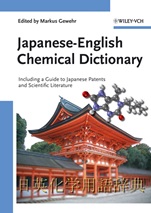
Japanese–English Chemical Dictionary: Including a Guide to Japanese Patents and Scientific Literature
ISBN 9783527312931
Autor: Markus Gewehr
Wydawca: Wiley
Dostępność: 3-6 tygodni
Cena: 1 179,15 zł
Przed złożeniem zamówienia prosimy o kontakt mailowy celem potwierdzenia ceny.
ISBN13: |
9783527312931 |
ISBN10: |
3527312935 |
Autor: |
Markus Gewehr |
Oprawa: |
Hardback |
Rok Wydania: |
2007-10-17 |
Ilość stron: |
680 |
Wymiary: |
242x181 |
Tematy: |
PN |
Japan is the world′s second largest economy with a large and diverse chemical industry and internationally recognized academic departments and institutions. A high proportion of Japanese chemical literature, including almost all of the many patents, is published in Japanese rather than in English and thus normally requires Japanese language skills.
This indispensable tool enables scientists and translators with only a basic knowledge of the language to quickly locate and evaluate pertinent information, tapping into this large body of chemical literature.
The dictionary is unique in both its scope and concept, listing over 15,000 technical terms from all chemical disciplines in kanji/kana script, romaji transcription and English translation, ordered for quick access.
An introductory section outlines Japanese language, grammar and script which are characteristic for technical publications. Because of it′s increasing importance, a focus is on patents from Japan while describing the Japanese patent documentation, giving online sources of patent information and providing an overview on the Japanese patent law.
With contributions by Klaus Hinkelmann and Irene Schellner.
Spis treści:
Preface.
Abbreviations and General Notes.
Contributors.
I General Part.
1 Introduction to the Japanese Language.
1.1 The Japanese Language.
1.2 Japanese Writing.
2 Japanese in Scientific and Technical Publications.
2.1 Scientific and Technical Publications.
2.2 Frequently used kanji.
2.3 Numbers, Symbols and Units.
2.4 Suggestions for Reading Japanese Scientific and Technical Publications.
2.5 Example Translations.
2.6 Tools for Supporting Text Analysis.
3 Naming of Chemical Compounds.
3.1 Naming of Elements and Inorganic Compounds.
3.2 Naming of Organic Compounds.
3.3 Overview of Specific Organic Molecules.
4 Japanese Patent Documentation (Irene Schellner and
Markus Gewehr).
4.1 The Japanese Patent System.
4.2 Special Characteristics of Japanese Patent Documentation.
4.3 Online Sources of Japanese Patent Information.
5 Overview of Japanese Patent Law (Klaus Hinkelmann).
5.1 Introduction.
5.2 Drafting of Japanese Patent Applications.
5.3 Filing of Japanese Patent Applications.
5.4 Examination of Japanese Patent Applications.
5.5 Attack on Patent Applications and Patents.
5.6 The Patent Right.
5.7 Enforcement of Patent Rights.
II Japanese–English Dictionary.
6 Dictionary Structure and Explanations.
6.1 General Explanations.
6.2 Dictionary Part I: Scientific Terms beginning with kana.
6.3 Dictionary Part II: Scientific Terms beginning with basic kanji.
6.4 Dictionary Part III: Further Scientific Terms beginning with kanji.
7 Dictionary Part I: Scientific Terms Beginning with kana.
8 Dictionary Part II: Scientific Terms Beginning with Basic kanji.
8.1 Scientific Terms Beginning with kanji for Figures and Quantities.
8.2 Scientific Terms Beginning with kanji for Chemical Elements.
8.3 Scientific Terms Beginning with Characters Frequently Appearing in the Initial Position of Chemical Terms.
8.4 Scientific Terms Beginning with Characters Representing Important Prefixes for Chemical Words.
9 Dictionary Part III: Further Scientific Terms Beginning with kanji.
9.1 kanji without Radicals.
9.2 kanji based on Radicals.
III Appendices.
10 Bibliography.
10.1 Character Dictionaries.
10.2 Grammar and Related Topics.
10.3 General Japanese–English Dictionaries.
10.4 Scientific Books and Dictionaries.
10.5 Further Literature and Information Sources.
10.5.1 Online Sources of Japanese Chemical Societies.
10.5.2 Online Sources of Authorities and Institutes in Japan.
11 Subject Index.
Nota biograficzna:
Markus Gewehr s
tudied chemistry at Johannes Gutenberg–University in Mainz, Germany. He received his Ph.D. 1996 in the group of Professor Horst Kunz on the use of enzymatic cleavable protecting groups in the synthesis of peptides and glyocopeptides. In 1990–1991 he studied at Kyoto University with Professor Norio Ise and Professor Hiromi Kitano in the field of macromolecular chemistry and chemical engineering, accompanied by learning the Japanese language. Since then, he is a regularly visitor to Japan and is the author of essays on different topics in anthologies about Japan. The results of his research activities are published in several journals.
After joining BASF Aktiengesellschaft in Ludwigshafen, Germany, in 1997, Markus Gewehr worked on fungicide active ingredient discovery research. By translating patents and other chemical literature from Japan, he gained experience in text analysis of scientific documents written in Japanese. He is inventor of over 160 patent families. Within BASF′s agricultural division, he is now responsible for global strategic IP management.
Okładka tylna:
Japan is the world′s second largest economy with a large and diverse chemical industry and internationally recognized academic departments and institutions. A high proportion of Japanese chemical literature, including almost all of the many patents, is published in Japanese rather than in English and thus normally requires Japanese language skills.
This indispensable tool enables scientists and translators with only a basic knowledge of the language to quickly locate and evaluate pertinent information, tapping into this large body of chemical literature.
The dictionary is unique in both its scope and concept, listing over 15,000 technical terms from all chemical disciplines in kanji/kana script, romaji transcription and English translation, ordered for quick access.
An introductory section outlines Japanese language, grammar and script whic
h are characteristic for technical publications. Because of it′s increasing importance, a focus is on patents from Japan while describing the Japanese patent documentation, giving online sources of patent information and providing an overview on the Japanese patent law.
With contributions by Klaus Hinkelmann and Irene Schellner.
Koszyk
Książek w koszyku: 0 szt.
Wartość zakupów: 0,00 zł
Informacje


Kontakt
Gambit
Centrum Oprogramowania
i Szkoleń Sp. z o.o.
Al. Pokoju 29b/22-24
31-564 Kraków
Siedziba Księgarni
ul. Kordylewskiego 1
31-542 Kraków
+48 12 410 5991
+48 12 410 5987
+48 12 410 5989
Subskrypcje
Administratorem danych osobowych jest firma Gambit COiS Sp. z o.o. Na podany adres będzie wysyłany wyłącznie biuletyn informacyjny.
Autoryzacja płatności

Informacje na temat autoryzacji płatności poprzez PayU.

© Copyright 2012: GAMBIT COiS Sp. z o.o. Wszelkie prawa zastrzeżone.
Projekt i wykonanie: Alchemia Studio Reklamy