


Wydawcy
Katalog tematyczny
- Archeologia (109)
- Ekonomia, finanse, business (13704)
- Filozofia (1445)
- Historia (3040)
- Języki i językoznawstwo (2356)
- Lifestyle, hobby i rozrywka (475)
- Medycyna (9704)
- Nauki humanistyczne (4)
- Nauki o Ziemi i środowisku (2638)
- Nauki ścisłe (20412)
- Astronomia (294)
- Biologia (5119)
- Chemia (6540)
- Fizyka (3309)
- Elektryczność i magnetyzm (90)
- Fizyka atomowa i molekularna (110)
- Fizyka cząstek elementarnych (36)
- Fizyka jądra atomowego (36)
- Fizyka kwantowa (210)
- Fizyka matematyczna (121)
- Fizyka relatywistyczna (36)
- Fizyka statystyczna (51)
- Fizyka stosowana (498)
- Mechanika klasyczna (186)
- Optyka i światło (133)
- Stany materii (202)
- Matematyka (4574)
- Nauki ścisłe, ogólnie (503)
- Nauki społeczne (8486)
- Nauki techniczne (13450)
- Prawo (1696)
- Publikacje informacyjne i interdyscyplinarne (1288)
- Religia i wierzenia (917)
- Technika komputerowa (4067)
- Zdrowie, relacje międzyludzkie i rozwój osobisty (657)





Informacje szczegółowe o książce
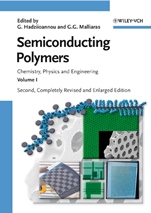
Semiconducting Polymers: Chemistry, Physics and Engineering
ISBN 9783527312719
Autor: Georges Hadziioannou, George G. Malliaras
Wydawca: Wiley
Dostępność: 3-6 tygodni
Cena: 1 798,65 zł
Przed złożeniem zamówienia prosimy o kontakt mailowy celem potwierdzenia ceny.
ISBN13: |
9783527312719 |
ISBN10: |
3527312714 |
Autor: |
Georges Hadziioannou, George G. Malliaras |
Oprawa: |
Hardback |
Rok Wydania: |
2006-11-03 |
Numer Wydania: |
2nd Edition, Two–Volume Set |
Ilość stron: |
768 |
Wymiary: |
243x174 |
Tematy: |
PH |
This book describes the various approaches to doped and undoped semiconducting polymers taken with the aim to provide vital understanding of how to control the properties of these fascinating organic materials. Prominent researchers from the fields of synthetic chemistry, physical chemistry, engineering, computational chemistry, theoretical physics, and applied physics cover all aspects from compounds to devices.
Since the first edition was published in 2000, significant findings and successes have been achieved in the field, and especially handheld electronic gadgets have become billion–dollar markets that promise a fertile application ground for flexible, lighter and disposable alternatives to classic silicon circuitry. This second edition brings readers up–to–date on cutting edge research in this field.
Spis treści:
Foreword.
Preface.
List of Contributors.
VOLUME 1.
Synthetic Methods.
1 Synthetic Methods for Semiconducting Polymers (Alberto Bolognesi and Maria Cecilia Pasini).
1.1 Introduction and Overview.
1.2 Synthetic Pathways for PA.
1.3 Conjugated Polymers by Step–Growth Polymerizations.
1.4 Block Copolymers.
1.5 Towards Autoorganized Devices.
References.
2 Processable Semiconducting Polymers Containing Oligoconjugated Blocks (Joannis K. Kallitsis, Panagiotis K. Tsolakis, and Aikaterini K. Andreopoulou).
2.1 Introduction.
2.2 Rod–Coil Block Copolymers.
2.3 Alternating Conjugated–Nonconjugated Polymers.
References.
Structure/Morphology.
3 Interfacial Aspects of Semiconducting Polymer Devices (Richard A. L. Jones).
3.1 Introduction.
3.2 Some Basics of Polymer Blend Thermodynamics and Dynamics.
3.3 Surface Segregation, Surface–driven Phase Separation, Wetting and Self–Stratification.
3.4 Morphology in Thin Films of Semiconducting Polymer Ble
nds.
3.5 Surface Segregation in Polymer–doped Conducting Polymers.
3.6 Interface Structure.
3.7 Conclusions.
References.
Electronic Structure of Interfaces.
4 Electronic Structure of Surfaces and Interfaces in Conjugated Polymers (Michael Lögdlund, Mats Fahlman, Stina K.M. Jönsson, and William R. Salaneck).
4.1 Introduction.
4.2 Photoelectron Spectroscopy.
4.3 Theoretical Approaches.
4.4 Materials.
4.5 Charge Storage States in Conjugated Polymers.
4.6 Interface Formations in Conjugated Systems.
4.7 Summary.
References.
Photophysics.
5 Photophysics of Conjugated Polymers (Lewis Rothberg).
5.1 Introduction and Overview.
5.2 Definitions and Terminology.
5.3 Spectroscopy.
5.4 Photophysics.
5.5 Summary.
5.6 Conclusion.
References.
6 Photophysics in Semiconducting Polymers: The Case of Polyfluorenes (Christoph Gadermaier, Larry Lüer, Alessio Gambetta, Tersilla Virgili, Margherita Zavelani–Rossi, and Guglielmo Lanzani).
6.1 Introduction.
6.2 Experimental.
6.3 Low–Dimensional Physics in Conjugated Chains.
6.4 Ground–State Absorption and cw Photoluminescence.
6.5 Long–Lived Photoexcitation in Polyfluorenes (PFs).
6.6 Singlet Exciton Dynamics.
6.7 On–Chain Emissive Defects.
6.8 Charged Excitations and Their Photogeneration Mechanism.
6.9 Intrachain Dynamics.
6.10 Three–Pulse Time–Resolved Experiments.
6.11 Light–Emitting–Diode–Related Dynamics in the Ultrafast Timescale.
References.
7 Spectroscopy of Photoexcitations in Conjugated Polymers (Z. Valy Vardeny and Markus Wohlgenannt).
7.1 Introduction.
7.2 Experimental Methods.
7.3 Experimental Results: cw PA Spectroscopy.
7.4 Transient Pump–and–Probe Spectroscopy.
7.5 Multiple–Pulse Transient Spectroscopy.
7.6 ODMR Spectroscopy: Measur
ement of Spin–Dependent Polaron Recombination Rates.
7.7 Summary.
References.
Transport/Injection.
8 Charge Transport in Neat and Doped Random Organic Semiconductors (Vladimir I. Arkhipov, Igor I. Fishchuk, Andriy Kadashchuk, and Heinz Bässler).
8.1 Introduction.
8.2 Charge Generation.
8.3 Charge–Carrier Hopping in Noncrystalline Organic Materials.
8.4 Experimental Techniques.
8.5 Experimental Results.
8.6 Conclusions.
References.
9 Charge Transport and Injection in Conjugated Polymers (Paul W.M. Blom, Cristina Tanase, and Teunis van Woudenbergh).
9.1 Introduction.
9.2 Charge Transport.
9.3 Charge Injection.
References.
VOLUME 2.
Applications.
10 Physics of Organic Light–Emitting Diodes (Ian H. Campbell, Brian K. Crone, and Darryl L. Smith).
10.1 Introduction.
10.2 Thin Films of Organic Semiconductors.
10.3 Device Electronic Structure.
10.4 Single–Layer Devices.
10.5 Multilayer Devices.
10.6 Conclusions.
References.
11 Conjugated Polymer–Based Organic Solar Cells (Gilles Dennler, Niyazi Serdar Sariciftci, and Christoph J. Brabec).
11.1 Introduction.
11.2 Conjugated Polymers as Photoexcited Donors.
11.3 Bulk–Heterojunction Solar Cells.
11.4 Determining Parameters of Bulk–Heterojunction Solar Cells.
11.5 From Basics to Applications.
11.6 Conclusions.
References.
12 Organic Thin–Film Transistors (Gilles Horowitz).
12.1 Introduction.
12.2 The MISFET – A Reminder.
12.3 The Organic Transistor – What’s Different?
12.4 Charge–Transport Mechanisms.
12.5 Concluding Remarks.
References.
13 n–Channel Organic Transistor Semiconductors for Plastic Electronics Technologies (Howard E. Katz).
13.1 Plastic Electronics Technology and Organic Semiconduc
tors.
13.2 n–Channel OFET Semiconductors.
13.3 Conclusion.
References.
14 Photochromic Diodes (Xavier Crispin, Peter Andersson, Nathaniel D. Robinson, Yoann Olivier, Jérôme Cornil, and Magnus Berggren).
14.1 Introduction.
14.2 Photochromic Molecules.
14.3 Organic Diodes.
14.4 Electronic Switches – Device Concepts.
14.5 Conclusions.
References.
15 Organic/Polymeric Thin–Film Memory Devices (Yang Yang, Jianyong Ouyang, Liping Ma, Jia–Hung Tseng, and Chih–Wei Chu).
15.1 Introduction.
15.2 Review of Polymer and Organic Memory.
15.3 OMO Nanoparticle Layered Memory Devices.
15.4 Polymer–Blend Composite System.
15.5 Advanced Memory Device Architecture.
15.6 Conclusion.
References.
16 Biosensors Based on Conjugated Polymers (Hoang–Anh Ho and Mario Leclerc).
16.1 Introduction.
16.2 Different Types of CPs.
16.3 Colorimetric Methods.
16.4 Fluorometric Methods.
16.5 Electrochemical Methods.
16.6 Conclusions and Perspectives.
References.
Processing.
17 Manufacturing of Organic Transistor Circuits by Solution–Based Printing (Henning Sirringhaus, Christoph W. Sele, Timothy von Werne, and Catherine Ramsdale).
17.1 Introduction to Printed Organic Thin–Film Transistors.
17.2 Overview of Printing–Based Manufacturing Approaches for OTFTs.
17.3 High–Resolution, Self–Aligned Inkjet Printing.
17.4 Performance and Reliability of Solution–Processed OTFTs for Applications in Flexible Displays.
17.5 Conclusions.
References.
18 High–Resolution Composite Materials for Organic Electronics (Graciela Blanchet).
18.1 Introduction.
18.2 Building Blocks.
18.3 Large–Area Printing Process and Devices.
18.4 Printable Materials.
18.5 Conclusion.
References.
Subject Index.
Nota biogr
aficzna:
Georges Hadziioannou is Director of the Polymer Department and the European School of Chemistry Polymers and Materials (ECPM) since 2001 at Louis Pasteur University in Strasbourg, France. Prior to this appointment, he spent most of the 80s in the USA, first as postdoc at the University of Massachusetts, then as a research staff member for IBM in San José. From 1986 to 1989, he led the Surface and Interface Dynamics group at IBM′s Almaden Research Center. Twelve years as professor of polymer chemistry at Groningen University in the Netherlands followed.
He was named Americal Physical Society Fellow in 1994 and received a Humboldt Research Award in 1998. He has authored over 190 scientific papers in peer–reviewed journals, contributed 10 chapters to books and edited the first edition of this book together with P. F. van Hutten in 2000.
George Malliaras studied physics as an undergraduate and did his doctoral research on photorefractivity in polymers. Before joining the faculty at Cornell in 1998, he was a post–doctoral fellow at the University of Groningen (1996) and the Center for Polymer Interfaces and Macromolecular Assemblies (CPIMA), at the IBM Almaden Research Center (1997–98). He is a recipient of the NSF Early Career Development Award, a member of the American Physical Society and of the Materials Research Society.
Okładka tylna:
This book describes the various approaches to doped and undoped semiconducting polymers taken with the aim to provide vital understanding of how to control the properties of these fascinating organic materials. Prominent researchers from the fields of synthetic chemistry, physical chemistry, engineering, computational chemistry, theoretical physics, and applied physics cover all aspects from compounds to devices.
Since the first edition was published in 2000, significant findings and successes have been achieved in the field, and espec
ially handheld electronic gadgets have become billion–dollar markets that promise a fertile application ground for flexible, lighter and disposable alternatives to classic silicon circuitry. This second edition brings readers up–to–date on cutting edge research in this field.
Koszyk
Książek w koszyku: 0 szt.
Wartość zakupów: 0,00 zł
Informacje


Kontakt
Gambit
Centrum Oprogramowania
i Szkoleń Sp. z o.o.
Al. Pokoju 29b/22-24
31-564 Kraków
Siedziba Księgarni
ul. Kordylewskiego 1
31-542 Kraków
+48 12 410 5991
+48 12 410 5987
+48 12 410 5989
Subskrypcje
Administratorem danych osobowych jest firma Gambit COiS Sp. z o.o. Na podany adres będzie wysyłany wyłącznie biuletyn informacyjny.
Autoryzacja płatności

Informacje na temat autoryzacji płatności poprzez PayU.

© Copyright 2012: GAMBIT COiS Sp. z o.o. Wszelkie prawa zastrzeżone.
Projekt i wykonanie: Alchemia Studio Reklamy