


Wydawcy
Katalog tematyczny
- Archeologia (109)
- Ekonomia, finanse, business (13704)
- Filozofia (1445)
- Historia (3040)
- Języki i językoznawstwo (2356)
- Lifestyle, hobby i rozrywka (475)
- Medycyna (9704)
- Nauki humanistyczne (4)
- Nauki o Ziemi i środowisku (2638)
- Nauki ścisłe (20412)
- Astronomia (294)
- Biologia (5119)
- Chemia (6540)
- Chemia analityczna (361)
- Chemia fizyczna (346)
- Chemia nieorganiczna (137)
- Chemia organiczna (535)
- Krystalografia (27)
- Minerologia (46)
- Fizyka (3309)
- Matematyka (4574)
- Nauki ścisłe, ogólnie (503)
- Nauki społeczne (8486)
- Nauki techniczne (13450)
- Prawo (1696)
- Publikacje informacyjne i interdyscyplinarne (1288)
- Religia i wierzenia (917)
- Technika komputerowa (4067)
- Zdrowie, relacje międzyludzkie i rozwój osobisty (657)





Informacje szczegółowe o książce
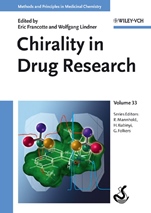
Chirality in Drug Research
ISBN 9783527310760
Autor: Eric Francotte, Wolfgang Lindner, Raimund Mannhold, Hugo Kubinyi, Gerd Folkers
Wydawca: Wiley
Dostępność: 3-6 tygodni
Cena: 1 071,00 zł
Przed złożeniem zamówienia prosimy o kontakt mailowy celem potwierdzenia ceny.
ISBN13: |
9783527310760 |
ISBN10: |
3527310762 |
Autor: |
Eric Francotte, Wolfgang Lindner, Raimund Mannhold, Hugo Kubinyi, Gerd Folkers |
Oprawa: |
Hardback |
Rok Wydania: |
2006-10-10 |
Ilość stron: |
370 |
Wymiary: |
247x182 |
Tematy: |
PN |
Most pharmaceutically active compounds possess a chirality that greatly influences their pharmacological properties. Since all pharmaceutical products nowadays are produced in chirally pure form, this places huge demands on the technology used for drug synthesis, purification, analysis and testing.
Here, the two editors from academia and a major pharmaceutical company have assembled an experienced, international team to provide first–hand practical advice and report previously unpublished data.
Divided into the three main sections of synthesis, analysis and drug development, this handbook covers all stages of the drug development process, including large–scale synthesis and purification of chirally pure pharmaceuticals.
In the first section, the isolation of chiral drugs from natural sources, their production in enzymatic processes and the resolution of racemic mixtures in preparative chromatography are outlined in separate chapters. For the section on qualitative and quantitative analysis, enantioselective chromatographic methods are presented as well as optical methods and CE–MS, while the final section deals with the pharmacology, pharmacokinetics and metabolic aspects of chiral drugs, devoting whole chapters to stereoselective drug binding and modeling chiral drug–receptor interactions.
With its unique industry–relevant aspects, this is a must for medicinal and pharmaceutical chemists.
Spis treści:
Preface.
List of Contributors.
Introduction.
1 Chiral Drugs from a Historical Point of View (Joseph Gal).
1.1 Introduction.
1.2 A Word About Words.
1.3 Old Chiral Drugs: Natural Remedies 3000BC–1900.
1.4 Recognition of Chirality in Drugs.
1.5 Enantioselectivity in Drug Action and Drug Metabolism: The Beginnings.
1.6 Drug Chirality in the 20th Century.
References.
Synthesis.
2 Stereoselective Synthesis of Drugs –
An Industrial Perspective (Hans–Jürgen Federsel).
2.1 Introduction: Historical Overview.
2.2 Asymmetry from an Industrial Scale Perspective.
2.3 Stereoselective Processes in Drug Manufacture – Drivers and Blockers.
2.4 The Metal – Friend and Foe.
2.5 Ligand Development – At the Core of Catalytic Chemistry.
2.6 Asymmetric Reactions – A Rich Reservoir.
2.7 Retrospect and Prospect.
References.
3 Aspects of Chirality in Natural Products Drug Discovery (Philipp Krastel, Frank Petersen, Silvio Roggo, Esther Schmitt, and Ansgar Schuffenhauer).
3.1 Introduction.
3.2 Stereochemical Aspects of Natural Products.
3.3 Mechanisms of Stereochemical Control in Natural Product Biosynthesis.
3.4 Biological Activity of Natural Products Related to Stereochemistry.
References.
4 Biotransformation Methods for Preparing Chiral Drugs and Drug Intermediates (Michael Müller and Marcel Wubbolts).
4.1 Introduction.
4.2 Examples of Established Applications of Biocatalysts in the Synthesis of Pharmaceuticals.
4.3 Some Special Aspects of Biocatalysts, Recent Developments.
4.4 Conclusions and Outlook.
References.
Separations.
5 Resolution of Chiral Drugs and Drug Intermediates by Crystallisation (Kazuhiko Saigo).
5.1 Introduction.
5.2 Physical Enantioseparation – Preferential Crystallization.
5.3 Chemical Enantioseparation – Diastereomeric Salt Formation.
5.4 The Bridge Between Preferential Crystallization and Diastereomeric Salt Formation.
5.5 Process Research on the Enantioseparation of Racemates by Diastereomeric Salt Formation.
5.6 Examples of Enantioseparations in the Pharmaceutical Industry.
References.
6 Isolation and Production of Optically Pure Drugs by Enantioselective Chromatography (Eric Francotte).
6.1 Introduction.
6.2 General Considerations Regarding the Preparati
on of Single Stereoisomers of Chiral Drugs.
6.3 Preparative Chiral Stationary Phases.
6.4 Strategies for Performing Enantioselective Separations.
6.5 Preparative Enantioselective Resolution of Chiral Drugs.
6.6 Conclusion.
References.
7 Stereoselective Chromatographic Methods for Drug Analysis (Norbert M. Maier and Wolfgang Lindner).
7.1 Introduction.
7.2 The Role of Enantioselective Analysis in Drug Development.
7.3 Separation Techniques in Enantiomer Analysis.
7.4 Principle of Enantiomer Separation.
7.5 Molecular Requirements for Chiral Recognition.
7.6 Thermodynamic Principles of Enantiomer Separation.
7.7 Role of Mobile Phase in Enantiomer Separation.
7.8 Chiral Selectors and Chiral Stationary Phases Employed in Liquid Chromatographic Enantiomer Separation.
7.9 Conclusions.
References.
8 Capillary Electrophoresis Coupled to Mass Spectrometry for Chiral Drugs Analysis (Serge Rudaz and Jean–Luc Veuthey).
8.1 Introduction.
8.2 Capillary Electrophoresis (CE).
8.3 CE–MS Coupling.
8.4 Chiral Separation Strategies.
8.5 Partial Filling.
8.6 Partial Filling – Counter Current Technique.
8.7 Chiral Micellar Electrokinetic Chromatography.
8.8 Quantitative Aspects in CE–MS and Parameters for CE–ESI–MS Coupling.
8.9 Capillary Electrochromatography Coupled to Mass Spectrometry.
8.10 Discussion and Conclusion.
References.
9 Powerful Chiral Molecular Tools for Preparation of Enantiopure Alcohols and Simultaneous Determination of Their Absolute Configurations by X–Ray Crystallography and/or 1H NMR Anisotropy Methods (Nobuyuki Harada).
9.1 Introduction.
9.2 Methodologies for Determining Absolute Configuration.
9.3 CSDP Acid, Camphorsultam Dichlorophthalic Acid (–)–1, Useful for the Enantioresolution of Alcohols by HPLC and Simultaneous Determination of Their Absolute Configurat
ions by X–ray Crystallography 287
9.4 A Novel Chiral Molecular Tool, 2–Methoxy–2–(1–naphthyl)propionic Acid (MαNP Acid (S)–(+)–3), Useful for Enantioresolution of Alcohols and Simultaneous Determination of Their Absolute Configurations by the 1H NMR Aisotropy Method.
9.5 Absolute Configuration of the Thyroid Hormone Analog KAT–2003 as Determined by the 1H NMR Anisotropy Method with MαNP Acid.
9.6 Conclusion.
References.
10 Keywords in Chirality Modeling Molecular Modeling of Chirality – Software and Literature Research on Chirality in Modeling, Chirality in Docking, Chiral Ligand–Receptor Interaction and Symmetry (Gerd Folkers, Mine Yarim, and Pavel Pospisil).
10.1 Introduction.
10.2 Chirality in QSAR.
10.3 Molecular Modeling in Chiral Chromatography.
10.4 Chirality of Protein Residues, Homology Modeling.
10.5 Chiral Selective Binding, MDS methods.
10.6 Docking of Chiral Compounds.
10.7 Molecular Modeling Software Dealing with Chirality and Some References to Its Successful Application.
References.
Subject Index.
Nota biograficzna:
Eric Francotte received his BS and PhD degrees from the University of Louvain (Belgium). After postdoctoral work at the University of Geneva, he joined the Central Research Laboratories at Ciba–Geigy, where he was working on optically active polymers. He is now Director and Head of Separations at the Novartis Institutes for BioMedical Research in Basel (Switzerland). He is also an editor of the Wiley journal ?Chirality?. His major interests include development and applications of chiral stationary phases for the separation of stereoisomers on an analytical and preparative scale.
Wolfgang Lindner received his PhD degree in Organic Chemistry from the University of Graz (Austria). After several academic positions, including a period at the FDA in
Koszyk
Książek w koszyku: 0 szt.
Wartość zakupów: 0,00 zł
Informacje


Kontakt
Gambit
Centrum Oprogramowania
i Szkoleń Sp. z o.o.
Al. Pokoju 29b/22-24
31-564 Kraków
Siedziba Księgarni
ul. Kordylewskiego 1
31-542 Kraków
+48 12 410 5991
+48 12 410 5987
+48 12 410 5989
Subskrypcje
Administratorem danych osobowych jest firma Gambit COiS Sp. z o.o. Na podany adres będzie wysyłany wyłącznie biuletyn informacyjny.
Autoryzacja płatności

Informacje na temat autoryzacji płatności poprzez PayU.

© Copyright 2012: GAMBIT COiS Sp. z o.o. Wszelkie prawa zastrzeżone.
Projekt i wykonanie: Alchemia Studio Reklamy