


Wydawcy
Katalog tematyczny
- Archeologia (109)
- Ekonomia, finanse, business (13704)
- Filozofia (1445)
- Historia (3040)
- Języki i językoznawstwo (2356)
- Lifestyle, hobby i rozrywka (475)
- Medycyna (9704)
- Nauki humanistyczne (4)
- Nauki o Ziemi i środowisku (2638)
- Nauki ścisłe (20412)
- Astronomia (294)
- Biologia (5119)
- Chemia (6540)
- Chemia analityczna (361)
- Chemia fizyczna (346)
- Chemia nieorganiczna (137)
- Chemia organiczna (535)
- Krystalografia (27)
- Minerologia (46)
- Fizyka (3309)
- Matematyka (4574)
- Nauki ścisłe, ogólnie (503)
- Nauki społeczne (8486)
- Nauki techniczne (13450)
- Prawo (1696)
- Publikacje informacyjne i interdyscyplinarne (1288)
- Religia i wierzenia (917)
- Technika komputerowa (4067)
- Zdrowie, relacje międzyludzkie i rozwój osobisty (657)





Informacje szczegółowe o książce
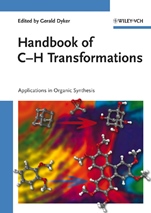
Handbook of C–H Transformations: Applications in Organic Synthesis 2 Volume Set
ISBN 9783527310746
Autor: Gerald Dyker
Wydawca: Wiley
Dostępność: 3-6 tygodni
Cena: 1 853,25 zł
Przed złożeniem zamówienia prosimy o kontakt mailowy celem potwierdzenia ceny.
ISBN13: |
9783527310746 |
ISBN10: |
3527310746 |
Autor: |
Gerald Dyker |
Oprawa: |
Hardback |
Rok Wydania: |
2005-09-30 |
Ilość stron: |
688 |
Wymiary: |
243x176 |
Tematy: |
PN |
Here, for the first time, the whole range of the functionalization of CH–bonds in one practical handbook. Throughout the more than 60 chapters the focus is on topicality and practicability, with all aspects presented in a compact and consistent way. Topics span modern catalysts for Friedel–Crafts type reactions to transition metal catalysts for the oxofunctionalization, via new methods for radicalic halogenation to domino processes by catalytic ortho metalation.
Renowned for his research as well as for his excellent articles and reviews, Gerald Dyker provides in these two volumes reliable and typical experimental procedures, making this a true source of high quality information, and a must for every organic chemist.
Spis treści:
Volume 1.
Preface.
List of Contributors.
I. General.
1. What is C–H Bond Activation? (Bengü Sezen and Dalibor Sames).
1.1 Introduction.
1.2 Activation or “Activation”.
1.3 The Origin and Historical Context of the “Organometallic Definition”.
1.4 What Do We Do With Two Definitions?
1.5 Conclusion.
2. C–H Transformation in Industrial Processes (Leslaw Mleczko, Sigurd Buchholz, Christian Münnich)
2.1 Introduction.
2.2 Alkane Activation.
2.3 C–H Transformation at Olefins.
2.4 Basic Chemicals from Aromatic Hydrocarbons.
2.5 Fine Chemicals.
II. C–H Transformation at sp–Hybridized Carbon Atoms.
1. C–H Transformation at Terminal Alkynes.
1.1 Recent Developments in Enantioselective Addition of Terminal Alkynes to Aldehydes (Tobias Ritter and Erick M. Carreira).
1.2 The Sonogashira Coupling Reaction (Herbert Plenio and Anupama Datta).
1.3 Glaser Homocoupling and the Cadiot–Chodkiewicz Heterocoupling Reaction (Peter Siemsen and Beatrice Felber).
1.4 Dimerization of Terminal Alkynes (Emilio Bustelo and Pierre H. Dixneuf).<
br>1.5 <i>anti</i>–Markovnikov Addition to Terminal Alkynes via Ruthenium Vinylidene Intermediates (Christian Bruneau).
2. Asymmetric Hydrocyanation of Alkenes (Jos Wilting and Dieter Vogt).
2.1 Introduction.
2.2 Mechanism.
III. C–H Transformation at sp<sup>2</sup>–hybridized Carbon Atoms.
1. C–H Transformations at Arenes.
1.1 Direct Oxidation of Arenes to Phenols and Quinones (Vsevolod V. Rostovtsev).
1.2 Metalation of Arenes.
1.3 Alkylation and Vinylation of Arenes.
1.4 Aryl–Aryl Coupling Reactions.
2. C–H Transformation at Alkenes.
2.1 The Heck Reaction (Lukas Gooben and K&auml;the Baumann).
2.2 Wacker Oxidation (Lukas Hintermann).
3. C–H Transformation at Aldehydes and Imines.
3.1 Inter– and Intramolecular Hydroacylation (Chul–Ho Jun and Young Jun Park).
Volume 2.
IV. C–H Transformation at sp<sup>3</sup>–hybridized Carbon Atoms.
1. C–H Transformation at Functionalized Alkanes.
1.1 C–H Transformation in the Position &alpha; to Polar Functional Groups.
1.2 C–H Transformation in the Allylic and Benzylic Positions.
1.3 C–H Transformation at Functionalized Alkanes via Palladacycles (Gerald Dyker).
2. C–H Transformation at Unfunctionalized Alkanes.
2.1 C–O Bond Formation by Oxidation.
2.2 Radical Halogenations of Alkanes (Peter R. Schreiner and Andrey A. Fokin).
2.3 Preparative SET C–H Transformations of Alkanes (Andrey A. Fokin and Peter R. Schreiner).
2.4 Photochemical Processes.
2.5 Heterogeneous Catalysts for the C–H Transformation of Unfunctionalized Alkanes (Robert Schl&ouml;gl).
2.6 Transition–metal Catalyzed Carboxylation of Alkanes (Yuzo Fujiwara and Tsugio Kitamura).
2.7 Photochemical and
Thermal Borylation of Alkanes (John F. Harwig and Joshua D. Lawrence).
2.8 Preparation of Olefins by Transition Metal–catalyzed Dehydrogenation (Alan S. Goldman and Rajshekhar Ghosh).
2.9 Rhodium–catalyzed Enantioselective Carbene Addition (Huw M.L. Davies).
Index.
Nota biograficzna:
Gerald Dyker was born in 1960. He studied chemistry at Dortmund University where he received his doctorate in 1988 for a thesis on ortho–quinonoid hetarenes. After postdoctoral research on ruthenium catalysis at Stanford University, he worked as a research chemist at Bayer AG in the field of veterinary pharmaceuticals. A Liebig fellowship enabled the completion of his habilitation on palladium catalyzed domino processes in 1994 at the Technical University of Braunschweig. Between 1995 and 1999 he was Professor for Organometallic Chemistry at Duisburg University. Since 2000 he has been Professor for Organic Chemistry at Bochum University. In addition to transition metal catalysis his current research interests include the synthesis of various complex targets, such as ligands with multiple coordination sites and a "nanodimensional baseball glove" for the complexation of metallic nanoparticles.
Okładka tylna:
Here, for the first time, the whole range of the functionalization of CH–bonds in one practical handbook. Throughout the more than 60 chapters the focus is on topicality and practicability, with all aspects presented in a compact and consistent way. Topics span modern catalysts for Friedel–Crafts type reactions to transition metal catalysts for the oxofunctionalization, via new methods for radicalic halogenation to domino processes by catalytic ortho metalation.
Renowned for his research as well as for his excellent articles and reviews, Gerald Dyker provides in these two volumes reliable and typical experimental procedures, making this a true source of high quality information, and a must
for every organic chemist.
Koszyk
Książek w koszyku: 0 szt.
Wartość zakupów: 0,00 zł
Informacje


Kontakt
Gambit
Centrum Oprogramowania
i Szkoleń Sp. z o.o.
Al. Pokoju 29b/22-24
31-564 Kraków
Siedziba Księgarni
ul. Kordylewskiego 1
31-542 Kraków
+48 12 410 5991
+48 12 410 5987
+48 12 410 5989
Subskrypcje
Administratorem danych osobowych jest firma Gambit COiS Sp. z o.o. Na podany adres będzie wysyłany wyłącznie biuletyn informacyjny.
Autoryzacja płatności

Informacje na temat autoryzacji płatności poprzez PayU.

© Copyright 2012: GAMBIT COiS Sp. z o.o. Wszelkie prawa zastrzeżone.
Projekt i wykonanie: Alchemia Studio Reklamy