


Wydawcy
Katalog tematyczny
- Archeologia (109)
- Ekonomia, finanse, business (13704)
- Filozofia (1445)
- Historia (3040)
- Języki i językoznawstwo (2356)
- Lifestyle, hobby i rozrywka (475)
- Medycyna (9704)
- Nauki humanistyczne (4)
- Nauki o Ziemi i środowisku (2638)
- Nauki ścisłe (20412)
- Astronomia (294)
- Biologia (5119)
- Chemia (6540)
- Chemia analityczna (361)
- Chemia fizyczna (346)
- Chemia nieorganiczna (137)
- Chemia organiczna (535)
- Krystalografia (27)
- Minerologia (46)
- Fizyka (3309)
- Matematyka (4574)
- Nauki ścisłe, ogólnie (503)
- Nauki społeczne (8486)
- Nauki techniczne (13450)
- Prawo (1696)
- Publikacje informacyjne i interdyscyplinarne (1288)
- Religia i wierzenia (917)
- Technika komputerowa (4067)
- Zdrowie, relacje międzyludzkie i rozwój osobisty (657)





Informacje szczegółowe o książce
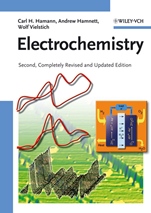
Electrochemistry
ISBN 9783527310692
Autor: Carl H. Hamann, Andrew Hamnett, Wolf Vielstich
Wydawca: Wiley
Dostępność: 3-6 tygodni
Cena: 422,10 zł
Przed złożeniem zamówienia prosimy o kontakt mailowy celem potwierdzenia ceny.
ISBN13: |
9783527310692 |
ISBN10: |
352731069X |
Autor: |
Carl H. Hamann, Andrew Hamnett, Wolf Vielstich |
Oprawa: |
Hardback |
Rok Wydania: |
2007-02-23 |
Numer Wydania: |
2nd, Completely Revised and Updated Edition |
Ilość stron: |
550 |
Wymiary: |
252x167 |
Tematy: |
PN |
Batteries, fuel cells, corrosion and electricity – with the advent of materials science and nanotechnology, electrochemistry is more important than ever. It is also becoming increasingly interdisciplinary, such that electrochemistry is a must for all chemistry students in their courses and for laboratory courses in physical chemistry.
This second, completely updated edition of a classic textbook provides a concise introduction to modern electrochemistry, from the physical–chemical fundamentals right up to technical applications, with an emphasis on energy technology. The renowned and experienced textbook authors present the material in a didactically skilful and lucid manner, backed by numerous informative illustrations and tables.
The scope of this book covers such modern methods of investigation as spectroelectrochemistry and mass spectrometry, electrochemical analysis and production methods, as well as fuel cells and micro– and nanotechnology.
The result is required reading for those majoring in chemistry, as well as those studying chemical engineering, materials science and physics.
Spis treści:
Preface.
List of Symbols and Units.
1 Foundations, Definitions and Concepts.
1.1 Ions, Electrolytes and the Quantisation of Electrical Charge.
1.2 Transition from Electronic to Ionic Conductivity in an Electrochemical Cell.
1.3 Electrolysis Cells and Galvanic Cells: The Decomposition Potential and the Concept of EMF.
1.4 Faraday’s Laws.
1.5 Systems of Units.
2 Electrical Conductivity and Interionic Interactions.
2.1 Fundamentals.
2.2 Empirical Laws of Electrolyte Conductivity.
2.3 Ionic Mobility and Hittorf Transport.
2.4 The Theory of Electrolyte Conductivity: The Debye–Hu¨ckel–Onsager Theory of Dilute Electrolytes.
2.5 The Concept of Activity from the Electrochemical Viewpoint.
2.6 The Properties of Weak Electrolytes.
2.7 The Concept of p
H and the Idea of Buffer Solutions.
2.8 Non–aqueous Solutions.
2.9 Simple Applications of Conductivity Measurements.
3 Electrode Potentials and Double–Layer Structure at Phase Boundaries.
3.1 Electrode Potentials and their Dependence on Concentration, Gas Pressure and Temperature.
3.2 Liquid–junction Potentials.
3.3 Membrane Potentials.
3.4 The Electrolyte Double–Layer and Electrokinetic Effects.
3.5 Potential and Phase Boundary Behaviour at Semiconductor Electrodes.
3.6 Simple Applications of Potential Difference Measurements.
4 Electrical Potentials and Electrical Current.
4.1 Cell Voltage and Electrode Potential during Current Flow: an Overview.
4.2 The Electron–transfer Region of the Current–Potential Curve.
4.3 The Concentration Overpotential – The Effect of Transport of Material on the Current–Voltage Curve.
4.4 The Effect of Simultaneous Chemical Processes on the Current Voltage Curve.
4.5 Adsorption Processes.
4.6 Electrocrystallisation – Metal Deposition and Dissolution.
4.7 Mixed Electrodes and Corrosion.
4.8 Current Flows on Semiconductor Electrodes.
4.9 Bioelectrochemistry.
5 Methods for the Study of the Electrode/Electrolyte Interface.
5.1 The Measurement of Stationary Current–Potential Curves.
5.2 Quasi–Stationary Methods.
5.3 Electrochemical Methods for the Study of Electrode Films.
5.4 Spectroelectrochemical and other Non–classical Methods.
5.5 Preparation of Nanostructures, Combination of STM and UHV–Transfer.
5.6 Optical Methods.
6 Electrocatalysis and Reaction Mechanisms.
6.1 On Electrocatalysis.
6.2 The Hydrogen Electrode.
6.3 The Oxygen Electrode.
6.4 Methanol Oxidation.
6.5 Carbon Monoxide Oxidation at Platinum Surfaces.
6.6 Conversion of Chemical Energy of Ethanol into Electricity.
6.7 Reaction Mechanisms in Electro–organic Chemistr
y.
6.8 Oscillations in Electrochemical Systems.
7 Solid and Molten–salt Ionic Conductors as Electrolytes.
7.1 Ionically Conducting Solids.
7.2 Solid Polymer Electrolytes (SPE’s).
7.3 Ionically–conducting Melts.
8 Industrial Electrochemical Processes.
8.1 Introduction and Fundamentals.
8.2 The Electrochemical Preparation of Chlorine and NaOH.
8.3 The Electrochemical Extraction and Purification of Metals.
8.4 Special Preparation Methods for Inorganic Chemicals.
8.5 Electro–organic Synthesis.
8.6 Modern Cell Designs.
8.7 Future Possibilities for Electrocatalysis.
8.8 Component Separation Methods.
9 Galvanic Cells.
9.1 Basics.
9.2 Properties, Components and Characteristics of Batteries.
9.3 Secondary Systems.
9.4 Primary Systems other than Leclanche´ Batteries.
9.5 Fuel Cells.
9.6 Primary and Secondary Air Batteries.
9.7 Efficiency of Batteries and Fuel Cells.
9.8 Super–capacitors.
10 Analytical Applications.
10.1 Titration Processes using Electrochemical Indicators.
10.2 Electro–analytical Methods.
10.3 Electrochemical Sensors.
Subject Index.
Nota biograficzna:
Carl H. Hamann: Following his studies in mathematics, physics, biology and economics in Hamburg and Bonn, graduating in 1966 as a physicist, Carl H. Hamann gained his doctorate in 1970, becoming Professor for Applied Physical Chemistry at the University of Oldenburg in 1975. He has since concentrated mainly on fuel cells, electrochemical metrology, passage and adsorption kinetics, turbulent flows, the thermodynamics of irreversible systems, preparative electroorganic chemistry and technical electrochemistry. Professor Hamann has thus far published some 80 articles in journals and books.
Wolf Vielstich: As Heinz Gerischer′s first student, in G?ngen in 1952/53, Wolf Vielstich was concerned with developing a fast Potentiosta
ten while determining exchange current densities. Upon starting work at the Institute for Physical Chemistry, Bonn University, in 1960 he demonstrated that, apart from mercury, reproducible cyclic voltamograms, such as for the oxidation of hydrogen and methanol, are contained in solid electrodes, including Pt, Ir, Rh, Au and Pd. There then followed experiments with methanol/air and NiMH cells, among others. He was always interested in developing novel methods, such as the rotating ring electrode, on–line MS (DEMS), in–situ FTIRS and UHV analysis of adsorbants. Between 1986 and 1993, Wolf Vielstich was the Coordinator of the first European project to develop a DMFC, and in 1998 he was awarded the Faraday Medal by the Royal Chemical Society. Since 1999 he has been working as a guest of the Universidade de Sao Paulo, and edited Wiley′s Handbook of Fuel Cells (2003).
Professor Hamnett graduated from the University of Oxford with a BA (Chemistry) in 1970 and a D.Phil. (Chemistry) in 1973. He has held research and academic positions at the University of British Columbia, Canada, and at Oxford and Newcastle Universities, England, before his appointment in January 2001 as Principal and Vice–chancellor of the University of Strathclyde. He has nearly 200 publications in books and scientific journals, covering areas of spectroscopy, quantum theory and electrochemistry. His primary academic interests in recent years include the development and utilisation of spectro–electrochemical techniques in electrochemistry, and the development of improved fuel cells and solar–energy conversion devices.
Okładka tylna:
Batteries, fuel cells, corrosion and electricity – with the advent of materials science and nanotechnology, electrochemistry is more important than ever. It is also becoming increasingly interdisciplinary, such that electrochemistry is a must for all chemistry students in their courses and for laborato
Koszyk
Książek w koszyku: 0 szt.
Wartość zakupów: 0,00 zł
Informacje


Kontakt
Gambit
Centrum Oprogramowania
i Szkoleń Sp. z o.o.
Al. Pokoju 29b/22-24
31-564 Kraków
Siedziba Księgarni
ul. Kordylewskiego 1
31-542 Kraków
+48 12 410 5991
+48 12 410 5987
+48 12 410 5989
Subskrypcje
Administratorem danych osobowych jest firma Gambit COiS Sp. z o.o. Na podany adres będzie wysyłany wyłącznie biuletyn informacyjny.
Autoryzacja płatności

Informacje na temat autoryzacji płatności poprzez PayU.

© Copyright 2012: GAMBIT COiS Sp. z o.o. Wszelkie prawa zastrzeżone.
Projekt i wykonanie: Alchemia Studio Reklamy