


Wydawcy
Katalog tematyczny
- Archeologia (109)
- Ekonomia, finanse, business (13704)
- Filozofia (1445)
- Historia (3040)
- Języki i językoznawstwo (2356)
- Lifestyle, hobby i rozrywka (475)
- Medycyna (9704)
- Nauki humanistyczne (4)
- Nauki o Ziemi i środowisku (2638)
- Nauki ścisłe (20412)
- Astronomia (294)
- Biologia (5119)
- Chemia (6540)
- Chemia analityczna (361)
- Chemia fizyczna (346)
- Chemia nieorganiczna (137)
- Chemia organiczna (535)
- Krystalografia (27)
- Minerologia (46)
- Fizyka (3309)
- Matematyka (4574)
- Nauki ścisłe, ogólnie (503)
- Nauki społeczne (8486)
- Nauki techniczne (13450)
- Prawo (1696)
- Publikacje informacyjne i interdyscyplinarne (1288)
- Religia i wierzenia (917)
- Technika komputerowa (4067)
- Zdrowie, relacje międzyludzkie i rozwój osobisty (657)





Informacje szczegółowe o książce
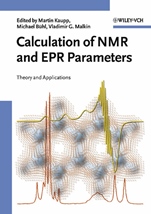
Calculation of NMR and EPR Parameters: Theory and Applications
ISBN 9783527307791
Autor: Martin Kaupp, Michael Bühl, Vladimir G. Malkin
Wydawca: Wiley
Dostępność: 3-6 tygodni
Cena: 1 368,15 zł
Przed złożeniem zamówienia prosimy o kontakt mailowy celem potwierdzenia ceny.
ISBN13: |
9783527307791 |
ISBN10: |
3527307796 |
Autor: |
Martin Kaupp, Michael Bühl, Vladimir G. Malkin |
Oprawa: |
Hardback |
Rok Wydania: |
2004-06-22 |
Ilość stron: |
621 |
Wymiary: |
245x179 |
Tematy: |
PN |
While NMR and EPR are among the most important analytical tools used in identifying and characterizing molecules, their complexity makes the critical interpretation of the spectra difficult. One way of acquiring the desired information is to calculate the NMR and EPR parameters from first principles. This is the first book to present the necessary quantum chemical methods for both resonance types in one handy volume, emphasizing the crucial interrelation between NMR and EPR parameters from a computational and theoretical point of view.
Here, readers are given a broad overview of all the pertinent topics, such as basic theory, methodic considerations, benchmark results and applications for both spectroscopy methods in such fields as biochemistry, bioinorganic chemistry as well as with different substance classes, including fullerenes, zeolites and transition metal compounds. The chapters have been written by leading experts in a given area, but with a wider audience in mind.
The result is the standard reference on the topic, serving as a guide to the best computational methods for any given problem, and is thus an indispensable tool for scientists using quantum chemical calculations of NMR and EPR parameters.
A must–have for all chemists, physicists, biologists and materials scientists who wish to augment their research by quantum chemical calculations of magnetic resonance data, but who are not necessarily specialists in these methods or their applications. Furthermore, specialists in one of the subdomains of this wide field will be grateful to find here an overview of what lies beyond their own area of focus.
Spis treści:
Foreword.
List of Contributors.
PART A: INTRODUCTORY CHAPTERS.
1. Introduction: The Quantum Chemical Calculation of NMR and EPR Parameters (M. Kaupp, et al.).
2. Theory of NMR Parameters. From Ramsey to Relativity, 1953–1983 (P. Pyykkö).
3. Historical Aspects of EPR Parameter C
alculations (F. Neese & M. Munzarová).
4. The Effective Spin Hamiltonian Concept from a Quantum Chemical Perspective (G. Lushington).
5. Fundamentals of Nonrelativistic and Relativistic Theory of NMR and ESR Parameters (W. Kutzelnigg).
PART B: NMR PARAMERTERS, METHODOLOGICAL ASPECTS.
6. Chemical Shifts with Hartree–Fock and Density Functional Methods (C. van Wüllen).
7. Spin–Spin Coupling Constants with HF and DFT Methods (T. Helgaker & M. Pecul).
8. Electron–Correlated Methods for the Calculation of NMR Chemical Shifts (J. Gauss & J. Stanton).
9. Semiempirical Methods for the Calculation of NMR Chemical Shifts (T. Heine & G. Seifert).
10. Ro–Vibrational Corrections to NMR Parameters (T. Ruden & K. Ruud).
11. Molecular Dynamics and NMR Parameter Calculations (D. Searles & H. Huber).
12. Use of Continuum Solvent Models in Magnetic Resonance Parameter Calculations (I. Ciofini).
13. Perturbational and ECP Calculation of Relativistic Effects in NMR Shielding and Spin–Spin Coupling (J. Vaara, et al.).
14. Calculation of Heavy–Nucleus Chemical Shifts. Relativistic All–Electron Methods (J. Autschbach).
15. Relativistic Calculations of Spin–Spin Coupling Constants of Heavy Nuclei (J. Autschbach & T. Ziegler).
16. Calculations of Magnetic Resonance Parameters in Solids and Liquids Using Periodic Boundary Conditions (C. Pickard & F. Mauri).
17. Calculation of Nuclear Quadrupole Coupling Constants (P. Schwerdtfeger, et al.).
18. Interpretation of NMR Chemical Shifts (M. Kaupp).
19. Interpretation of Indirect Nuclear Spin–Spin Coupling Constants (O. Malkia).
20. First–Principles Calculations of Paramagnetic NMR Shifts (S. Moon & S. Patchkovskii).
PART C: NMR PARAMERTERS, APPLICATIONS.
21. NMR Parameters in Proteins and Nucleic Acids (D. Case).
22. Characterizing
Two–Bond NMR 13C–15N, 15N–15N, and 19F–15N Spin–Spin Coupling Constants across Hydrogen Bonds Using in Ab Initio EOM–CCSD Calculations (J. Del Bene).
23. Calculation of NMR Parameters in Carbocation Chemistry (H. Siehl & V. Vrcek).
24. Aromaticity Indices from Magnetic Shieldings (Z. Chen, et al.).
25. Fullerenes (T. Heine).
26. NMR of Transition Metal Compounds (M. Bühl).
27. Characterization of NMR Tensors via Experiment and Theory (R. Wasylishen).
28. Calculation of Nuclear Magnetic Resonance Parameters in Zeolites (A. Goursot & D. Berthomieu).
PART D: EPR PARAMETERS, METHODOLOGICAL ASPECTS.
29. DFT Calculations of EPR Hyperfine Coupling Tensors (M. Munzarová).
30. Ab Initio Post–Hartree–Fock Calculations of Hyperfine Coupling Tensors and Their Comparison with DFT Approaches (B. Engels).
31. Alternative Fermi Contact Operators for EPR and NMR (V. Rassolov & D. Chipman).
32. Calculations of EPR g–Tensors with Density Functional Theory (S. Patchkovskii & G. Schreckenbach).
33. Ab Initio Calculations of g–Tensors (G. Lushington).
34. Zero–Field Splitting (F. Neese).
PART E: EPR PARAMETERS, APPLICATIONS.
35. Computation of Hyperfine Coupling Tensors to Complement EPR Experiments (F. Ban, et al.).
36. Applications to EPR in Bioinorganic Chemistry (F. Neese).
Index.
Nota biograficzna:
Martin Kaupp is Professor at the Institut für Anorganische Chemie at Universität Würzburg. He was born in Stuttgart and studied chemistry in Stuttgart and Cincinnati, before carrying out his PhD thesis in Erlangen. After postdoctoral work at Max–Planck–Institut für Festkörperforschung in Stuttgart and at Université de Montréal, Canada, he completed his habilitation in
Theoretical Chemistry in Stuttgart, before moving to Würzburg in November 1999. His wide research interests include development and applications of quantum chemical methods to calculate NMR and EPR parameters, density functional theory, relativistic effects, bioradicals, and various aspects of computational bioinorganic, inorganic, and organometallic chemistry.
Michael Bühl is Research Associate in the Theoretical Department of the Max–Planck–Institut für Kohlenforschung in Mülheim/Ruhr (Germany) and lecturer at the University of Wuppertal. He was born in Würzburg and did his studies in Erlangen including his thesis. He was a post–doctoral fellow at the University of Georgia, Athens, GA (USA), then pursued his habilitation at the University of Zürich, before moving as a Heisenberg fellow to the MPI in Mülheim in 1999. He is interested in computational chemistry and applications to transition metal complexes, NMR parameters, and catalysis.
Vladimir G. Malkin is a Leading Research Scientist at the Institute of Inorganic Chemistry of the Slovak Academy of Sciences (Bratislava, Slovak Republic). He was born in Russia and carried out his studies of Physics in the Novosibirsk). He was an Alexander von Humboldt fellow at the Ruhr–Universität Bochum, Germany before he was working at the Université de Montréal, Canada. His major interests include development of quantum–chemical methods for non–relativistic and relativistic calculation of NMR and EPR parameters using Density Functional theory as well as new general approaches in quantum chemistry.
Okładka tylna:
While NMR and EPR are among the most important analytical tools used in identifying and characterizing molecules, their complexity makes the critical interpretation of the spectra difficult. One way of acquiring the desired information is to calculate the NMR and EPR parameters from first pr
Koszyk
Książek w koszyku: 0 szt.
Wartość zakupów: 0,00 zł
Informacje


Kontakt
Gambit
Centrum Oprogramowania
i Szkoleń Sp. z o.o.
Al. Pokoju 29b/22-24
31-564 Kraków
Siedziba Księgarni
ul. Kordylewskiego 1
31-542 Kraków
+48 12 410 5991
+48 12 410 5987
+48 12 410 5989
Subskrypcje
Administratorem danych osobowych jest firma Gambit COiS Sp. z o.o. Na podany adres będzie wysyłany wyłącznie biuletyn informacyjny.
Autoryzacja płatności

Informacje na temat autoryzacji płatności poprzez PayU.

© Copyright 2012: GAMBIT COiS Sp. z o.o. Wszelkie prawa zastrzeżone.
Projekt i wykonanie: Alchemia Studio Reklamy