


Wydawcy
Katalog tematyczny
- Archeologia (109)
- Ekonomia, finanse, business (13704)
- Filozofia (1445)
- Historia (3040)
- Języki i językoznawstwo (2356)
- Lifestyle, hobby i rozrywka (475)
- Medycyna (9704)
- Nauki humanistyczne (4)
- Nauki o Ziemi i środowisku (2638)
- Nauki ścisłe (20412)
- Astronomia (294)
- Biologia (5119)
- Chemia (6540)
- Fizyka (3309)
- Elektryczność i magnetyzm (90)
- Fizyka atomowa i molekularna (110)
- Fizyka cząstek elementarnych (36)
- Fizyka jądra atomowego (36)
- Fizyka kwantowa (210)
- Fizyka matematyczna (121)
- Fizyka relatywistyczna (36)
- Fizyka statystyczna (51)
- Fizyka stosowana (498)
- Mechanika klasyczna (186)
- Optyka i światło (133)
- Stany materii (202)
- Matematyka (4574)
- Nauki ścisłe, ogólnie (503)
- Nauki społeczne (8486)
- Nauki techniczne (13450)
- Prawo (1696)
- Publikacje informacyjne i interdyscyplinarne (1288)
- Religia i wierzenia (917)
- Technika komputerowa (4067)
- Zdrowie, relacje międzyludzkie i rozwój osobisty (657)





Informacje szczegółowe o książce
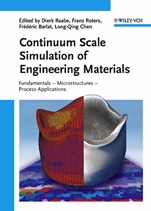
Continuum Scale Simulation of Engineering Materials: Fundamentals – Microstructures – Process Applications
ISBN 9783527307609
Autor: Dierk Raabe, Franz Roters, Frédéric Barlat, Long–Qing Chen
Wydawca: Wiley
Dostępność: 3-6 tygodni
Cena: 2 071,65 zł
Przed złożeniem zamówienia prosimy o kontakt mailowy celem potwierdzenia ceny.
ISBN13: |
9783527307609 |
ISBN10: |
3527307605 |
Autor: |
Dierk Raabe, Franz Roters, Frédéric Barlat, Long–Qing Chen |
Oprawa: |
Hardback |
Rok Wydania: |
2004-07-09 |
Ilość stron: |
885 |
Wymiary: |
244x180 |
Tematy: |
PH |
This book presents our current knowledge and understanding of continuum–based concepts behind computational methods used for microstructure and process simulation of engineering materials above the atomic scale. While the area of ground–state and molecular dynamics simulation techniques has recently been reviewed in some excellent overviews no such collection was presented for the field of continuum scale materials simulation concepts. This book tries to fill that gap.
By presenting in this volume a spectrum of different computational approaches to materials we also hope to initiate the development of corresponding virtual laboratories in the industry in which these methods are exploited. Another field which might substantially profit from the field of computational continuum materials science is the domain of computational bio–materials science which increasingly makes use of modeling approaches which have been developed by the materials community.
We feel that students and scientists who increasingly work in the field of continuum–based materials simulations should have a chance to compare the different methods in terms of their respective particular weaknesses and advantages. Such critical evaluation is important since continuum models do as a rule not emerge directly from ab–initio calculations. In other words, continuum simulations of materials rely on approximate constitutive models which are usually not derived by the help of quantum mechanics. This means that one should carefully check the underlying model assumptions of such approaches with respect to their applicability to a given problem. We hope that this volume provides a good overview on the different methods and train the reader in its ability to identify appropriate approaches to the new challenges emerging every day in this exciting domain.
Continuum–based simulation approaches cover a wide class of activities in the materials research community ranging
from basic thermodynamics and kinetics to large scale structural materials mechanics and microstructure–oriented process simulations. This spectrum of tasks is matched by a variety of simulation methods. The volume, therefore, consists of three main parts. The first one presents basic overview chapters which cover fundamental key methods in the field of continuum scale materials simulation. Prominent examples are the phase field model, cellular automata, crystal elasticity–plasticity finite element methods, Potts models, lattice gas approaches, discrete dislocation dynamics, yield surface plasticity, as well as artificial neural networks. The second one presents applications of these methods to the prediction of microstructures.
This part deals with explicit simulation examples such as phase field simulations of solidification, modeling of dendritic structures by means of cellular automata, phase field simulations of solid–state phase transformations and strain/stress–dominated microstructure evolution, statistical theory of grain growth, curvature–driven grain growth and coarsening including the motion of multiple interfaces, deformation and recrystallization of particle–containing aluminum alloys, cellular automaton simulation with variable cell size of grain growth, vertex grain boundary modeling, fluid mechanics of suspensions, thermal activation in discrete dislocation dynamics, statistical dislocation modeling, discrete dislocation simulations of thin film plasticity and brittle to ductile transition in fracture mechanics, coarse graining of dislocation dynamics, constitutive modeling of polymer deformation, Taylor–type homogenization methods for texture and anisotropy, continuum thermodynamic modeling, self consistent homogenization methods for texture and anisotropy , crystal plasticity finite element simulations, texture component crystal plasticity finite element methods, coupling of continuum fields to materia
ls properties through microstructure (the OOF project), micromechanical simulations of composites, as well as computational fracture mechanics.
Spis treści:
Preface.
List of Contributors.
I Fundamentals and Basic Methods.
1 Computer Simulation of Diffusion Controlled Phase Transformations
(A. Schneider and G. Inden).
1.1 Introduction.
1.2 Numerical Treatment of Diffusion Controlled Transformations.
1.3 Typical Applications.
1.4 Outlook.
References.
2 Introduction to the Phase–Field Method of Microstructure Evolution
(L.–Q. Chen).
2.1 Introduction.
2.2 Origin of the Model.
2.3 Theoretical Fundamentals of the Method.
2.4 Advantages and Disadvantages of the Method.
2.5 Typical Fields of Applications and Examples.
2.6 Summary and Opportunities.
References.
3 Cellular, Lattice Gas, and Boltzmann Automata
(D. Raabe).
3.1 Cellular Automata.
3.2 Cellular Automata for Fluid Dynamics.
3.3 Conclusions and Outlook.
References.
4 The Monte Carlo Method
(A. D. Rollett and P. Manohar).
4.1 Introduction.
4.2 History of the Monte Carlo Method.
4.3 Description of the Monte Carlo Method for Grain Growth & Recrystallization.
4.4 Nucleation in Recrystallization.
4.5 Initialization of MC Simulations.
4.6 Verification of the Monte Carlo Model.
4.7 Scaling of Simulated Grain Size to Physical Grain Size.
4.8 Recrystallization Kinetics in the Monte Carlo model.
4.9 Results of Simulation of Recrystallization by Monte Carlo Method.
4.10 Summary.
References.
5 Crystal Plasticity
(P. R. Dawson).
5.1 Introduction.
5.2 Theoretical Background.
5.3 Macroscopic Criteria for Anisotropic Strength.
5.3.1 Generalities.
5.4 Numerical Implementations.
5.5 Applications.
5.6 Summary.
References.
6 Yield Surface Plasticity and Anisotropy
(<
i>F. Barlat, O. Cazacu, M. ˙ Zyczkowski, D. Banabic, and J. W. Yoon).
6.1 Introduction.
6.2 Classical Plasticity Theory.
6.3 Material Structure and Plastic Anisotropy.
6.4 Yield Functions for Metals and Alloys.
6.5 Application to Sheet Forming and Formability.
6.6 Conclusions.
References.
7 Artificial Neural Networks
(E. Broese and H.–U. Löffler).
7.1 Introduction.
7.2 Basic Terms.
7.3 Fields of Application.
7.4 Implementation.
7.5 Types of Artificial Neural Networks.
7.6 Kinds of Learning.
7.7 Application Details.
7.8 Future Prospects.
References.
8 Multiscale Discrete Dislocation Dynamics Plasticity
(H. M. Zbib, M. Hiratani, and M. Shehadeh).
8.1 Introduction.
8.2 Theoretical Fundamentals of the Method.
8.3 Integration of DD and Continuum Plasticity.
8.4 Typical Fields of Applications and Examples.
8.5 Summary and Concluding Remarks.
References.
9 Physically Based Models for Industrial Materials: What For?
(Y. Brechet).
9.1 Introduction.
9.2 Recent Trends in Modelling Materials Behavior.
9.3 Some Examples of Physically Based Models for Industrial Materials.
9.4 Perspectives.
References.
II Application to Engineering Microstructures.
10 Modeling of Dendritic Grain Formation During Solidification at the Level of Macro– and Microstructures
(M. Rappaz, A. Jacot, and Ch.–A. Gandin).
10.1 Introduction.
10.2 Pseudo–Front Tracking Model.
10.3 Coupling with Thermodynamic Databases.
10.4 Cellular Automaton –Finite Element Model.
10.5 Results and Discussion.
10.6 Conclusion.
References.
11 Phase–Field Method Applied to Strain–dominated Microstructure Evolution during Solid–State Phase Transformations
(L.–Q. Chen and S. Y. Hu).
11.1 Introduction.
11.2 Phenomenological Description of Solid State
Phase Transformations.
11.3 Phase–Field Model of Solid State Phase Transformations.
11.4 Elastic Energy of a Microstructure.
11.5 Bulk Microstructures with Periodic Boundary Conditions.
11.6 A Single Crystal Film with Surface and Substrate Constraint.
11.7 Elastic Coupling of Structural Defects and Phase Transformations.
11.8 Phase–Field Model Applied to Solid State Phase Transformations.
11.9 Isostructura lPhase Separation.
11.10 Precipitation of Cubic Intermetallic Precipitates in a Cubic Matrix.
11.11 Structural Transformations Resulting in a Point Group Symmetry Reduction.
11.12 Ferroelectric Phase Transformations.
11.13 Phase Transformation in a Reduced Dimensions: Thin Films and Surfaces.
11.14 Summary.
References.
12 Irregular Cellular Automata Modeling of Grain Growth
(K. Janssens).
12.1 Introduction.
12.2 Irregular Cellular Automata.
12.3 Irregular Shapeless Cellular Automata for Grain Growth.
12.4 A Qualitative Example: Static Annealing of a Cold Rolled Steel.
12.5 Conclusion.
References.
13 Topological Relationships in 2D Trivalent Mosaics and Their Application to Normal Grain Growth
(R. Brandt, K. Lücke, G. Abbruzzese, and J. Svoboda).
13.1 Introduction.
13.2 Individual Grains and their Distributions (One–Grain Model).
13.3 Topological Relationships of Trivalent Mosaics.
13.4 Cases of Randomness.
13.5 Curvature Driven GG.
13.6 Summarizing Remarks.
References.
14 Motion of Multiple Interfaces: Grain Growth and Coarsening
(B. Nestler).
14.1 Introduction.
14.2 The Diffuse Interface Model.
14.3 Free Energies.
14.4 Numerical Simulations.
14.5 Outlook.
References.
15 Deformation and Recrystallization of Particle–containing Aluminum Alloys
(B. Radhakrishnan and G. Sarma).
15.1 Background.
15.2 Computational Approach.
15.3 Simulations.
15.4
Results and Discussion.
15.5 Summary.
References.
16 Mesoscale Simulation of Grain Growth
(D. Kinderlehrer, J. Lee, I. Livshits, and S. Ta’asan).
16.1 Introduction.
16.2 Discretization.
16.3 Numerical Implementation.
16.4 Numerical Results.
16.5 Conclusion.
References.
17 Dislocation Dynamics Simulations of Particle Strengthening
(V. Mohles).
17.1 Introduction.
17.2 Simulation Method.
17.3 Particle Arrangement.
17.4 Strengthening Mechanisms.
17.5 Summary and Outlook.
References.
18 Discrete Dislocation Dynamics Simulation of Thin Film Plasticity
(B. von Blanckenhagen and P. Gumbsch) 397
18.1 Thin Film Plasticity.
18.2 Simulation of Dislocations in Thin Films.
18.2.1 Boundary Conditions.
18.3 Thin Film Deformation, Models and Simulation.
18.3.1 Mobility Controlled Deformation.
18.3.2 Source Controlled Deformation.
References.
19 Discrete Dislocation Dynamics Simulation of Crack–Tip Plasticity
(A. Hartmaier and P. Gumbsch).
19.1 Introduction.
19.2 Model.
19.3 Crack–Tip Plasticity.
19.4 Scaling Relations.
19.5 Discussion.
19.6 Conclusions.
References.
20 Coarse Graining of Dislocation Structure and Dynamics
(R. LeSar and J. M. Rickman).
20.1 Introduction.
20.2 Dynamics of Discrete Dislocations.
20.3 Static Coarse–Grained Properties.
20.4 Dynamic Coarse–Grained Properties.
20.5 Conclusions.
References.
21 Statistical Dislocation Modeling
(R. Sedlá&ccaron;ek).
21.1 Introduction.
21.2 One–parameter Models.
21.3 Multi–parameter Models.
21.4 Conclusions.
References.
22 Taylor–Type Homogenization Methods for Texture and Anisotropy
(P. Van Houtte, S. Li, and O. Engler).
22.1 Introduction.
22.2 Local Constitutive Laws (Mesoscopic Scale).
22.3 The
Taylor Ambiguity.
22.4 Full Constraints (FC) Taylor Theory.
22.5 Classical Relaxed Constraints (RC) Models.
22.6 Multi–grain RC Models.
22.7 Validation of the Models.
22.8 Conclusions.
References.
23 Self Consistent Homogenization Methods for Texture and Anisotropy
(C. N. Tomé and R. A. Lebensohn).
23.1 Introduction.
23.2 Viscoplastic Selfconsistent Formalism.
23.3 Implementation of a Texture Development Calculation.
23.4 Applications.
23.5 Further Selfconsistent Models and Applications.
References.
24 Phase–field Extension of Crystal Plasticity with Application to Hardening Modeling
(B. Svendsen).
24.1 Introduction.
24.2 Basic Considerations and Results.
24.3 The Case of Small Deformation.
24.4 Simple Shear of a Crystalline Strip.
References.
25 Generalized Continuum Modelling of Single and Polycrystal Plasticity
(S. Forest).
25.1 Introduction.
25.2 Generalized Continuum Crystal Plasticity Models.
25.3 From Single to Polycrystals: Homogenization of Generalized Continua.
25.4 Simulations of Size Effects in Crystal Plasticity.
25.5 Conclusion.
References.
26 Micro–Mechanical Finite Element Models for Crystal Plasticity
(S. R. Kalidindi).
26.1 Introduction.
26.2 Theoretical Background.
26.3 Micro–Mechanical Finite Element Models.
26.4 Examples.
References.
27 A Crystal Plasticity Framework for Deformation Twinning
(S. R. Kalidindi).
27.1 Introduction.
27.2 Historical Perspective.
27.3 Incorporation of Deformation Twinning.
27.4 Examples.
References.
28 The Texture Component Crystal Plasticity Finite Element Method
(F. Roters).
28.1 Introduction.
28.2 The Texture Component Method.
28.3 The Crystal Plasticity Model.
28.4 Application of the TCCP–FEM to Forming Simulation.
28.5 Outlook.
References.
29 Microstructural Modeling of Multifunctional Material Properties: The OOF Project
(R. E. García, A. C. E. Reid, S. A. Langer, and W. C. Carter).
29.1 Introduction.
29.2 Program Overview.
29.3 Modeling of Piezoelectric Microstructures.
29.4 Modeling of Electrochemical Solids: Rechargeable Lithium Ion Batteries.
29.5 The OOFTWO Project: A Preview.
References.
30 Micromechanical Simulation of Composites
(S. Schmauder).
30.1 Introduction.
30.2 Matricity.
30.3 Results and Discussion.
30.4 Conclusion.
References.
31 Creep Simulation
(W. Blum).
31.1 Introduction.
31.2 Empirical Relations.
31.3 Basic Dislocation Processes.
31.4 Models.
31.5 Concluding Remarks.
References.
32 Computational Fracture Mechanics
(W. Brocks).
32.1 Introductory Remarks on Inelastic Material Behaviour.
32.2 FE Meshes for Structures with Crack–Like Defects.
32.3 The J–Integral as Characteristic Parameter in Elasto–Plastic Fracture Mechanics.
32.4 The Cohesive Model.
32.5 Summary.
References.
33 Rheology of Concentrated Suspensions: A Lattice Model
(Y. Brechet, M. Perez, Z. Neda, J. C. Barbe, and L. Salvo).
33.1 Introduction.
33.2 Behaviour of Suspensions: The Generation of Clusters.
33.3 Conclusions.
References.
III Application to Engineering Materials Processes.
34 Solidification Processes: From Dendrites to Design
(J. A. Dantzig).
34.1 Introduction.
34.2 Dendritic Microstructures.
34.3 Inverse Problems and Optimal Design.
34.4 Conclusion.
References.
35 Simulation in Powder Technology
(H. Riedel and T. Kraft).
35.1 Introduction.
35.2 Powder Production.
35.3 Die Filling.
35.4 Powder Compaction.
35.5 Sintering.
35.6 Sizing and Post–Sintering Mechanical Densification.
35.7 Fatigue.
35.8 Conclusions.
Koszyk
Książek w koszyku: 0 szt.
Wartość zakupów: 0,00 zł
Informacje


Kontakt
Gambit
Centrum Oprogramowania
i Szkoleń Sp. z o.o.
Al. Pokoju 29b/22-24
31-564 Kraków
Siedziba Księgarni
ul. Kordylewskiego 1
31-542 Kraków
+48 12 410 5991
+48 12 410 5987
+48 12 410 5989
Subskrypcje
Administratorem danych osobowych jest firma Gambit COiS Sp. z o.o. Na podany adres będzie wysyłany wyłącznie biuletyn informacyjny.
Autoryzacja płatności

Informacje na temat autoryzacji płatności poprzez PayU.

© Copyright 2012: GAMBIT COiS Sp. z o.o. Wszelkie prawa zastrzeżone.
Projekt i wykonanie: Alchemia Studio Reklamy