


Wydawcy
Katalog tematyczny
- Archeologia (109)
- Ekonomia, finanse, business (13704)
- Filozofia (1445)
- Historia (3040)
- Języki i językoznawstwo (2356)
- Lifestyle, hobby i rozrywka (475)
- Medycyna (9704)
- Nauki humanistyczne (4)
- Nauki o Ziemi i środowisku (2638)
- Nauki ścisłe (20412)
- Astronomia (294)
- Biologia (5119)
- Chemia (6540)
- Fizyka (3309)
- Elektryczność i magnetyzm (90)
- Fizyka atomowa i molekularna (110)
- Fizyka cząstek elementarnych (36)
- Fizyka jądra atomowego (36)
- Fizyka kwantowa (210)
- Fizyka matematyczna (121)
- Fizyka relatywistyczna (36)
- Fizyka statystyczna (51)
- Fizyka stosowana (498)
- Mechanika klasyczna (186)
- Optyka i światło (133)
- Stany materii (202)
- Matematyka (4574)
- Nauki ścisłe, ogólnie (503)
- Nauki społeczne (8486)
- Nauki techniczne (13450)
- Prawo (1696)
- Publikacje informacyjne i interdyscyplinarne (1288)
- Religia i wierzenia (917)
- Technika komputerowa (4067)
- Zdrowie, relacje międzyludzkie i rozwój osobisty (657)





Informacje szczegółowe o książce
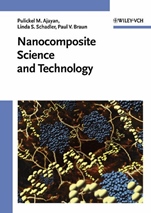
Nanocomposite Science and Technology
ISBN 9783527303595
Autor: Pulickel M. Ajayan, Linda S. Schadler, Paul V. Braun
Wydawca: Wiley
Dostępność: 3-6 tygodni
Cena: 1 167,60 zł
Przed złożeniem zamówienia prosimy o kontakt mailowy celem potwierdzenia ceny.
ISBN13: |
9783527303595 |
ISBN10: |
3527303596 |
Autor: |
Pulickel M. Ajayan, Linda S. Schadler, Paul V. Braun |
Oprawa: |
Hardback |
Rok Wydania: |
2003-09-12 |
Ilość stron: |
239 |
Wymiary: |
246x178 |
Tematy: |
PH |
In recent years, nanocomposites have captured and held the attention and imagination of scientists and engineers alike. Based on the simple premise that by using a wide range of building blocks with dimensions in the nonosize region, it is possible to design and create new materials with unprecedented flexibility and improvements in their physical properties.
This book contains the essence of this emerging technology, the underlying science and motivation behind the design of these structures and the future, particularly from the perspective of applications. It is intended to be a reference handbook for future scientists and hence carries the basic science and the fundamental engineering principles that lead to the fabrication and property evaluation of nonocomposite materials in different areas of materials science and technology.
Spis treści:
1. Bulk Metal and Ceramics Nanocomposites (Pulickel M. Ajayan).
1.1 Introduction.
1.2 Ceramic/Metal Nanocomposites.
1.2.1 Nanocomposites by Mechanical Alloying.
1.2.2 Nanocomposites from SolGel Synthesis.
1.2.3 Nanocomposites by Thermal Spray Synthesis.
1.3 Metal Matrix Nanocomposites.
1.4 Bulk Ceramic Nanocomposites for Desired Mechanical Properties.
1.5 Thin–Film Nanocomposites: Multilayer and Granular Films.
1.6 Nanocomposites for Hard Coatings.
1.7 Carbon Nanotube–Based Nanocomposites.
1.8 Functional Low–Dimensional Nanocomposites.
1.8.1 Encapsulated Composite Nanosystems.
1.8.2 Applications of Nanocomposite Wires.
1.8.3 Applications of Nanocomposite Particles.
1.9 Inorganic Nanocomposites for Optical Applications.
1.10 Inorganic Nanocomposites for Electrical Applications.
1.11 Nanoporous Structures and Membranes: Other Nanocomposites.
1.12 Nanocomposites for Magnetic Applications.
1.12.1 Particle–Dispersed Magnetic Nanocomposites.
1.12.2 Magnetic Multilayer Nanocomposites.
1.12.2.1 Microstructure and Th
ermal Stability of Layered Magnetic Nanocomposites.
1.12.2.2 Media Materials.
1.13 Nanocomposite Structures having Miscellaneous Properties.
1.14 Concluding Remarks on Metal/Ceramic Nanocomposites.
2. Polymer–based and Polymer–filled Nanocomposites (Linda S. Schadler).
2.1 Introduction.
2.2 Nanoscale Fillers.
2.2.1 Nanofiber or Nanotube Fillers.
2.2.1.1 Carbon Nanotubes.
2.2.1.2 Nanotube Processing.
2.2.1.3 Purity.
2.2.1.4 Other Nanotubes.
2.2.2 Plate–like Nanofillers.
2.2.3 Equi–axed Nanoparticle Fillers.
2.3 Inorganic FillerPolymer Interfaces.
2.4 Processing of Polymer Nanocomposites.
2.4.1 Nanotube/Polymer Composites.
2.4.2 Layered FillerPolymer Composite Processing.
2.4.2.1 Polyamide Matrices.
2.4.2.2 Polyimide Matrices.
2.4.2.3 Polypropylene and Polyethylene Matrices.
2.4.2.4 Liquid–Crystal Matrices.
2.4.2.5 Polymethylmethacrylate/Polystyrene Matrices.
2.4.2.6 Epoxy and Polyurethane Matrices.
2.4.2.7 Polyelectrolyte Matrices.
2.4.2.8 Rubber Matrices.
2.4.2.9 Others.
2.4.3 Nanoparticle/Polymer Composite Processing.
2.4.3.1 Direct Mixing.
2.4.3.2 Solution Mixing.
2.4.3.3 In–Situ Polymerization.
2.4.3.4 In–Situ Particle Processing Ceramic/Polymer Composites.
2.4.3.5 In–Situ Particle Processing Metal/Polymer Nanocomposites.
2.4.4 Modification of Interfaces.
2.4.4.1 Modification of Nanotubes.
2.4.4.2 Modification of Equi–axed Nanoparticles.
2.4.4.3 Small–Molecule Attachment.
2.4.4.4 Polymer Coatings.
2.4.4.5 Inorganic Coatings.
2.5 Properties of Composites.
2.5.1 Mechanical Properties.
2.5.1.1 Modulus and the Load–Carrying Capability of Nanofillers.
2.5.1.2 Failure Stress and Strain Toughness.
2.5.1.3 Glass Transition and Relaxation Behavior.
2.5.1.4 Abrasion and Wear Resistance.
2.5.2 Permeability.
2.5.3 Dimensional Stability.
2.5.4 Thermal Stability and
Flammability.
2.5.5 Electrical and Optical Properties.
2.5.5.1 Resistivity, Permittivity, and Breakdown Strength.
2.5.5.2 Optical Clarity.
2.5.5.3 Refractive Index Control.
2.5.5.4 Light–Emitting Devices.
2.5.5.5 Other Optical Activity.
2.6 Summary.
3. Natural Nanobiocomposites, Biomimetic Nanocomposites, and Biologically Inspired Nanocomposites (Paul V. Braun).
3.1 Introduction.
3.2 Natural Nanocomposite Materials.
3.2.1 Biologically Synthesized Nanoparticles.
3.2.2 Biologically Synthesized Nanostructures.
3.3 Biologically Derived Synthetic Nanocomposites.
3.3.1 Protein–Based Nanostructure Formation.
3.3.2 DNA–Templated Nanostructure Formation.
3.3.3 Protein Assembly.
3.4 Biologically Inspired Nanocomposites.
3.4.1 Lyotropic Liquid–Crystal Templating.
3.4.2 Liquid–Crystal Templating of Thin Films.
3.4.3 Block–Copolymer Templating.
3.4.4 Colloidal Templating.
3.5 Summary.
4. Modeling of Nanocomposites (Catalin Picu and Pawel Keblinski).
4.1 Introduction The Need For Modeling.
4.2 Current Conceptual Frameworks.
4.3 Multiscale Modeling.
4.4 Multiphysics Aspects.
4.5 Validation.
Index.
Nota biograficzna:
Pulickel M. Ajayan is Professor of Materials Science and Engineering at Rensselaer Polytechnic Institute. He received his Ph.D. in materials science and engineering from Northwestern University in 1989. After Three years of industrial research experience (NEC Corporation, Japan), he spent two years as a research scientist at the CNRS laboratoire de Physique des Solides, Orsay in France and about a year and a half as an Alexander von Humboldt fellow at the Max–Planck–Institut fur Metallforschung, Stuttgate in Germany. Professor Ajayan’s research interests are mainly focused on the synthesis and characterization of one–dimensional nonostructures with special emphasis on carbon nan
o–tubes. He is a pioneer in the area of nanotubes and has published some of the key papers in the field with more than 3000 citations for his work in this area.
Linda S. Schadler is Associate Professor at Rensselaer Polytechnic Institute. She graduated from Cornell University in 1985 with a B.S. in materials science and engineering and received a PhD in materials science and engineering in 1990 from the University of Pennsylvania. After two years of post–doctoral work at IBM Yorktown Heights, Schadler served as a faculty member at Drexel University in Philadelphia, PA before coming to Rensselaer. Professor Schadler is a current member of the National Materials Advisory Board. She serves on numerous professional committees and as education and outreach coordinator for the Center “Directed Assembly of Nanostructures”.
Dr. Schadler received a National Science Foundation National Young Investigator award in 1994 and the ASM International Bradley Staughton Award for Teaching in 1997. She received a Dow Outstanding New Faculty member award from the American Society of Engineering Education in 1998.
Paul V. Braun received his BS degree, with distinction, from Cornell University, and his PhD in Materials Science and Engineering from the University of Illinois at Urbana–Champaign in 1998. Following a one year post–doctoral appointment at Bell Labs, Lucent Technologies, he joined the faculty at the University of Illinois at U–C in 1999 as an assistant professor of materials Science and Engineering. He is the recipient of a 2001 Beckman Young Investigator Award, a 3M Nontenured Faculty Award, the 2002 Robert Lansing Hardy Award from TMS, and a Willett Faculty Scholar Award from the University of Illinois at U–C College of Engineering.
Okładka tylna:
In recent years, nanocomposites have captured and held the attention and imagination of scientists and engineers alike. Based on the simp
le premise that by using a wide range of building blocks with dimensions in the nonosize region, it is possible to design and create new materials with unprecedented flexibility and improvements in their physical properties.
This book contains the essence of this emerging technology, the underlying science and motivation behind the design of these structures and the future, particularly from the perspective of applications. It is intended to be a reference handbook for future scientists and hence carries the basic science and the fundamental engineering principles that lead to the fabrication and property evaluation of nonocomposite materials in different areas of materials science and technology.
Koszyk
Książek w koszyku: 0 szt.
Wartość zakupów: 0,00 zł
Informacje


Kontakt
Gambit
Centrum Oprogramowania
i Szkoleń Sp. z o.o.
Al. Pokoju 29b/22-24
31-564 Kraków
Siedziba Księgarni
ul. Kordylewskiego 1
31-542 Kraków
+48 12 410 5991
+48 12 410 5987
+48 12 410 5989
Subskrypcje
Administratorem danych osobowych jest firma Gambit COiS Sp. z o.o. Na podany adres będzie wysyłany wyłącznie biuletyn informacyjny.
Autoryzacja płatności

Informacje na temat autoryzacji płatności poprzez PayU.

© Copyright 2012: GAMBIT COiS Sp. z o.o. Wszelkie prawa zastrzeżone.
Projekt i wykonanie: Alchemia Studio Reklamy