


Wydawcy
Katalog tematyczny
- Archeologia (109)
- Ekonomia, finanse, business (13704)
- Filozofia (1445)
- Historia (3040)
- Języki i językoznawstwo (2356)
- Lifestyle, hobby i rozrywka (475)
- Medycyna (9704)
- Nauki humanistyczne (4)
- Nauki o Ziemi i środowisku (2638)
- Nauki ścisłe (20412)
- Astronomia (294)
- Biologia (5119)
- Chemia (6540)
- Chemia analityczna (361)
- Chemia fizyczna (346)
- Chemia nieorganiczna (137)
- Chemia organiczna (535)
- Krystalografia (27)
- Minerologia (46)
- Fizyka (3309)
- Matematyka (4574)
- Nauki ścisłe, ogólnie (503)
- Nauki społeczne (8486)
- Nauki techniczne (13450)
- Prawo (1696)
- Publikacje informacyjne i interdyscyplinarne (1288)
- Religia i wierzenia (917)
- Technika komputerowa (4067)
- Zdrowie, relacje międzyludzkie i rozwój osobisty (657)





Informacje szczegółowe o książce
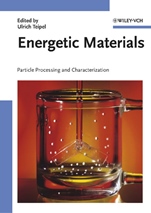
Energetic Materials: Particle Processing and Characterization
ISBN 9783527302406
Autor: Ulrich Teipel
Wydawca: Wiley
Dostępność: 3-6 tygodni
Cena: 1 476,30 zł
Przed złożeniem zamówienia prosimy o kontakt mailowy celem potwierdzenia ceny.
ISBN13: |
9783527302406 |
ISBN10: |
3527302409 |
Autor: |
Ulrich Teipel |
Oprawa: |
Hardback |
Rok Wydania: |
2004-11-26 |
Ilość stron: |
643 |
Wymiary: |
252x177 |
Tematy: |
PN |
Incorporation of particular components with specialized properties allows one to tailor the end product′s properties. For instance, the sensitivity, burning behavior, thermal or mechanical properties or stability of energetic materials can be affected and even controllably varied through incorporation of such ingredients. This book examines particle technologies as applied to energetic materials such as propellants and explosives, thus filling a void in the literature on this subject.
Following an introduction covering general features of energetic materials, the first section of this book describes methods of manufacturing particulate energetic materials, including size reduction, crystallization, atomization, particle formation using supercritical fluids and microencapsulation, agglomeration phenomena, special considerations in mixing explosive particles and the production of nanoparticles. The second section discusses the characterization of particulate materials. Techniques and methods such as particle size analysis, morphology elucidation and the determination of chemical and thermal properties are presented. The wettability of powders and rheological behavior of suspensions and solids are also considered. Furthermore, methods of determining the performance of particular energetic materials are described.
Each chapter deals with fundamentals and application possibilities of the various methods presented, with particular emphasis on issues applicable to particulate energetic materials. The book is thus equally relevant for chemists, physicists, material scientists, chemical and mechanical engineers and anyone interested or engaged in particle processing and characterization technologies.
Spis treści:
Preface.
List of Contributors.
1 New Energetic Materials (Horst H. Krause).
1.1 Introduction.
1.2 Application Requirements.
1.3 New Energetic Materials.
1.4 Conclusion.
1.5 Acknowledgments.
1.6 Refere
nces.
2 Size Reduction (U. Teipel, I. Mikonsaari).
2.1 Fundamentals of Size Reduction.
2.2 Size Reduction Processes.
2.3 References.
3 Crystallization (A. v. d. Heijden, J. ter Horst, J. Kendrick, K.–J. Kim, H. Kröber, F. Simon, U. Teipel).
3.1 Fundamentals of Crystallization.
3.2 Crystallization of Energetic Materials.
3.3 Simulation.
3.4 References.
4 Crystallization with Compressed Gases (E. Reverchon, H. Kröber, U. Teipel).
4.1 Introduction.
4.2 Rapid Expansion of Supercritical Solutions.
4.3 Supercritical Antisolvent Precipitation.
4.4 Precipitation of Energetic Materials by Supercritical Fluids.
4.5 Conclusions and Perspectives.
4.6 References.
5 Size Enlargement (E. Schmidt, R. Nastke, T. Heintz, M. Niehaus, U. Teipel).
5.1 Agglomeration.
5.2 Microencapsulating and Coating Processes.
5.2.1 Basics of Technologies.
5.3 References.
6 Mixing (A. C. Hordijk, A. v. d. Heijden).
6.1 Introduction.
6.2 Theory.
6.3 Type of Mixers.
6.4 Mixing Time and Efficiency.
6.5 Sequence of Addition of Ingredients.
6.6 Scale Effects.
6.7 Conclusions.
6.8 References.
7 Nanoparticles (A. E. Gash, R. L. Simpson, Y. Babushkin, A. I. Lyamkin, F. Tepper, Y. Biryukov, A. Vorozhtsov, V. Zarko).
7.1 Nano–structured Energetic Materials Using Sol–Gel Chemistry.
7.2 Detonation Synthesis of Ultrafine Diamond Particles from Explosives.
7.3 ALEX® Nanosize Aluminum for Energetic Applications.
7.4 Pneumatic Production Methods for Powdered Energetic Materials.
7.5 References.
8 Particle Characterization (U. Teipel, J. K. Bremser).
8.1 Particle Size Analysis.
8.2 Properties of Powders.
8.3 References.
9 Microstructure and Morphology (L. Borne, M. Herrmann, C. B. Skidmore).
9.1 Introduction.
9.2 Defects of Explosive Particles.
9.3 Characterization of the Microstructure by X–ray
Diffraction.
9.4 Composite Explosives as Probed with Microscopy.
9.5 References.
10 Thermal and Chemical Analysis (S. Löbbecke, M. Kaiser, G. A. Chiganova).
10.1 Characterization of Energetic Materials by Thermal Analysis.
10.2 Characterization of Energetic Materials by NMR Spectroscopy.
10.3 Chemical Decomposition in Analysis of Shock Wave Synthesis Materials.
10.4 Conclusion.
10.5 References.
11 Wettability Analysis (U. Teipel, I. Mikonsaari, S. Torry).
11.1 Introduction.
11.2 Determination of Surface Energy.
11.3 Surface Characterization using Chromatographic Techniques.
11.4 References.
12 Rheology (U. Teipel, A. C. Hordijk, U. Förter–Barth, D. M. Hoffman, C. Hübner, V. Valtsifer, K. E. Newman).
12.1 Stationary Shear Flow.
12.2 Flow Behavior of Fluids.
12.3 Non–stationary Shear Flow.
12.4 Rheometers.
12.5 Rheology of Suspensions.
12.6 Gel Propellants.
12.7 Rheology as a Development Tool for Injection Moldable Explosives.
12.8 Computer Simulation of Rheological Behavior of Suspensions.
12.9 Rheology of Solid Energetic Materials.
12.10 Injection Loading Technology.
12.11 References.
13 Performance of Energetic Materials (N. Eisenreich, L. Borne, R. S. Lee, J.W. Forbes, H. K. Ciezki).
13.1 Influence of Particle Size on Reactions of Energetic Materials.
13.2 Defects of Explosive Particles and Sensitivity of Cast Formulations.
13.3 A New, Small–Scale Test for Characterizing Explosive Performance.
13.4 Diagnostics of Shock Wave Processes in Energetic Materials.
13.5 Diagnostics for the Combustion of Particle–Containing Solid Fuels with Regard to Ramjet Relevant Conditions.
13.6 References.
Index.
Nota biograficzna:
Dr. Ulrich Teipel, 45, Verfahrenstechniker und bisheriger stellvertretender Leiter des Produktbereichs "Energetische Materialien", wechselt vom Fraunhofer–
;Institut für Chemische Technologie ICT in Pfinztal an die Georg–Simon–Ohm Fachhochschule Nürnberg, um dort den Lehrstuhl für Mechanische Verfahrenstechnik, Partikeltechnologie und Fluidmechanik zu übernehmen. Die offizielle Berufung erfolgte durch den Rektor der FH Nürnberg, Professor Dr. Herbert Eichele im Auftrag des Bayerischen Staatsministers für Wissenschaft, Forschung und Kunst, Dr. Thomas Goppel.
Nach seinem Maschinenbau–Studium an der RWTH Aachen setzte Ulrich Teipel seine wissenschaftliche Laufbahn 1991 im ICT mit Arbeiten zur mechanischen Verfahrenstechnik fort, promovierte extern an der Universität Bayreuth und wurde 1996 zum stellvertretenden Leiter der Abteilung "Energetische Materialien" des Fraunhofer ICT berufen. Er hat dort insbesondere die Partikeltechnologie ausgebaut und sich einen hervorragenden Ruf in der mechanischen Verfahrenstechnik erarbeitet, unter anderem auch durch die Begründung der ICT–Kongressreihe "Partikeltechnologie". Er wird dem Fraunhofer ICT im Rahmen einer vertraglich vereinbarten Zusammenarbeit weiterhin eng verbunden bleiben und dort die entsprechenden wissenschaftlichen Arbeiten betreuen.
Okładka tylna:
Incorporation of particular components with specialized properties allows one to tailor the end product′s properties. For instance, the sensitivity, burning behavior, thermal or mechanical properties or stability of energetic materials can be affected and even controllably varied through incorporation of such ingredients. This book examines particle technologies as applied to energetic materials such as propellants and explosives, thus filling a void in the literature on this subject.
Following an introduction covering general features of energetic materials, the first section of this book describes methods of manufacturing particulate energetic materials, including size reduction, crystallization, atomization, particle
Koszyk
Książek w koszyku: 0 szt.
Wartość zakupów: 0,00 zł
Informacje


Kontakt
Gambit
Centrum Oprogramowania
i Szkoleń Sp. z o.o.
Al. Pokoju 29b/22-24
31-564 Kraków
Siedziba Księgarni
ul. Kordylewskiego 1
31-542 Kraków
+48 12 410 5991
+48 12 410 5987
+48 12 410 5989
Subskrypcje
Administratorem danych osobowych jest firma Gambit COiS Sp. z o.o. Na podany adres będzie wysyłany wyłącznie biuletyn informacyjny.
Autoryzacja płatności

Informacje na temat autoryzacji płatności poprzez PayU.

© Copyright 2012: GAMBIT COiS Sp. z o.o. Wszelkie prawa zastrzeżone.
Projekt i wykonanie: Alchemia Studio Reklamy