


Wydawcy
Katalog tematyczny
- Archeologia (109)
- Ekonomia, finanse, business (13704)
- Filozofia (1445)
- Historia (3040)
- Języki i językoznawstwo (2356)
- Lifestyle, hobby i rozrywka (475)
- Medycyna (9704)
- Nauki humanistyczne (4)
- Nauki o Ziemi i środowisku (2638)
- Nauki ścisłe (20412)
- Nauki społeczne (8486)
- Nauki techniczne (13450)
- Budownictwo lądowe (1045)
- Budownictwo komunikacyjne (9)
- Hydraulika (33)
- Konstrukcje budowlane (95)
- Mechanika konstrukcji (182)
- Przemysł budowlany (7)
- Chemia przemysłowa (2258)
- Elektronika i telekomunikacja (3287)
- Energetyka (1122)
- Inne nauki stosowane (363)
- Inżynieria biochemiczna (507)
- Inżynieria transportu (232)
- Mechanika i materiały (3316)
- Nauka o środowisku (321)
- Rolnictwo (507)
- Technika, ogólnie (475)
- Prawo (1696)
- Publikacje informacyjne i interdyscyplinarne (1288)
- Religia i wierzenia (917)
- Technika komputerowa (4067)
- Zdrowie, relacje międzyludzkie i rozwój osobisty (657)





Informacje szczegółowe o książce
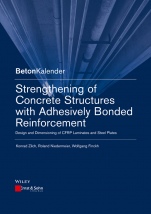
Strengthening of Concrete Structures with Adhesively Bonded Reinforcement: Design and Dimensioning of CFRP Laminates and Steel Plates
ISBN 9783433030868
Autor: Konrad Zilch, Roland Niedermeier, Wolfgang Finckh
Wydawca: Wiley
Dostępność: 3-6 tygodni
Cena: 286,65 zł
Przed złożeniem zamówienia prosimy o kontakt mailowy celem potwierdzenia ceny.
ISBN13: |
9783433030868 |
ISBN10: |
3433030863 |
Autor: |
Konrad Zilch, Roland Niedermeier, Wolfgang Finckh |
Oprawa: |
Paperback |
Rok Wydania: |
2014-06-11 |
Ilość stron: |
158 |
Wymiary: |
241x170 |
Tematy: |
TN |
Design and construction in existing contexts is becomingincreasingly important, and often the structures sometimesof historical interest can be preserved easily and atminimum cost by employing strengthening measures. Existing concretemembers can be strengthened by using adhesives to bond additionalreinforcing elements onto or into those members. This book explainsthe design rules, together with their background, and uses examplesto illustrate their use, specifically for slabs, beams and columns.Concrete member strengthening measures can take the form of, forexample, flexural strengthening with externally bonded(surface–mounted) CFRP strips, CF sheets and steel plates, flexuralstrengthening with CFRP strips bonded in slots(near–surface–mounted reinforcement), shear strengthening withexternally bonded CF sheets and steel plates, and columnstrengthening with CF sheets as confining reinforcement.
The explanations and background information provided are mainlybased on the new German guideline Strengthening of ConcreteMembers with Adhesively Bonded Reinforcement by the GermanCommittee for Structural Concrete (DAfStb). This is the firstEuropean guideline to regulate this topic in the form of asupplement to the Eurocode. As it is planned to produce a documentin a future Eurocode 2, the DAfStb guideline serves as a startingpoint. The authors are extensively involved in the planning,design, operation and inspection of buildings for preservation andreconstruction, and in the updating of European Technical ApprovalGuidelines (ETAGs) and design rules.
Foreword
1 Introduction
2 DAfStb guideline
2.1 The reasons for drawing up a guideline
2.2 Preparatory work
2.3 Work on the guideline
2.4 The structure and content of the guideline
2.5 Safety concept
2.6 Applications (Member to be strengthened, Strengthening systems, Ambient conditions, Fire protection)
2.7 Relationship with other regulations
2.8 Documents and assistance for practical applications
3 Design of strengthening measures with externally bonded CFRP strips
3.1 Principles
3.2 Verification of flexural strength
3.3 Bond analysis (Simplified method, More accurate method, Determining the crack spacing, Simplified analysis of element between cracks, End anchorage analysis)
3.4 Shear force analyses
3.5 Fatigue analysis
3.6 Analyses for the serviceability limit state
3.7 Detailing
4 Example 1: Strengthening a slab with externally bonded CFRP strips
5 Design of strengthening with near–surface–mounted CFRP strips
5.1 Principles
5.2 Verification of flexural strength
5.3 Bond analysis
5.4 Shear force analyses
5.5 Fatigue analysis
5.6 Analyses for the serviceability limit state
5.7 Detailing
6 Example 2: Strengthening a beam with near–surface–mounted CFRP strips
7 Design of column strengthening with CF sheets
7.1 Principles
7.2 Properties of CF sheets relevant to design
7.3 Load–carrying capacity of cross–section
7.4 Load–carrying capacity of member
7.5 Creep
7.6 Analysis at ultimate limit state
7.7 Analysis at serviceability limit state
8 Example 3: Column strengthening
9 Summary and outlook
References
Prof. em. Dr.–Ing. habil. Dr.–Ing. E. h. Konrad Zilch studied civil engineering and gained his doctorate at TU Darmstadt in 1976. Following research posts at the University of California, Berkley, and the University of Western Ontario, Canada, he worked in the construction industry for many years. From 1988 to 1993 he was professor for structural analysis at RWTH Aachen University, and from 1993 to 2009 professor for concrete structures at TU Munich.
PD Dr.–Ing. habil. Roland Niedermeier studied civil engineering and gained his doctorate at TU Munich in 2001. Since 1993 he has been involved in research at TU Munich and MPA BAU, the accredited authority for testing construction materials and products, where he has been the head of the Structural Engineering Laboratory since 2001.
Dr.–Ing. Wolfgang Finckh studied civil engineering and gained his doctorate at TU Munich in 2012. He has been a chief design engineer at Wayss & Freytag Ingenieurbau AG (w&f) since 2012.
Koszyk
Książek w koszyku: 0 szt.
Wartość zakupów: 0,00 zł
Informacje


Kontakt
Gambit
Centrum Oprogramowania
i Szkoleń Sp. z o.o.
Al. Pokoju 29b/22-24
31-564 Kraków
Siedziba Księgarni
ul. Kordylewskiego 1
31-542 Kraków
+48 12 410 5991
+48 12 410 5987
+48 12 410 5989
Subskrypcje
Administratorem danych osobowych jest firma Gambit COiS Sp. z o.o. Na podany adres będzie wysyłany wyłącznie biuletyn informacyjny.
Autoryzacja płatności

Informacje na temat autoryzacji płatności poprzez PayU.

© Copyright 2012: GAMBIT COiS Sp. z o.o. Wszelkie prawa zastrzeżone.
Projekt i wykonanie: Alchemia Studio Reklamy